Let’s talk about a hard truth. You can have the most beautifully written article, the fastest website, and a mountain of backlinks, but if you get one thing wrong, you’ll still fail at SEO.
What is that one thing? Search Intent.

I’ve analyzed thousands of websites and seen this pattern over and over. People focus so much on keywords that they forget to ask the most important question: What does the searcher actually want?
Google’s entire business model depends on giving users exactly what they’re looking for, fast. Their algorithms have become incredibly sophisticated at understanding not just the words people type, but the reason they’re searching. If your content doesn’t match that reason, you’re invisible.
In this guide, I’m going to break down everything you need to know about search intent. We’ll cover what it is, why it’s the new king of SEO, and how you can master it to dominate the search results.
What is Search Intent, Really?
Search intent (also called user intent) is the primary goal a user has when they type a query into a search engine. Are they trying to buy something? Learn something? Find a specific website?
Think of it like this: a keyword is what they search, but intent is why they search.
For years, SEO was a game of keyword density. We’d stuff our pages with a target keyword and hope for the best. Today, that strategy is dead. Google’s RankBrain and BERT algorithms are designed to understand context and nuance, making intent alignment non-negotiable.
Data shows that pages ranking on the first page of Google satisfy the search intent for over 80% of the keywords they rank for. If you’re not aligning with intent, you’re not getting on page one. It’s that simple.
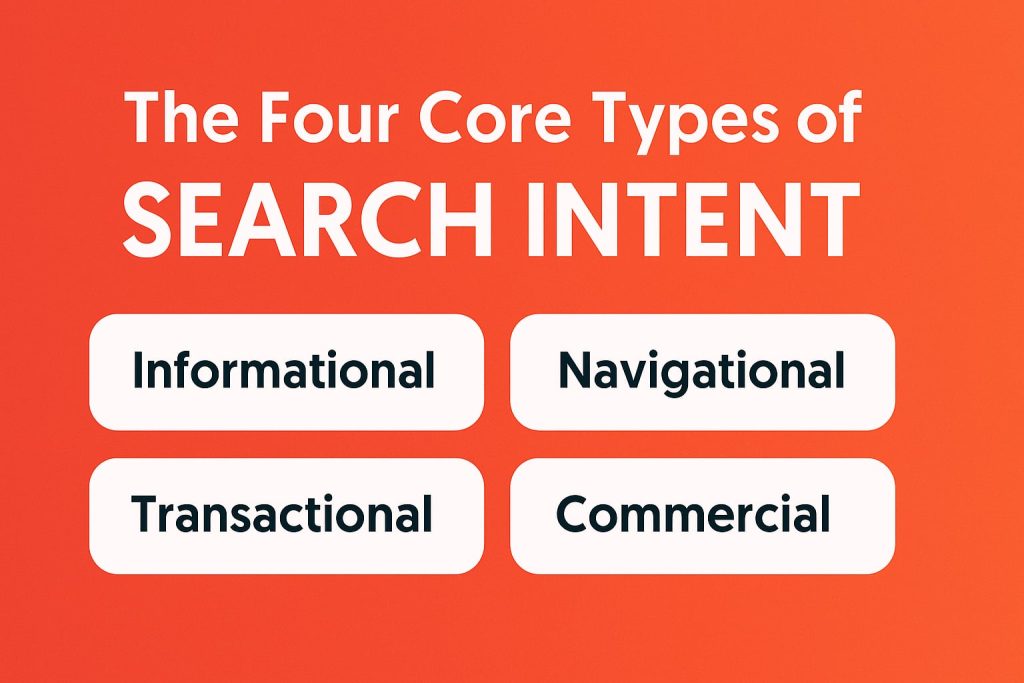
The Four Core Types of Search Intent
To win at this game, you first need to understand the four main categories of search intent. Almost every query falls into one of these buckets.
1. Navigational Intent
This is the simplest one. The user wants to go to a specific website. They know where they want to go, and they’re just using Google as a shortcut.
- Examples: “YouTube,” “Facebook login,” “Neil Patel blog“
- What it means for you: It’s very difficult to rank for these unless you are the brand they’re searching for. Trying to rank for “Amazon” is a waste of time and money. The only play here is to make sure you rank #1 for your own brand name.
2. Informational Intent
Here, the user is looking for information. They have a question and they want an answer. This represents the vast majority of searches on the internet.
- Examples: “how to bake a cake,” “what is the capital of Australia,” “best SEO strategies“
- What it means for you: This is a huge opportunity. Creating high-quality blog posts, guides, tutorials, and how-to articles that answer these questions positions you as an authority. This is top-of-funnel content that builds trust and brand awareness.
3. Transactional Intent
The user is ready to buy. They have their credit card out (or are mentally ready to) and are looking to make a purchase. These keywords are often highly commercial and extremely valuable.
- Examples: “buy iPhone 15,” “Nike Air Max sale,” “Ubersuggest subscription discount”
- What it means for you: This is where you drive revenue. Your product pages, service pages, and sales pages must be optimized for these terms. The user wants to see prices, features, reviews, and a clear “Buy Now” button. Don’t show them a 3,000-word blog post.
4. Commercial Investigation Intent
This is a hybrid intent. The user intends to buy something soon, but they are still in the research phase. They are comparing products, looking for reviews, and weighing their options.
- Examples: “Ubersuggest vs Ahrefs,” “best running shoes for men,” “Samsung Galaxy S23 review”
- What it means for you: This is your chance to guide the user toward your product. Content like comparison articles, in-depth reviews, and “best of” lists works wonders here. You’re helping them make an informed decision, which builds incredible trust right before the purchase.
Why Google Is Obsessed with Search Intent
Google’s goal is user satisfaction. When a user finds the perfect answer on their first click, they’re happy. When they’re happy, they keep using Google.
How does Google measure satisfaction? Through user behavior signals:
- Click-Through Rate (CTR): Does your title and description entice users to click?
- Dwell Time & Time on Page: Do users stick around and engage with your content, or do they leave immediately?
- Pogo-sticking: This is when a user clicks on your result, quickly hits the “back” button, and clicks on another result. It’s a massive red flag for Google that your page failed to satisfy their intent.
A study analyzing 5 million search results found a direct correlation between high dwell time and higher rankings. When you nail search intent, users stay longer, pogo-sticking decreases, and Google sees your page as a high-quality result.
Someone typing “best jeans shoes” into Google is most likely trying to compare different options before making a choice.
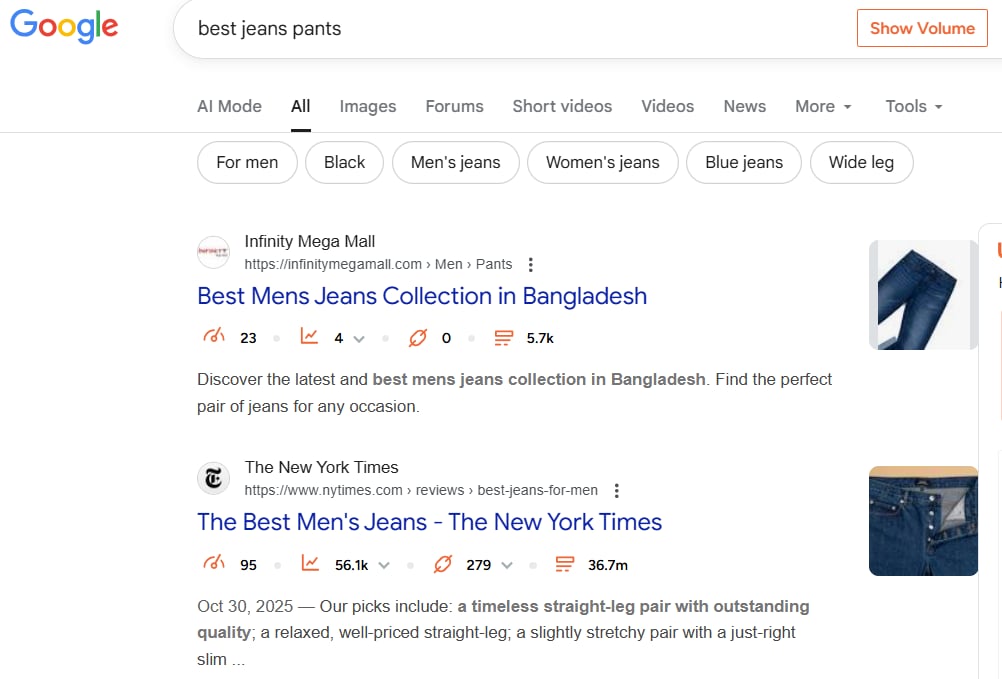
Example given as image
This creates a powerful feedback loop:
- You align your content with search intent.
- Users engage with your content (high dwell time, low bounce rate).
- Google sees these positive signals and rewards you with higher rankings.
- Higher rankings lead to more traffic, reinforcing the cycle.
Failing to match intent breaks this cycle. You might get some initial clicks, but if users bounce immediately, Google will quickly demote your page.
What This Image Tells Us About Search Intent
The image shows Ahrefs keyword data for the term “digital marketing agencies.” The Keyword Difficulty (KD) score is 59, which means ranking for this query requires strong topical authority and roughly 123 referring domains. This instantly reveals the search intent behind the term: users are not casually browsing, they’re actively comparing agencies, exploring options, and likely preparing to hire one.

High difficulty and strong traffic potential signal that this keyword attracts commercial investigation intent, where users want expert recommendations, lists, and trustworthy evaluations before making a decision. Understanding this helps you create content that matches user expectations and stands a real chance of ranking.
Actionable Strategy: How to Optimize for Search Intent
Optimizing for search intent starts with understanding what users truly expect from a query. Identify whether they want information, comparisons, or solutions, then structure your content to match that purpose. Analyze top-ranking pages, study keyword variations, and align your headings, examples, and CTAs with the intent behind the search. When your content matches what users want to see, Google rewards it with better visibility and stronger engagement. This approach transforms guesswork into a consistent, repeatable optimization process.
Alright, you understand the theory. Now let’s get to the good stuff—how to actually do it. This isn’t guesswork. It’s a repeatable process.
Step 1: Decode the SERP (Search Engine Results Page)
The best way to understand the intent behind a keyword is to look at what’s already ranking. Google is literally showing you the answer key.
Go ahead, type your target keyword into Google. Now, analyze the first page. Ask yourself:
- What type of content is ranking? Are they blog posts? Product pages? Videos? Category pages? If the top 10 results are all “how-to” articles, your product page isn’t going to rank.
- What is the content format? Are they listicles (“10 Best…”), step-by-step guides, comparison tables, or long-form reviews? The format that dominates the SERP is the format Google believes best serves the user.
- What is the angle? Look at the titles. Is the focus on “for beginners,” “on a budget,” “in 2025,” or “comprehensive guide”? This tells you what specific pain point the top results are solving.
For example, if you search for “how to tie a tie,” you’ll see videos and simple, image-heavy guides. The intent is clearly informational and requires a visual, step-by-step format. A 5,000-word essay on the history of neckties would fail spectacularly.
Step 2: Choose the Right Content Framework
Once you’ve decoded the SERP, you need to structure your content to match the dominant format. Don’t try to reinvent the wheel. Give Google what it wants.
Here are some common content frameworks based on intent:
- Informational Intent:
- The Ultimate Guide: A comprehensive, long-form post covering a topic in depth.
- The How-To Post: A step-by-step guide to accomplishing a specific task. Use lots of images, short paragraphs, and clear headings.
- The Listicle: “X Ways to…”, “Y Best Tools for…”. These are highly scannable and popular.
- Commercial Investigation Intent:
- The Comparison Post: “Product A vs. Product B.” Use tables to compare features, pricing, and pros/cons.
- The “Best Of” List: “Best CRMs for Small Business.” Review several products and give a clear recommendation.
- The Product Review: An in-depth, honest look at a single product.
- Transactional Intent:
- The Product Page: High-quality images, clear pricing, compelling product descriptions, social proof (reviews, testimonials), and a prominent call-to-action (CTA).
- The Category Page: For e-commerce sites, this page should showcase a range of products with good filtering options.
Step 3: Optimize Your On-Page Elements for Intent
Matching search intent isn’t limited to the main content or articles you publish. For true on page optimization, you need to signal that intent in every visible and hidden part of your web page. This holistic approach ensures that both users and search engines immediately understand the purpose and value of your content, leading to a more coherent and effective user experience.
Every element, from the browser tab to the headings within your page, plays a role in clearly communicating what your page offers.
- Title Tag: Your title is the first thing a user sees. Make sure it clearly communicates the content’s value and matches the intent. For an informational query like “learn SEO,” a title like “Learn SEO: The Ultimate Beginner’s Guide (2025)” is perfect. For a transactional query, “Buy SEO Tools – Ubersuggest” is more appropriate.
- Meta Description: Use this to expand on the title and reinforce the intent. Mention what the user will learn or what action they can take.
- Headings (H2, H3): Structure your content with subheadings that answer specific questions related to the main query. For “best running shoes,” your H2s could be “Best for Trail Running,” “Best for Road Running,” and “Best Budget-Friendly Option.” This makes your content scannable and directly addresses micro-intents within the main query.
- Call-to-Action (CTA): Your CTA must match the intent. For an informational post, the CTA might be “Download our free SEO checklist” or “Subscribe for more tips.” For a transactional page, it’s “Add to Cart” or “Buy Now.” A mismatch here kills conversions and confuses users.
Putting It All Together: A Real-World Example
Let’s say your keyword is “content marketing for beginners.”
- Decode the SERP: A quick Google search shows the top results are all long-form guides, “what is” definitions, and beginner-focused articles. The intent is clearly informational. The format is “ultimate guides” and “how-to” posts.
- Choose the Framework: The best framework would be The Ultimate Guide. This allows you to cover all the fundamental questions a beginner would have.
- Structure Your Content:
- H1: Content Marketing for Beginners: A Simple Step-by-Step Guide
- H2: What is Content Marketing? (Definitional)
- H2: Why is Content Marketing Important? (Benefits)
- H2: Types of Content Marketing (Listicle-style subsection)
- H3: Blogging
- H3: Video
- H3: Podcasting
- H2: How to Create a Content Marketing Strategy in 5 Steps (How-To)
- H2: Tools to Get You Started (Resource list)
- Optimize On-Page Elements:
- Title: Content Marketing for Beginners: A Step-by-Step Guide
- Meta Description: New to content marketing? This guide breaks down everything you need to know, from strategy to execution. Learn how to grow your business with content.
- CTA: A soft CTA like “Sign up for our free content marketing course” or “Download our content calendar template.”
By following this process, you create a piece of content that perfectly aligns with what a beginner searching that term wants and needs. Google will notice, and you’ll be rewarded.
Conclusion
Stop chasing keywords and start satisfying intent.
SEO is no longer about tricking algorithms. It’s about understanding people. When you shift your focus from “how can I rank for this keyword?” to “how can I best help the person searching for this keyword?”, everything changes. Even you can think about best consideration of semantic keywords to make sure search intent for rankings.
Your content will be more valuable, your users will be happier, and your rankings will reflect that. By decoding the SERPs, choosing the right format, and optimizing your page, you’re not just playing Google’s game—you’re mastering it.
So before you write another word, ask yourself: What does my audience really want? Answer that question correctly, and you’re already halfway to the top of page one.