Starting a new business is an exciting venture, but it comes with its challenges.
Imagine you’ve just spent 100 hours creating the perfect online course. The content is brilliant, the videos are crisp, and you know it’s going to change lives. You launch it, and the sales start trickling in. Then, a month later, you stumble upon a site selling your exact course for a tenth of the price.

Your heart sinks. All that work, stolen.
This isn’t a rare horror story. It happens every single day to creators, writers, artists, and developers. But here’s the good news: you have a powerful shield at your disposal. It’s called copyright, and understanding how to use it is one of the most important business skills you can learn.
Here I’m going to break down everything you need to know about how to obtain copyright protection. We’ll cover what it is, how you get it, and how to use it to protect your hard work. Forget the dense legal jargon.
This is your practical, step-by-step guide to safeguarding your creations.
What is Copyright, Really? (Hint: It’s Automatic)
Let’s start with a mind-blowing fact: you get copyright protection the moment you create something original and fix it in a tangible form.
That’s it. You don’t have to file a form, pay a fee, or say a magic word. The instant you write that blog post, snap that photo, or record that podcast, the law grants you a bundle of exclusive rights.
Think of it like this. You bake a cake. The moment that cake comes out of the oven and exists in the real world, it’s your cake. You decide who gets a slice, who can take a picture of it, and who can use your recipe. Copyright works the same way for your creative works.
This “bundle of rights” includes the exclusive power to:
- Reproduce the work (make copies).
- Create derivative works (like turning a book into a movie).
- Distribute copies of the work (sell it, rent it, or lend it).
- Perform or display the work publicly (like a play or an art gallery showing).
This automatic protection is a game-changer. It means that from day one, you have legal standing.
What Can You Copyright?
The U.S. Copyright Office protects “original works of authorship” fixed in a tangible medium. That’s a fancy way of saying creative stuff that you can see, hear, or touch.
Here’s a quick list of what’s eligible:
- Literary Works: Books, blog posts, articles, poems, and even computer code.
- Musical Works: Compositions and lyrics.
- Dramatic Works: Plays, screenplays, and scripts.
- Artistic Works: Paintings, sculptures, photographs, and graphic designs.
- Audiovisual Works: Movies, videos, and online courses.
- Sound Recordings: The actual recording of a song or podcast.
- Architectural Works: Building designs.
What Can’t You Copyright?
Just as important is knowing what doesn’t qualify for protection. Copyright doesn’t protect ideas, facts, or concepts. It only protects the specific expression of those ideas.
You can’t copyright:
- Ideas and Concepts: The idea for a vampire romance novel isn’t copyrightable. Your specific 700-page novel about a vampire who falls for a data scientist in Silicon Valley is.
- Facts: You can’t copyright the fact that the Earth revolves around the sun. A textbook that explains this fact with unique charts and text is protected.
- Names, Titles, and Short Phrases: Brand names and logos are protected by trademarks, not copyright. The title of your book isn’t copyrightable on its own.
- Systems or Processes: A method for organizing your files or a new workout routine can’t be copyrighted. You might be able to get a patent, but that’s a different legal tool.
The line is “idea vs. expression.” You own your unique expression, not the underlying idea.
If Protection is Automatic, Why Should I Register?
This is the million-dollar question. If you already have copyright, why go through the trouble of registering with the U.S. Copyright Office?
Let me tell you a quick story. A photographer I know, let’s call her Jane, took a stunning photo of a cityscape at sunrise. She posted it on her blog. A few months later, a major corporation used her photo in a national advertising campaign without permission.
Because Jane had only automatic copyright, her options were limited. She could send a cease-and-desist letter, but she couldn’t sue them for big damages. Now, imagine if Jane had spent about $65 and 30 minutes to register her photo.
By registering, you unlock a set of superpowers:
- The Right to Sue: This is the big one. You cannot file a lawsuit for copyright infringement in federal court until your work is registered. Without registration, your “cease and desist” letters have no teeth.
- Public Record of Ownership: Registration creates a public, searchable record that you are the owner of the work. This deters potential thieves and makes it easy to prove your claim.
- Eligibility for Statutory Damages and Attorney’s Fees: If you register your work before an infringement occurs (or within three months of publication), you can sue for statutory damages. This means you don’t have to prove how much money you lost. A court can award you between $750 and $30,000 per infringed work. If the infringement was willful, that amount can jump to $150,000. You can also have the infringer pay your legal bills.
Without registration, Jane could only sue for “actual damages”—the money she lost. That might be the few hundred dollars she would have charged for a license. With registration, she could have sued for tens of thousands of dollars plus her attorney’s fees, making it a much stronger case.
Bottom line: Automatic copyright is a shield. Registered copyright is a sword.
How to Register Your Copyright: A Step-by-Step Guide
Registering your work with the U.S. Copyright Office is easier and cheaper than you think. You don’t need a lawyer for a straightforward registration.
Here’s the entire process, broken down.
Step 1: Go to the Electronic Copyright Office (eCO) Website
Everything happens online. Head over to copyright.gov and find the “Register Your Works” section. The online system is called the Electronic Copyright Office, or eCO. It’s faster and less expensive than filing with paper forms.
Step 2: Create an Account and Start a New Claim
You’ll need to create a user account. Once you’re in, you’ll start a new registration claim. The system will ask you to choose the type of work you’re registering.
The categories are fairly intuitive:
- Literary Work
- Work of the Visual Arts
- Sound Recording (choose this if you are registering the recording itself, the performance).
- Work of the Performing Arts (choose this for the underlying musical composition or script).
- Motion Picture/Audiovisual Work
Choose the one that best fits your creation. If you’re registering a blog, you can register a collection of posts as a single literary work, which saves a lot of money.
Step 3: Fill Out the Application
This is the most detailed part, but it’s just a form. Take your time and be accurate. You’ll need to provide the following information:
- Title of the Work: Be specific. For a collection of blog posts, you could use a title like “Collected Blog Posts of [Your Name], [Date Range].”
- Author(s): That’s you! Provide your name and citizenship. If it’s a work made for hire, you’ll specify that here.
- Year of Completion: The year you finished the work.
- Date and Nation of First Publication: “Publication” is when you make the work available to the public (e.g., publishing a blog post, releasing a song). If it’s unpublished, you can state that.
- Claimant(s): This is the person or entity who owns the copyright. Usually, this is also you, the author. If you have a business entity (like an LLC), you might list that as the claimant.
- Limitation of Claim (if applicable): This section is for derivative works. If your work includes pre-existing material (like a stock photo or a public domain song), you must identify it here. You are only claiming copyright on the new material you added.
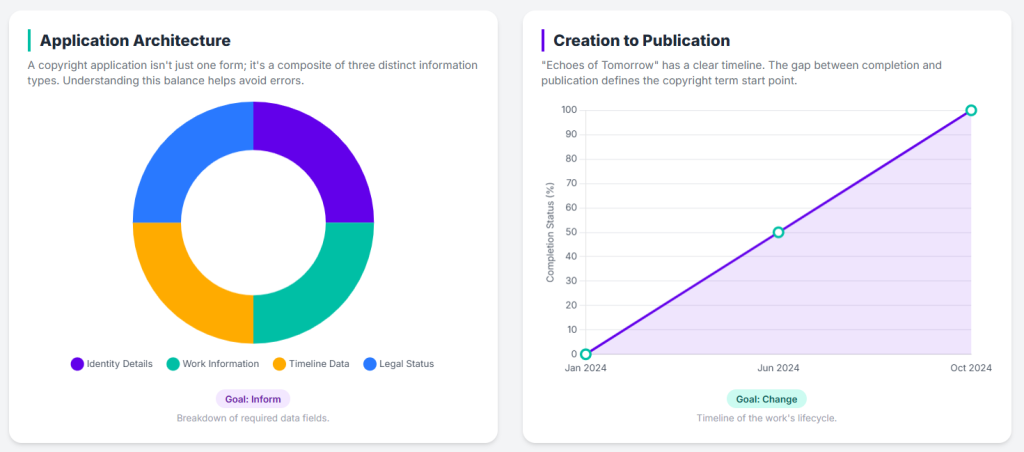
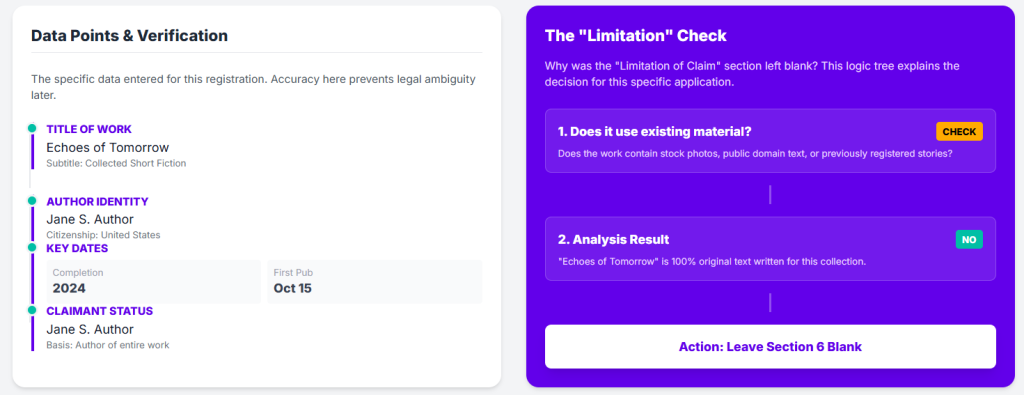
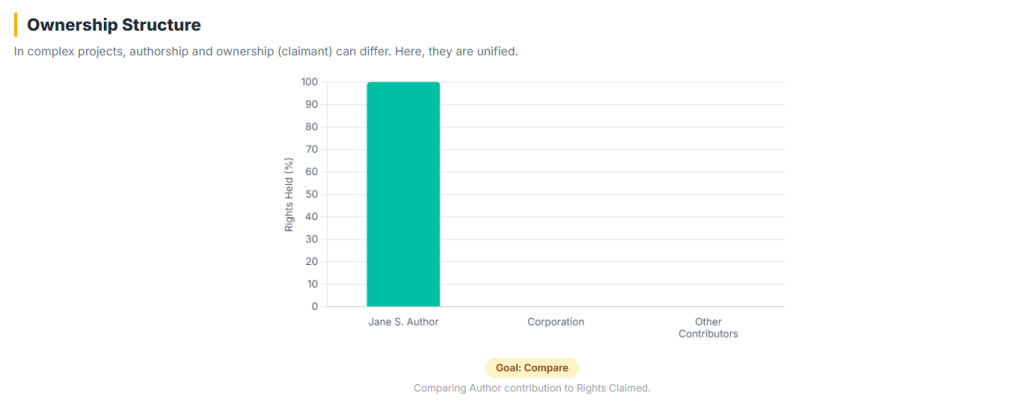
Double-check everything before moving on. An error could delay or invalidate your registration.
Step 4: Pay the Fee
The fee for a standard online registration is typically between $45 and $65. This is a small price to pay for powerful legal protection. The eCO system accepts payments by credit card or from a bank account.
Step 5: Deposit Your Work
Finally, you need to submit a copy of your work to the Copyright Office. This is called a “deposit.” For most digital creations, you can simply upload the file(s) directly through the eCO portal.
- For a book or article collection, you’d upload a PDF.
- For a photograph, a JPG or PNG file.
- For a song, an MP3 file.
- For a video course, you might upload the video files or provide detailed scripts and slide decks.
Once you’ve uploaded your deposit, you submit the application. That’s it! You’ve officially filed for copyright registration.
Timelines and What to Expect
After you submit your application, the waiting game begins. The U.S. Copyright Office is not known for its speed.
Current processing times can range from a few months to over a year. The average for a simple electronic filing is around 3 to 6 months. Don’t panic if you don’t hear back right away.
The good news is that your effective date of registration is the day the Copyright Office receives your completed application, payment, and deposit—not the day they approve it. This is crucial. If someone infringes your work while your application is pending, you are still eligible for the full benefits of registration, including statutory damages.
Once your application is approved, you’ll receive an official certificate of registration in the mail. Frame it, store it in a safe place, and celebrate. You now have the ultimate proof of ownership.
Protecting Your Creations in a Global World
What happens if someone in another country steals your work? Your U.S. copyright registration is powerful, but does it work internationally?
Mostly, yes. Thanks to international treaties like the Berne Convention, your creative work is protected in most countries around the world. Over 170 countries have signed this treaty.
The Berne Convention operates on a principle of “national treatment.” This means that signatory countries must give your creative work the same copyright protection they give to their own citizens. So, if you’re a U.S. creator and someone in France infringes your copyright, you have rights under French law.
Your U.S. registration serves as strong evidence of your ownership in foreign courts, making it a valuable asset for global protection.
Special Tips for Digital Content Creators
Digital content is incredibly easy to copy and distribute, making protection even more critical. Here are some pro tips specifically for online creators.
1. Use a Copyright Notice
While not legally required since 1989, using a copyright notice is still a very smart move. It serves as a clear, visible deterrent. A proper notice has three parts:
- The © symbol (or the words “Copyright” or “Copr.”).
- The year of first publication.
- The name of the copyright owner.
Example: © 2025 Your Name, Inc.
Place this in the footer of your website, on the title slide of your videos, or in the metadata of your photos. It tells the world, “This is mine, and I’m serious about protecting it.”
2. Watermark Your Visuals
For photographers and videographers, watermarks are essential. A visible watermark on your images makes them less appealing to thieves. An invisible, or digital, watermark embeds your copyright information directly into the file’s data, which can be used to track unauthorized use across the web.
3. Register Your Content in Batches
If you’re a prolific creator, like a blogger or a YouTuber, registering every single piece of content individually would be expensive and time-consuming. The Copyright Office allows you to register collections of related works with a single application and fee.
You can register up to 10 unpublished works as a collection. For published works, you can register all works published within a three-month calendar period. For example, you could file one application for “Blog Posts, January-March 2025” and deposit all the articles from that quarter. This is a massive cost and time saver.
4. Use Technology to Monitor Your Content
You can’t stop what you can’t see. Use tools to monitor for infringement.
- Google Alerts: Set up alerts for unique phrases from your content to see if they appear on other websites.
- Reverse Image Search: Use Google Images or TinEye to upload your photos and see where else they are being used.
- DMCA Takedown Services: For a fee, companies can monitor the web for your content and automatically issue DMCA takedown notices on your behalf.
Common Mistakes to Avoid
Many creators make simple, costly mistakes when it comes to copyright. Here are the most common pitfalls and how to steer clear of them.
- Mistake #1: Believing the “Poor Man’s Copyright” Myth. You may have heard that you can protect your work by mailing a copy to yourself and keeping it sealed. This is a myth and has no legal effect. It does not replace official registration.
- Mistake #2: Waiting Too Long to Register. The biggest benefits of registration (statutory damages and attorney’s fees) only apply if you register before the infringement happens. Make registration a regular part of your creative workflow, not an afterthought.
- Mistake #3: Assuming “Fair Use” is a Blanket Excuse. Fair use is a complex legal doctrine that allows limited use of copyrighted material without permission for purposes like criticism, commentary, and education. It is a defense, not a right. Relying on fair use without understanding its four-factor legal test is risky. When in doubt, get permission.
- Mistake #4: Misunderstanding “Public Domain.” Just because something is on the internet does not mean it is in the public domain. Works enter the public domain only after their copyright term has expired (typically 70 years after the author’s death). Always assume a work is copyrighted unless you know for a fact it is not.
Your Action Plan for Copyright Protection
You’ve put in the work to create something amazing. Now it’s time to protect it. Let’s recap your action plan.
- Understand Your Rights: Recognize that you have automatic copyright the moment you create something original and fix it in a tangible form.
- Make Registration a Habit: Don’t wait for a thief to strike. Register your most valuable works with the U.S. Copyright Office as soon as possible. Use the batch registration option for blogs, photos, or video series to save time and money.
- Display Your Ownership: Use copyright notices (© 2025 Your Name) and watermarks. These simple signals deter many would-be infringers.
- Monitor Your Work: Use free tools like Google Alerts and reverse image search to keep an eye out for unauthorized use of your content.
- Enforce Your Rights: If you find an infringer, start by sending a DMCA takedown notice to the website host. If the work is registered and the infringement is significant, consult an attorney about filing a lawsuit.
Copyright protection isn’t just a legal formality. It’s a business strategy. It’s the tool that ensures you, the creator, get to reap the rewards of your own creativity and hard work. By taking these simple, proactive steps, you can build a fortress around your content and focus on what you do best: creating.