You have a million-dollar idea. You’ve bought the domain name. You’ve even designed a logo on Canva. But here’s the cold, hard truth: ideas don’t build businesses. Skills do.
According to data from the U.S. Bureau of Labor Statistics, approximately 20% of new businesses fail during the first two years of being open, 45% during the first five years, and 65% during the first 10 years. Only 25% of new businesses make it to 15 years or more.

Why? It’s rarely because the product was terrible. It’s usually because the founder lacked the specific toolkit required to navigate the stormy waters of entrepreneurship.
10 Business Skills for Entrepreneurs
Being an entrepreneur isn’t just about being a “visionary.” It’s about being a Swiss Army Knife. One minute you’re the CFO, the next you’re the janitor, and ten minutes later you’re negotiating a partnership that could make or break your quarter.
If you want to be in that 25% that survives and thrives, you need to master the core competencies of business. Let’s break down the essential skills every entrepreneur needs to scale from zero to hero.
1. Financial Literacy: The Language of Business
I see this mistake constantly. Founders obsess over their product features but have no idea what their burn rate is. If you don’t understand your numbers, you don’t understand your business. Period.
Financial literacy isn’t just about hiring an accountant to do your taxes. It’s about having the ability to look at a spreadsheet and instantly diagnose the health of your company.
Understanding Cash Flow vs. Profit
Many entrepreneurs think profit is king. It’s not. Cash is king. You can be profitable on paper but go bankrupt because your cash is tied up in inventory or unpaid invoices.
Real-World Example:
Consider Tesla in 2008 or even 2018. They were burning cash at an alarming rate. Elon Musk had to understand the intricacies of cash flow management to keep the lights on while production ramped up. A founder without that literacy would have folded.
Actionable Framework: The 3-Statement Check
Every week, you should review:
- Income Statement: Are we making money?
- Balance Sheet: What do we own vs. what do we owe?
- Cash Flow Statement: Do we have enough liquidity to survive the month?
Mistakes to Avoid
- Mixing personal and business finances: This is the amateur hour. Open a separate business account immediately.
- Ignoring margins: Revenue is vanity; margin is sanity. Selling $1M worth of product doesn’t matter if it costs you $1.1M to produce and ship it.
2. Strategic Planning: Playing Chess, Not Checkers
Strategic business planning is the art of answering three questions: Where are we now? Where are we going? How will we get there?
Without a strategy, you are just reacting to the market. With a strategy, you are shaping it.
The North Star Metric
Successful startups often focus on one key metric that matters above all else. For Airbnb, it was nights booked. For Facebook, it was daily active users.
Actionable Tip: Identify your “One Metric That Matters” (OMTM). Every strategic decision—hiring, marketing spend, product development—should be filtered through the lens of: “Does this improve our OMTM?”
SWOT Analysis 2.0
The old school SWOT (Strengths, Weaknesses, Opportunities, Threats) is still relevant, but make it data-driven. Don’t just guess your weaknesses; look at your churn rate. Don’t guess opportunities; look at keyword search volume trends.
3. Marketing and Sales: The Engine of Growth
You can have the best product in the world, but if no one knows about it, you don’t have a business—you have a hobby. Marketing is about storytelling at scale, and sales is about solving problems for money.
The Funnel Mindset
You need to understand the customer journey.
- Top of Funnel (Awareness): SEO, Content Marketing, Social Media.
- Middle of Funnel (Consideration): Email Drip Campaigns, Webinars, Case Studies.
- Bottom of Funnel (Decision): Demos, Sales Calls, Pricing Pages.
Expert Insight:
Data shows that it takes an average of 8 touchpoints to make a sale. If you give up after one email or one ad, you’re leaving money on the table.
Conversion Rate Optimization (CRO)
This is where the magic happens. Increasing your traffic is expensive. Increasing your conversion rate is free money.
If you have 10,000 visitors converting at 1%, you get 100 customers. If you tweak your headline and CTA to convert at 2%, you get 200 customers from the same traffic. That doubles your revenue without spending a dime more on ads.
Mistakes to Avoid:
- Selling features, not benefits: People don’t buy a drill; they buy a hole in the wall. Stop talking about your specs and start talking about how you change the customer’s life.
- Ignoring existing customers: It costs 5x more to acquire a new customer than to retain an existing one. Upsell and cross-sell.
4. Leadership and Team Management: Scaling Yourself
At the beginning, you do everything.
But the truth is, you cannot scale a business on your own. At some point, success demands more than just your individual effort. Leadership is about more than having a vision and it’s the ability to effectively communicate that vision to others, embedding it into their understanding so clearly that they can take action and execute it without your constant involvement.
It’s about building a team that shares your goals and can operate independently, ensuring the business thrives even when you step away.
The “Hire Slow, Fire Fast” Rule
It sounds harsh, but a bad hire can kill a small team’s culture faster than a bad product. Look for “A-Players.” As Steve Jobs said, “A small team of A+ players can run circles around a giant team of B and C players.”
Delegation vs. Abdication
Delegation is assigning a task with clear expectations and checking in on progress. Abdication is throwing a task at someone and hoping it gets done.
Actionable Framework: The Eisenhower Matrix
Use this to decide what to delegate:
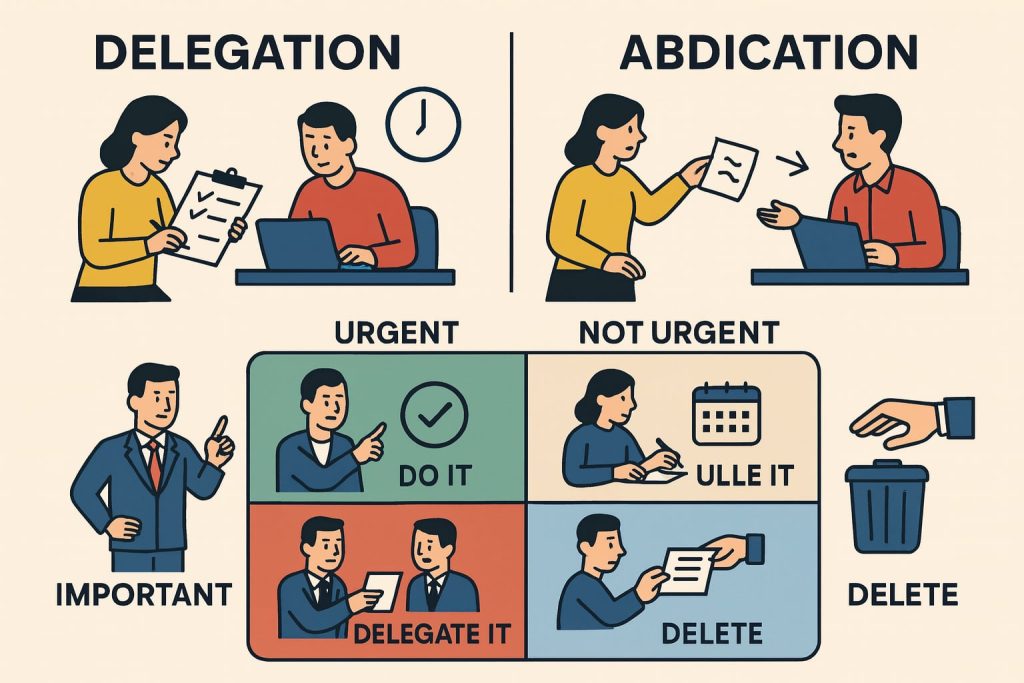
- Urgent & Important: Do it yourself.
- Important, Not Urgent: Schedule it.
- Urgent, Not Important: Delegate it.
- Not Urgent, Not Important: Delete it.
5. Negotiation: The Art of the Deal
Whether you’re pitching to secure funding from a venture capitalist, negotiating better terms with a supplier to lower costs, or persuading a talented engineer to join your team in exchange for equity, you’re constantly engaged in the art of negotiation. Every interaction requires balancing priorities, building trust, and finding common ground to achieve your brand goals.
These moments are not just about getting what you want but about creating agreements that set the stage for long-term success.
The BATNA Principle
In negotiation theory, BATNA stands for Best Alternative to a Negotiated Agreement. You must always know what you will do if the deal falls through. If your BATNA is strong (e.g., you have another investor lined up), you have leverage. If your BATNA is weak (e.g., you run out of cash next week), you are desperate.
Actionable Tip: Never negotiate against yourself. When you state a price, stop talking. The next person to speak loses. Silence is uncomfortable, but it forces the other party to fill the void, often by conceding.
Win-Win or No Deal
The “I win, you lose” mentality works for one-off transactions (like buying a used car), but in business, relationships are long-term. If you squeeze a supplier so hard they make zero profit, they will eventually cut corners or prioritize other clients. A sustainable deal must benefit both sides.
6. Problem-Solving and Critical Thinking
Entrepreneurship is, at its core, like getting punched in the face over and over again and only to stand back up, learn from it, and figure out how to avoid the next blow. It’s not about avoiding challenges altogether, but about adapting and improving with each hit.
The problems you face aren’t interruptions to your work; they are the work. Solving them, navigating setbacks, and finding better ways to move forward is what defines the journey. Every obstacle is an opportunity to refine your approach and come back stronger.
First Principles Thinking
This is a mental model used by Elon Musk and other innovators. Instead of reasoning by analogy (“We should do X because our competitors do X”), you boil things down to the fundamental truths and build up from there.
Example:
- Analogy: Battery packs are expensive because that’s just how much they cost historically.
- First Principles: What are batteries made of? Cobalt, nickel, aluminum. What is the market price of those metals? It’s much lower than a battery pack. Conclusion: If we buy the metals and build the batteries ourselves, we can drastically reduce costs.
Root Cause Analysis (The 5 Whys)
When a problem occurs (e.g., “Website traffic dropped”), don’t just apply a band-aid. Ask “Why?” five times to find the source.
- Why did traffic drop? The server crashed.
- Why did the server crash? It ran out of memory.
- Why did it run out of memory? We had a spike in API requests.
- Why was there a spike? A specific code loop was inefficient.
- Why was the code inefficient? The developer didn’t follow the optimization guidelines.
Solution: Update the coding guidelines and train the developer, rather than just restarting the server.
7. Innovation and Adaptability: The Pivot
The marketplace should be viewed as a living, breathing organism. It is in a constant state of flux. New technologies emerge, disrupting old ways of doing things, and consumer preferences are always shifting and evolving. In such a dynamic environment, the most crucial skill for a startup isn’t simply “inventing new things” out of thin air. Instead, it’s about adaptability to the ability to recognize these changes and pivot accordingly.
Validated Learning
This comes from The Lean Startup methodology. Don’t spend a year building a product in a cave. Build a Minimum Viable Product (MVP), launch it, measure the results, and learn.
Real-World Example:
Slack started as a internal communication tool for a gaming company. The game failed, but the chat tool was brilliant. They pivoted, and now they are a multi-billion dollar enterprise. That is adaptability in action.
Kill Your Darlings
You must be willing to abandon features, products, or marketing channels that you love if the data shows they aren’t working. Emotional attachment to a failing idea is the silent killer of startups.
8. Time Management and Productivity
As an entrepreneur, you’ll quickly find that time is your most precious and scarcest resource. While you can always find ways to raise more capital or secure another round of funding, you absolutely cannot get more time. Every second that passes is gone forever, making how you manage it critically important to your success.
Deep Work
Author Cal Newport defines “Deep Work” as professional activities performed in a state of distraction-free concentration.
Actionable Tip: Block out 2-3 hours every morning for your most cognitively demanding task (e.g., coding, writing copy, strategy). Turn off Slack, put your phone in another room, and close your email tab.
The Pareto Principle (80/20 Rule)
20% of your activities result in 80% of your desired outcomes.
- 20% of your customers provide 80% of your revenue.
- 20% of your bugs cause 80% of the crashes.
Identify the top 20% and double down on them. Ruthlessly eliminate or automate the rest.
9. Emotional Intelligence (EQ)
Business is fundamentally about people and the relationships you build with them. Emotional intelligence, or EQ, is the crucial ability to not only understand and manage your own emotions but also to recognize and positively influence the emotions of those around you.
It’s about being aware of how you feel and how that affects your actions, while also being perceptive to the emotional states of others, whether they are your team members, customers, or investors.
Empathy in Customer Service
When a customer is angry, logic often fails. Empathy wins. Acknowledging their frustration (“I understand why you are upset, and I would be too”) de-escalates situations faster than explaining why they are wrong.
Resilience and Grit
This is the internal aspect of EQ. Entrepreneurship is a roller coaster. You will have days where you feel on top of the world and days where you want to curl up in a ball. Resilience is the ability to regulate your emotions so that the highs don’t make you arrogant and the lows don’t make you quit.
10. Networking and Relationship Building
It’s often said that your network is your net worth, and for an entrepreneur, this couldn’t be more true. But effective networking isn’t just about collecting contacts or handing out business cards at a cocktail party. True relationship building with customers is about genuinely providing value to others first.
The “Give First” Mentality
When you meet someone, don’t ask “How can they help me?” Ask “How can I help them?” If you help enough people get what they want, you will eventually get what you want.
Actionable Tip:
Reach out to one person in your industry every week just to compliment their work or share a resource they might find useful. Don’t ask for anything. Build the relationship before you need it.
Conclusion: The Continuous Learning Loop
Mastering these skills isn’t a destination; it’s a journey. The best entrepreneurs are lifelong learners. They read voraciously, they seek mentors, and they stay humble enough to admit when they don’t know the answer.
You don’t need to be an expert in all ten of these areas today. But you do need to be aware of them. Identify your weak spots. If you’re great at product but bad at finance, take a course or hire a CFO. If you’re a great leader but terrible at marketing, find a co-founder who lives and breathes growth hacking.
Building a business is the ultimate test of character and skill. But with this toolkit, you aren’t just rolling the dice. You’re stacking the deck in your favor.
Now, go build something great.