Have you ever opened an email that felt like it was written just for you — perfectly timed, useful, and even a little exciting? That’s not luck; it’s strategy. Smart marketers understand that a well-crafted email can build trust faster than a thousand social posts. It’s personal, measurable, and still one of the highest-ROI tools in the digital world. If you’re serious about growing your brand, you need to master the digital marketing tactics to grow businesses — and email marketing stands proudly among the most powerful of them all.

Think about it this way: while social algorithms decide who sees your content, your email list is entirely yours. You control the message, the timing, and the audience. That freedom is what makes email so effective for business growth. Whether you’re running a new startup or scaling an established brand, sending the right message at the right time can turn casual readers into loyal customers.
And here’s the exciting part — email marketing isn’t just about sending newsletters anymore. It’s about conversations that build credibility, nurture relationships, and strengthen your reputation over time. If you want your audience to remember your brand, you must learn how to build brand awareness for business through storytelling, consistency, and value-driven communication. In this complete guide, you’ll explore the best email marketing strategies that actually work — from crafting compelling campaigns to turning your email list into a long-term growth engine.
What Is Email Marketing and Why It Still Matters
Email marketing is a direct communication channel between a brand and its audience—delivering personalized content, offers, and value straight to their inbox. It’s cost-effective, measurable, and still the best way to reach people who’ve shown genuine interest in your product or service.
Unlike social media, where organic reach can plummet overnight, email lists remain owned assets. Studies consistently show that for every $1 spent, businesses earn an average of $36–$42 in return. That level of ROI makes it indispensable for startups, SMEs, and established enterprises alike.

Email marketing also enhances your other strategies. A customer might discover you via search, but consistent email follow-ups keep your brand alive in their memory. This synergy between email and SEO helps to grow your organic customers with nurture prospects over time.
Does Email Marketing Work?
Absolutely—and the data proves it. Email marketing works because it communicates directly with people who already care about what you offer. It’s personal, targeted, and measurable. Global reports indicate that over 4.6 billion people use email daily, and open rates for personalized subject lines are up to 50% higher.
Brands like Amazon, Airbnb, and Spotify rely heavily on email campaigns to retain users, increase lifetime value, and drive cross-selling opportunities. Even small businesses using simple automation tools can nurture relationships at scale—sending timely offers, reminders, and thank-you messages that build loyalty and repeat purchases. See the functional works for an example brand like apple!

The iPhone 17 Pro Max Orange Edition campaign perfectly illustrates how minimalism and premium design can captivate attention. With clean visuals, bold typography, and concise messaging, it communicates sophistication and innovation effortlessly. The campaign focuses on emotional appeal—highlighting style, power, and safety—without overwhelming text. Readers can learn how visual storytelling, color psychology, and strategic layout drive engagement in email marketing. The use of white space, high-quality imagery, and simple CTAs like “Buy” and “Learn More” shows how less can truly be more when designing campaigns that convert and strengthen brand identity.
Email’s effectiveness lies in its ability to combine trust, timing, and value—and those are the exact elements that form the three pillars of a high-impact strategy.
Email Marketing Opportunities: What the Data Tells Us About the Future
The future of email marketing is brighter — and busier — than ever before. As the chart shows, the number of emails sent and received worldwide is projected to rise from 281 billion in 2018 to more than 424 billion by 2028. This massive growth signals not just more digital conversations but a surge in marketing potential. Businesses are realizing that the inbox is where meaningful engagement still happens — free from social media noise and fleeting trends.
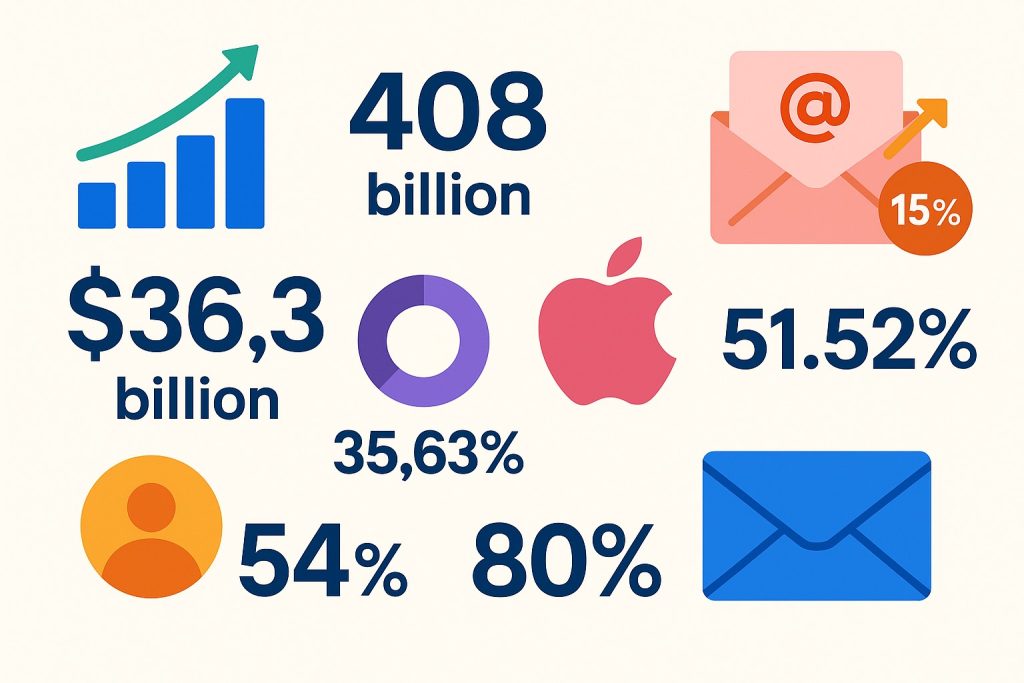
Global Email Marketing Insights at a Glance | Connect the image with texts
- Email usage is skyrocketing: Daily email volume is projected to surpass 408 billion messages by 2027, confirming that inbox engagement remains at an all-time high.
- Massive industry growth: The global email marketing market is expected to reach $36.3 billion by 2033, driven by automation, personalization, and AI-powered tools.
- Mobile optimization pays off: Responsive email design boosts unique mobile clicks by 15%, showing the importance of mobile-friendly layouts for engagement.
- High engagement continues: The average open rate across industries stands at 35.63%, indicating that subscribers are still actively engaging with emails.
- Apple dominates email clients: With a 51.52% global share, Apple remains the largest email service provider, setting design and privacy benchmarks for marketers.
- Personalization is mainstream: Over 54% of marketers now personalize email content to improve relevance and conversions.
- B2B adoption remains strong: Seven out of ten B2B marketers used email newsletters in 2024 to nurture leads and strengthen relationships.
- Exceptional ROI: Email marketing delivers an average return of $36 for every $1 spent, outperforming most other digital channels.
- Widespread adoption: Nearly 80% of marketers worldwide integrate email into their broader marketing strategy — underscoring its reliability and scalability.
This growth opens doors for smarter personalization, AI-driven automation, and hyper-segmented campaigns. With billions of messages exchanged daily, brands that use data wisely to deliver relevant, human-centered communication will win. The opportunity lies in standing out — creating experiences that feel timely, valuable, and authentic. In short, the future of email marketing isn’t just about sending more emails; it’s about sending the right ones at the right moment.
3 Pillars of High-Impact Email Marketing Strategy
1. Relevance (segmentation and personalization)
Relevance means understanding your audience and sending the right message to the right person. Through segmentation, you can categorize subscribers by behavior, purchase history, or demographics. When your emails reflect what users truly care about, engagement and sales naturally rise.
2. Timing (automation and behavior-based delivery)
Even the most relevant message fails if delivered at the wrong time. Automation allows marketers to send behavior-based emails—like welcome sequences, cart reminders, or re-engagement flows—at the moment users are most likely to act. Timing creates momentum, and automation ensures it never breaks.
3. Value (content that informs, inspires, or rewards the subscriber)
Every email should deliver value, whether through insights, offers, or entertainment. Subscribers stay loyal when they consistently receive something worth opening. Value builds anticipation—and anticipation drives conversions.
The Core Email Marketing Funnel
Email marketing operates much like a traditional sales funnel. It begins with awareness and ends with advocacy.
- Awareness: Introduce your brand through welcome emails and valuable content.
- Consideration: Send educational guides or case studies to help subscribers evaluate your solutions.
- Conversion: Deliver special offers or social proof to drive purchase decisions.
- Retention: Nurture customers through loyalty programs or exclusive updates.
- Advocacy: Encourage reviews, referrals, and testimonials.
This funnel structure is essential for understanding how each campaign contributes to long-term growth.
Segmentation and Targeting Techniques
Segmentation turns generic broadcasting into intelligent targeting. You can categorize your subscribers based on:
- Demographics: Age, gender, or location.
- Behavior: Pages visited, products viewed, or purchases made.
- Engagement: Frequency of email opens or clicks.
Advanced CRMs and AI tools now predict what each segment will likely engage with next, allowing marketers to send personalized offers automatically. Segmentation not only boosts conversions but also reduces unsubscribes by delivering value where it matters most.
Personalization and Dynamic Content
Personalization goes beyond adding a first name to an email. Dynamic content uses real-time data to tailor entire sections of an email for each reader. For example, Netflix sends recommendations based on viewing habits, while e-commerce brands display different product images depending on previous purchases.
This level of personalization increases engagement dramatically. According to Campaign Monitor, personalized emails generate six times higher transaction rates. Whether you use AI-driven personalization or behavioral triggers, remember: every email should feel handcrafted for the reader.
Automation: The Heart of Modern Email Campaigns
Automation has transformed email marketing from manual work into an intelligent system. With tools like Mailchimp, Active Campaign, or HubSpot, marketers can set up automatic workflows that react to customer behavior—such as welcoming new subscribers, sending reminders for abandoned carts, or re-engaging inactive users.
Automation ensures consistency and scalability. Once your workflows are set, you can communicate with thousands of people as personally as if you were writing one-to-one. It’s the backbone of sustainable growth.
Crafting High-Converting Email Copy
Email copywriting is both an art and a science. It begins with a magnetic subject line—your first (and sometimes only) chance to grab attention. Use curiosity, urgency, or emotional language, but keep it authentic.
In the body, write in short sentences with clear CTAs. Focus on benefits rather than features. End with a strong, action-driven line—“Shop now,” “Get your free demo,” or “Learn more.” Test multiple variations through A/B testing to see which resonates best.
To learn persuasive writing that connects deeply with audiences, explore PR strategies for insights into tone and message alignment.
Design and Visual Optimization
Design determines how your message feels. A cluttered, poorly formatted email will lose readers before they even finish the first line. Follow these best practices:
- Keep layouts clean with ample white space.
- Use branded colors and logos consistently.
- Optimize for mobile devices—over 70% of users check emails on phones.
- Position CTAs above the fold for visibility.
Great design enhances readability and drives clicks. Always preview your email across devices before hitting “send.”
Email Deliverability and Compliance
Even the best content won’t perform if your emails land in spam. To maintain strong deliverability:
- Authenticate your domain with SPF, DKIM, and DMARC.
- Use verified sender addresses.
- Avoid spammy trigger words like “free,” “act now,” or “guarantee.”
- Regularly clean your email list to remove inactive subscribers.
Additionally, comply with privacy laws such as GDPR and CAN-SPAM. Include an easy unsubscribe link and explain why users are receiving your messages. A transparent approach builds long-term trust and credibility.
10 Best Email Marketing Strategies That Work
- Welcome Email Series: First impressions matter—send an engaging sequence that introduces your brand and sets expectations.
- Cart Abandonment Campaigns: Recover up to 20–30% of lost sales with gentle reminders and limited-time offers.
- Re-Engagement Emails: Win back inactive subscribers through exclusive content or discounts.
- Personalized Recommendations: Suggest products based on browsing or purchase history.
- Value-Driven Newsletters: Educate subscribers with blogs, tips, or curated insights.
- Interactive Content: Add polls, surveys, or quizzes to increase engagement.
- Seasonal Promotions: Align offers with holidays or special events.
- Drip Campaigns: Nurture leads gradually with educational content.
- Cross-Channel Integration: Sync email with social media, SMS, and remarketing ads.
- Analytics & Optimization: Continuously test and adjust subject lines, timing, and design for maximum ROI.
These ten strategies have stood the test of time because they merge human psychology with data-driven decision-making.
From Campaigns to Growth Engine
Email marketing is no longer a one-off campaign tool—it’s a complete growth engine. Businesses use it to onboard customers, gather feedback, and upsell products. By combining automation, personalization, and analytics, your email system can become a self-sustaining ecosystem that generates leads and nurtures them into lifelong customers.
Successful brands treat their email lists as communities rather than databases. They use newsletters not to sell, but to provide value, stories, and insights that strengthen emotional connections. Over time, this consistent value turns subscribers into advocates—your most powerful marketing asset.
Analytics and Performance Tracking
Data is your compass. Monitor these metrics consistently:
- Open Rate: Indicates subject-line effectiveness.
- Click-Through Rate (CTR): Measures engagement and relevance.
- Conversion Rate: Reflects revenue-driving impact.
- Bounce & Unsubscribe Rates: Reveal list health and content quality.
Tools like HubSpot, Google Analytics, and ConvertKit offer built-in dashboards that make it easy to visualize performance. Review your data weekly and optimize your copy, timing, and design based on real insights.
How Much Does It Cost?
The cost of email marketing depends on your tools, list size, and goals. For beginners, platforms like Mailchimp, MailerLite, or Brevo (Sendinblue) offer free plans with limited subscribers. Paid tiers usually start from $15–$50 per month for small businesses.
As your list grows, mid-tier automation systems like ActiveCampaign or GetResponse range between $100–$500 monthly, offering advanced segmentation, A/B testing, and analytics. Enterprise-level platforms like HubSpot or Salesforce Marketing Cloud can cost over $1,000 per month but come with deep integration capabilities.
Despite these expenses, email remains the most cost-effective marketing channel. On average, businesses see a 3,000–4,000% ROI, meaning every dollar spent can return up to $40 in revenue. The secret is consistency, relevance, and clear measurement.
Building a Long-Term Email Strategy
Short-term campaigns create spikes, but long-term strategy sustains growth. Start by defining your content calendar, mapping out newsletters, product launches, and seasonal offers in advance. Use lead magnets—such as free guides, discount codes, or webinars—to grow your subscriber base.
Once subscribers join, maintain consistent communication. Don’t sell in every email; alternate between education, inspiration, and promotion. Segment loyal customers for VIP updates or beta launches to make them feel special.
If you’re a new entrepreneur or marketer, looking for new business to start in recent time and business growth strategies to understand how email fits within the broader growth ecosystem.
Email Marketing for Small Businesses and Startups
Small businesses can compete with large brands using smart automation and creativity. Start with simple workflows—like welcome emails, birthday offers, and seasonal updates. Use free tools and focus on building a clean, high-quality list rather than chasing numbers.
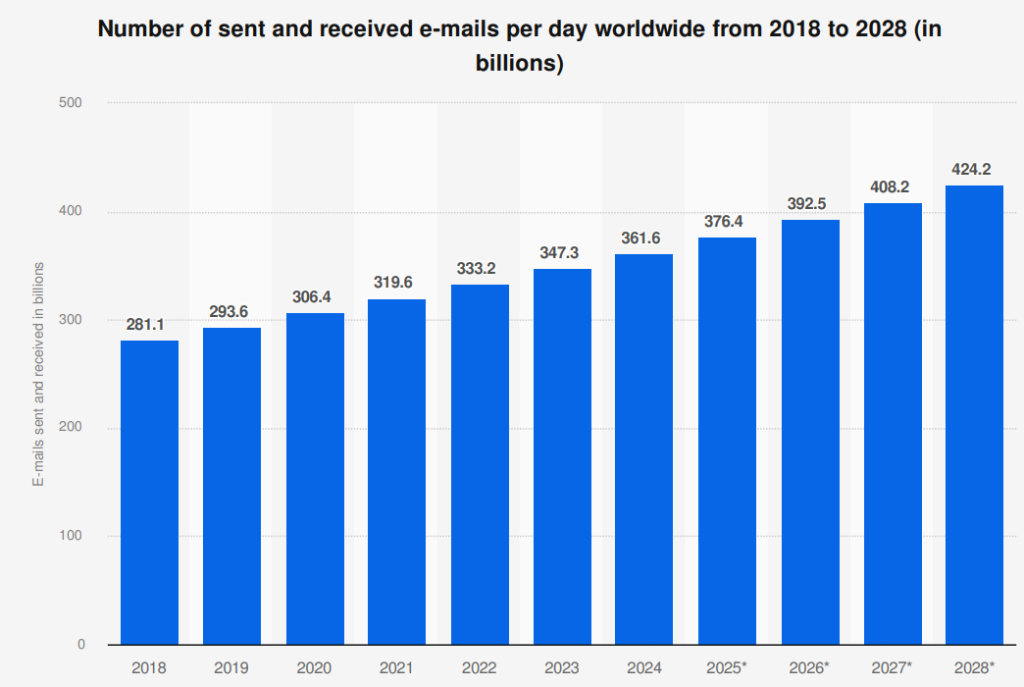
Source: The Radicati Group © Statista 2025
The image shows a clear and steady rise in global email activity — proving that email marketing is not only relevant but more essential than ever. According to the data, the number of sent and received emails per day worldwide was about 281.1 billion in 2018, and it’s projected to reach over 424 billion by 2028. That’s nearly a 51% increase in just ten years, signaling an unstoppable growth in digital communication.
This surge reflects both personal and business usage, but the takeaway for marketers is massive: the inbox remains one of the most powerful, high-traffic spaces on the internet. By 2025 alone, more than 376 billion emails will be exchanged daily — and with that volume comes fierce competition for attention. To stand out, brands must focus on smarter email marketing strategies — using personalization, segmentation, and automation to cut through the noise.
Repurpose blog posts into newsletters or share product updates with storytelling. Authenticity always outperforms perfection. Remember, even a list of 500 loyal subscribers can outperform a list of 50,000 inactive ones.
How to Build Your Email List Effectively?
Focus on quality over quantity — engaged subscribers drive better results than a large but inactive list.
The Future of Email Marketing
The future of email marketing is deeply human. As automation and AI continue to evolve, the brands that win will be those that combine technology with empathy. We’ll see a rise in storytelling-based newsletters, minimalistic design, and privacy-first communication.
AI will predict customer needs before they’re expressed. Voice-controlled inboxes will allow users to shop or reply hands-free. And sustainability will enter the conversation—companies will optimize sending frequency to reduce digital carbon footprints.
Ultimately, email marketing is not about algorithms; it’s about relationships. It’s about showing up in someone’s inbox with value, empathy, and consistency. Those who treat email not as a sales tool but as a relationship channel will continue to dominate the digital landscape.
Conclusion
Email marketing remains the heartbeat of digital communication. It’s measurable, personal, and timeless. From welcome sequences to AI-driven personalization, every strategy you adopt today will compound your growth tomorrow.
As you refine your campaigns, remember the three pillars—Relevance, Timing, and Value—because they turn ordinary emails into extraordinary brand experiences. Build your system patiently, measure everything, and keep learning from your data.
In the end, email marketing isn’t just about inboxes—it’s about impact. It’s about building genuine connections that drive lasting growth, one meaningful message at a time.