Let’s talk about a common point of confusion I see all the time: brand strategy versus marketing strategy. Many entrepreneurs and even seasoned marketers use these terms interchangeably.
But here’s the truth: they are not the same thing. Mistaking one for the other is like confusing a ship’s destination with the map you use to get there for 10X benefits. Both are vital, but they serve very different purposes.
Getting this right isn’t just a matter of semantics. It directly impacts your bottom line. A study shows that consistently presented brands are expected to see an average revenue increase of 33%. That consistency is born from a clear brand strategy and positioning that guides your marketing efforts, not the other way around. Without a solid brand foundation, your marketing campaigns are just scattered tactics shouting into the void.

In this guide, I’m going to break down the critical differences between brand strategy and marketing strategy. We’ll dive deep into what each one is, why you need both, and how they work together to build a business that not only attracts customers but keeps them for life.
Let’s clear up the confusion once and for all.
What is a Brand Strategy? The Foundation of Your Business
A brand strategy is the high-level, long-term plan for how you want your business to be perceived by the public. It’s the “who” and the “why” behind your company. It defines your core identity, personality, and promise to your customers.
Think of your brand strategy as the soul of your business.
It’s less about what you sell and more about what you stand for.
This strategy is an internal compass that guides every single decision your company makes from product development and customer service to your company culture. It’s about building an emotional connection and fostering loyalty. In fact, 65% of consumers say they feel an emotional connection to a brand that’s directly increase customers royalty, and that connection is what drives long-term value. Your brand strategy is how you build that bond.
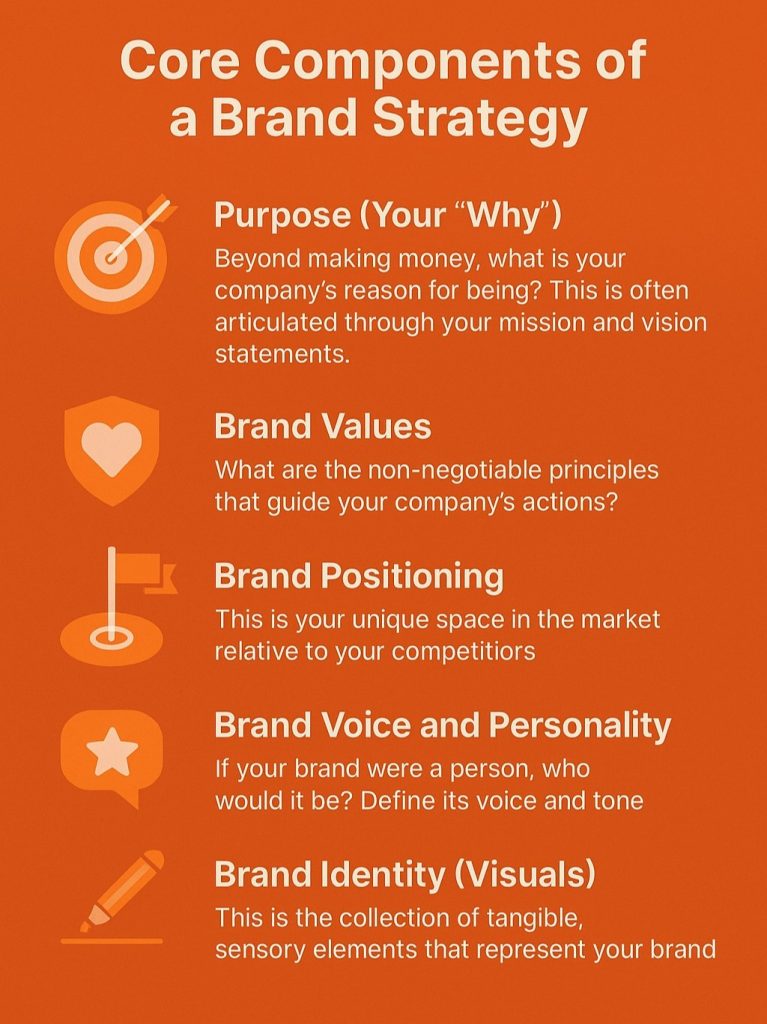
Core Components of a Brand Strategy
To build a robust brand strategy, you need to define several key elements that together form your brand’s DNA. These components ensure your identity is clear, consistent, and compelling.
- Purpose (Your “Why”): Beyond making money, what is your company’s reason for being? This is often articulated through your mission and vision statements. Your purpose inspires your team and connects with customers on a deeper level. For example, Patagonia’s purpose is to “save our home planet.” This purpose guides their product materials, their activism, and their entire business model.
- Brand Values: What are the non-negotiable principles that guide your company’s actions? These values dictate how you treat your employees, customers, and the community. They are the moral compass of your organization. Companies with a strong sense of purpose for a brand and clear values often outperform their competitors.
- Brand Positioning: This is your unique space in the market relative to your competitors. It answers the question: “Why should a customer choose you over everyone else?” Your positioning statement clarifies your target audience, your unique value proposition, and the reason customers should believe your promise. Volvo, for instance, has long positioned itself as the safest car for families.
- Brand Voice and Personality: If your brand were a person, who would it be? Is it a wise mentor, a witty friend, or a rebellious innovator? This personality comes to life through your brand voice—the language and tone you use in all communications. Mailchimp’s friendly and helpful voice is a perfect example of a personality that makes a tech product feel approachable.
- Brand Identity (Visuals): This is the collection of tangible, sensory elements that represent your brand. It includes your logo, color palette, typography, and imagery. These visual cues make your brand instantly recognizable. Think of the iconic Coca-Cola red or the Nike “swoosh.” These visual assets are powerful shortcuts to brand recognition.
What is a Marketing Strategy? The Plan to Reach Your Goals
If brand strategy is the “who” and “why,” then marketing strategy is the “how” and “when.” A marketing strategy is the comprehensive plan for how you will promote your products or services to your target audience. It’s about taking your brand’s core message and getting it in front of the right people, at the right time, through the right channels.
Marketing is fundamentally about driving action. Its goal is to generate leads, increase sales, and achieve specific, measurable business objectives. While brand strategy is about building communication for a long-term reputation, marketing strategy is focused on more immediate results and is often planned in shorter cycles (quarterly or annually). It’s the engine that pushes your brand out into the market. Research shows that businesses with a documented marketing strategy are 313% more likely to report success.
Core Components of a Marketing Strategy
A successful marketing strategy is built on research, planning, and measurement. It’s a dynamic plan that should be reviewed and adjusted based on performance data. Here are its essential parts.
- Marketing Goals (The 5 P’s): Before you start, you need to know what you want to achieve. Your goals should be SMART (Specific, Measurable, Achievable, Relevant, Time-bound). These goals are often defined by the 5 P’s of Marketing:
- Product: What you’re selling and how it meets customer needs.
- Price: Your pricing strategy and how it positions you in the market.
- Promotion: The tactics you’ll use to communicate with your audience (e.g., ads, content, PR).
- Place: Where you will sell your product and distribute it.
- People: The target audience you are trying to reach.
- Target Audience & Buyer Personas: While brand strategy defines your audience broadly, marketing strategy gets hyper-specific. You create detailed buyer personas that represent your ideal customers. These personas include demographics, pain points, motivations, and media consumption habits. This level of detail allows you to create highly targeted and effective campaigns.
- Marketing Channels: This is where you will execute your marketing tactics for branding. The channels you choose should be based on where your target audience spends their time. Common channels include:
- Content Marketing & SEO: Creating valuable blog posts, videos, and guides to attract organic traffic.
- Social Media Marketing: Engaging with your audience on platforms like Instagram, LinkedIn, or TikTok.
- Email Marketing: Nurturing leads and building customer relationships through direct communication.
- Paid Advertising (PPC & Social Ads): Paying to place your message in front of a targeted audience.
- Public Relations (PR): Earning media coverage to build credibility.
- Key Performance Indicators (KPIs): These are the metrics you use to measure the success of your marketing efforts. KPIs must be tied directly to your goals. For example, if your goal is to generate leads, your KPIs might include website conversion rate, cost per lead, and the number of qualified leads. Tracking these metrics is crucial for optimizing your strategy and proving ROI.
Brand Strategy vs Marketing Strategy: A Side-by-Side Comparison
To make the distinction even clearer, let’s look at these two concepts side-by-side. Imagine you are building a house. Your brand strategy is the architectural blueprint, defining the structure, style, and overall feel of the home. Your marketing strategy is the plan to sell the house—the open house events, the online listings, and the promotional flyers.
| Aspect | Brand Strategy | Marketing Strategy |
|---|---|---|
| Primary Goal | To build a long-term reputation, trust, and loyalty. | To drive short-to-mid-term actions like sales and leads. |
| Time Horizon | Long-term and foundational. | Shorter-term and cyclical (e.g., quarterly, annually). |
| Focus | Defines who you are as a company (your identity). | Defines how you will reach your audience (your tactics). |
| Direction | Pulls people toward your brand through emotional connection. | Pushes products and messages out to the market. |
| Core Question | “Why should people care about us?” | “How do we get people to buy from us?” |
| Key Metrics | Brand awareness, sentiment, customer loyalty, perception. | Sales revenue, conversion rates, cost per acquisition (CPA), ROI. |
| Example | Apple’s brand strategy is built on innovation, simplicity, and beautiful design. | Apple’s marketing strategy for a new iPhone includes a launch event, pre-order campaigns, and targeted ads. |
Why You Absolutely Need Both Strategies
Thinking you can choose between a brand strategy and a marketing strategy is a false choice. A successful business requires both working in harmony. They are two sides of the same coin, each one strengthening the other.
How Brand Strategy Empowers Marketing
Your brand strategy provides the essential framework that makes your marketing effective. Without it, your marketing efforts are inconsistent and lack direction.
- Ensures Consistency: A strong brand strategy ensures that every ad, social media post, and email campaign communicates a consistent message and reflects the same personality. This consistency builds recognition and trust.
- Increases Efficiency: When you know exactly who you are and what you stand for, creating marketing materials becomes faster and easier. You have clear guidelines for your voice, visuals, and messaging, which eliminates guesswork.
- Enables Premium Pricing: A strong brand creates perceived value that goes beyond the product itself. Brands like Nike or Starbucks can charge more because customers aren’t just buying shoes or coffee; they’re buying into a lifestyle and a promise of quality. 59% of shoppers prefer to buy new products from brands they are familiar with.
- Builds Long-Term Loyalty: Marketing can drive an initial sale, but brand is what keeps customers coming back. The emotional connection forged through a powerful brand strategy turns one-time buyers into loyal advocates who promote your business for free.
How Marketing Strategy Brings Your Brand to Life
Your brand strategy can be brilliant, but if no one knows about it, it’s useless. Marketing is the vehicle that carries your brand message to the world.
- Builds Awareness: Marketing tactics are how you introduce your brand to new audiences and build recognition in the market. Through SEO, social media, and advertising, you make people aware that your brand exists.
- Validates Your Brand Promise: Your marketing campaigns are where you prove that your brand can deliver on its promises. A well-executed campaign that provides value and solves a customer’s problem reinforces the trust your brand strategy aims to build.
- Gathers Crucial Feedback: Marketing is a two-way street. Through social media comments, customer reviews, and survey data, your marketing efforts provide valuable feedback that can be used to refine both your marketing tactics and your overarching brand strategy.
How to Align Your Brand and Marketing Strategies
Alignment is key. When your brand and marketing strategies work together, they create a powerful force that drives sustainable growth. Here’s how to ensure they are perfectly in sync.
Step 1: Start with Brand Strategy First
You must define who you are before you can decide how to talk about yourself. Your brand strategy—your purpose, values, and positioning—must be established first. It is the North Star that will guide all subsequent marketing decisions. Never build a marketing plan without a solid brand foundation in place.
Step 2: Let Brand Guide Your Marketing Message
Every piece of marketing content you create should be a reflection of your brand strategy. Before you launch a campaign, ask yourself these questions:
- Does this message align with our core values?
- Does the tone of this ad reflect our brand personality?
- Does this campaign reinforce our market positioning?
If the answer to any of these questions is no, it’s time to go back to the drawing board.
Step 3: Use Marketing to Tell Your Brand Story
Your brand’s purpose and values can feel abstract. Marketing makes them tangible. Use your content—blog posts, videos, customer testimonials—to tell stories that bring your brand to life. If one of your brand values is “community,” create marketing campaigns that highlight and support your local community. Show, don’t just tell.
Step 4: Create a Feedback Loop
Use the data and insights from your marketing campaigns to inform your brand strategy. Are customers responding positively to a certain message? That might indicate a core value that resonates deeply with your audience. Is a particular marketing channel underperforming? It might be a sign that your brand’s voice isn’t a good fit for that platform. Your marketing results provide a real-world test of your brand’s relevance and appeal.
Final Thoughts
Understanding the difference between brand strategy and marketing strategy is fundamental to building a successful and enduring business. Your brand strategy is your long-term vision, your identity, your purpose, and your promise. It’s the soul of your company that builds trust and loyalty. Your marketing strategy is the actionable plan you use to communicate that brand, attract customers, and drive sales.
One cannot thrive without the other. A great marketing strategy without a solid brand foundation is just noise. A brilliant brand strategy without effective marketing is a secret.
Start by defining your brand. Get crystal clear on who you are and what you stand for. Then, build a marketing strategy that brings that brand to life with creativity, precision, and passion. When you align these two powerful forces, you don’t just sell a product, you build a legacy.