I used to think sustainability was just another affordable brand PR tactic.
A feel-good buzzword that companies used to appeal to the masses..
You know the type and companies slapping a green leaf on their logo for Earth Day and calling it a strategy.
It felt performative. It felt like a box to check so investors wouldn’t ask awkward questions during quarterly earnings calls.
But then I saw the data. And more importantly, I saw the shift in consumer psychology.

We aren’t just talking about “saving the turtles” anymore (though, let’s be honest, the turtles are important). We are talking about hard, cold cash flow. We are talking about survival.
The businesses that treat sustainability as a side project are slowly bleeding out. The ones that treat sustainability as a competitive advantage are dominating their markets. They are recruiting better talent, slashing operational costs, and building brand loyalty that money literally cannot buy.
If you think going green is just a cost center, you are leaving money on the table. Today, I’m going to show you why sustainability is the smartest growth hack you haven’t fully optimized yet, and how you can build a framework that drives profit with purpose.
Let’s dive in.
The Old Way vs. The New Reality
Remember when “going digital” was optional? Blockbuster thought it was optional. Borders Books thought it was optional.
Sustainability is in that exact same phase right now.
For decades, the “Old Way” of business thinking was simple: maximize shareholder value at all costs. If you polluted a river or churned through cheap labor, it was just the cost of doing business. Externalities were someone else’s problem.
The “New Reality” is starkly different. Information is transparent. Supply chains are visible. And consumers? They are smarter and more cynical than ever before.
A Nielsen report found that 66% of global consumers are willing to pay more for sustainable goods. That number jumps to 73% for Millennials. If your target audience is under the age of 40, sustainability isn’t a “nice-to-have.” It’s a requirement for entry.
But it’s not just about customers. It’s about resilience.
When you optimize your supply chain to use less water, you aren’t just being “green.” You are insulating your business against future water scarcity and price hikes. When you switch to renewable energy, you are protecting your bottom line from volatile fossil fuel markets.
Sustainability is basically risk management dressed up in eco-friendly packaging.
Why Sustainability Wins (The Psychology of Purpose)
Let me tell you a quick story about Patagonia.
In 2011, on Black Friday, seen the biggest shopping day of the year, Patagonia ran a full-page ad in the New York Times featuring their best-selling jacket. The headline read: “Don’t Buy This Jacket.”
The ad explained the environmental cost of manufacturing the jacket and urged people to repair their old gear instead of buying new.
Marketing suicide, right?
Wrong. Their sales rose 30% following that campaign.
Why? Because it built massive trust. Consumers realized Patagonia wasn’t just trying to extract money from them; they stood for something. In a marketplace crowded with noise and generic products, values are the ultimate differentiator.
When you adopt sustainability as a competitive advantage, you tap into three psychological triggers:
- Tribalism: People want to belong to a group that does good. Buying your product becomes a badge of honor.
- Trust: Transparency about your supply chain signals honesty. If you are honest about your carbon footprint, customers assume you are honest about your product quality too.
- Justification: We all love shopping, but we hate the guilt. A sustainable product gives consumers permission to buy because it feels like a moral choice, not just a material one.
The 3-Pillar Framework for Sustainable Growth
You can’t just wake up one day and declare, “We are sustainable now!” True sustainability requires more than just words, it demands a clear, actionable strategy.
It’s not something that happens overnight or by chance. Personally, I like to use a straightforward framework to break this process down into manageable steps. While it’s not overly complex, it does call for consistent effort and real commitment.
Without a plan and the dedication to follow through, sustainability remains just an idea rather than a meaningful practice.
1. Operational Efficiency (The “Low-Hanging Fruit”)
This is where you start. It’s the boring stuff that saves you the most money immediately.
Walmart is a great example here. They aren’t exactly known as a hippie commune, right? But they are obsessed with efficiency.
A few years ago, Walmart realized that by simply reducing the packaging on their toy trucks, they could save $2.4 million a year in shipping costs. They used less fuel, fewer trucks, and less cardboard.
Actionable Step: Audit your waste. Where are you burning cash?
- Are your office lights on when no one is home? (Install motion sensors).
- Are you shipping too much air in your e-commerce boxes? (Resize your packaging).
- Is your server usage optimized? (Green cloud computing is a massive saver).
Every ounce of waste you cut is pure profit margin.
2. Product Innovation (The Differentiator)
This is where you start stealing market share. instead of making the same thing slightly better, make something different that solves an environmental problem.
Look at Adidas. They partnered with Parley for the Oceans to create sneakers made from recycled ocean plastic.
Did they sacrifice quality? No.
Did they charge less? No.
They sold millions of pairs at a premium price point.
They turned a global crisis (ocean pollution) into a raw material. That is innovation.
Actionable Step: Look at your product lifecycle.
- Can you use recycled materials?
- Can you design your product to be easily repaired rather than thrown away?
- Can you offer a “take-back” program to recycle old products?
3. Brand Storytelling (The Amplifier)
Doing good is pointless if nobody knows about it. You have to tell the story, but—and this is critical—you cannot greenwash.
Greenwashing is when you claim to be eco-friendly but your actions don’t back it up. Consumers can smell this from a mile away. (Remember Volkswagen’s “Clean Diesel” scandal? That cost them billions).
Your storytelling needs to be vulnerable. Don’t say “We are perfect.” Say, “We are trying to be better, and here is how far we have come.”
Actionable Step: Create a “Sustainability Report” page on your site, but make it readable. Use infographics, not dense PDFs. Show your goals (e.g., “Carbon Neutral by 2030”) and track your progress openly.
Real-World Examples: Who is doing it right?
We talked about Patagonia and Walmart, but let’s look at a few others across different industries.
Unilever: The “Sustainable Living” Brands
Unilever, the giant behind Dove and Ben & Jerry’s, made a distinct choice. They designated certain brands within their portfolio as “Sustainable Living Brands.” These brands focused on sourcing sustainably and reducing environmental impact.
The result? These sustainable brands grew 69% faster than the rest of their business and delivered 75% of the company’s overall growth.
Sustainability wasn’t a charity project; it was the engine of their expansion.
IKEA: The Circular Economy
IKEA used to be the poster child for “fast furniture”—buy it cheap, throw it away in two years. They realized that model wasn’t sustainable for the planet or their reputation.
Now, they are investing heavily in the “circular economy.” They have buy-back programs where they purchase your old IKEA furniture to resell in their “As-Is” section. They are designing products specifically to be disassembled and repaired.
They are turning the secondhand market usually a threat to retailers into a revenue stream.
Interface: The Carpet Tile Revolution
Interface creates carpet tiles for offices. Boring, right? Not really. Their founder, Ray Anderson, read a book about ecology in the 90s and had an epiphany. He set a goal called “Mission Zero”—zero negative impact on the environment by 2020.
They reinvented how they made carpet. They used discarded fishing nets to make yarn. They reduced greenhouse gas emissions by 96%. And in the process, they became the absolute market leader in commercial flooring because architects and designers wanted to specify the “greenest” product available.
The Talent War: Why Sustainability Attracts the Best
We talk a lot about customers, but what about your team?
I hire a lot of people. And I can tell you, the smartest, most talented workers today do not want to work for a soulless corporation. They want purpose.
A study by Cone Communications found that 64% of millennials won’t take a job if a potential employer doesn’t have strong corporate social responsibility (CSR) practices.
If you are competing for top-tier developers, marketers, or engineers, you aren’t just competing on salary. You are competing on values.
When your company has a clear mission—like reducing waste or fighting climate change—employees are more engaged. They stay longer. They work harder because they feel like they are contributing to something bigger than a quarterly dividend.
Turnover is expensive. Replacing an employee can cost up to 2x their annual salary. If a sustainable mission reduces your churn rate by even 10%, that is a massive competitive advantage.
How to Measure Success (Metrics That Matter)
You can’t improve what you don’t measure. If you want sustainability to be a competitive advantage, you need KPIs just like you have for sales or marketing.
Here is a simple dashboard you should be tracking:
- Carbon Footprint per Unit: How much carbon does it take to make one widget? Your brand goal is to drive this down year over year.
- Energy Intensity: How much energy do you use per dollar of revenue?
- Waste Diversion Rate: What percentage of your waste is being recycled vs. sent to a landfill?
- Supplier Sustainability Score: Rank your vendors. If a vendor is polluting, they are a liability to your brand.
- Employee Engagement Score: specifically related to your CSR initiatives.
Overcoming the “It Costs Too Much” Myth
I hear this objection constantly. “Neil, I’d love to be sustainable, but solar panels are expensive. Organic cotton is expensive.”
Yes, the upfront investment can be higher. But you have to look at the Total Cost of Ownership (TCO).
- LED lights cost more to buy than incandescent bulbs, but they last 25 times longer and use 75% less energy. The ROI is usually less than a year.
- Retraining staff to reduce waste costs time, but it saves materials forever.
- Building a reputation for sustainability takes effort, but it lowers your Customer Acquisition Cost (CAC) because organic word-of-mouth increases.
Stop thinking in quarters. Start thinking in years. The businesses that win the next decade are the ones playing the long game.
Step-by-Step Implementation Guide
Ready to start? Don’t get overwhelmed. You don’t need to become Tesla overnight. Just start moving.
Step 1: Define Your “North Star”
Pick one major issue that aligns with your brand. If you are a coffee shop, focus on fair trade and compostable cups. If you are a tech company, focus on e-waste and energy efficiency. Don’t try to save the whole world at once.
Step 2: Conduct a Materiality Assessment
Survey your stakeholders (customers, employees, investors). Ask them what environmental issues matter most to them. Focus your efforts where they overlap with your business impact.
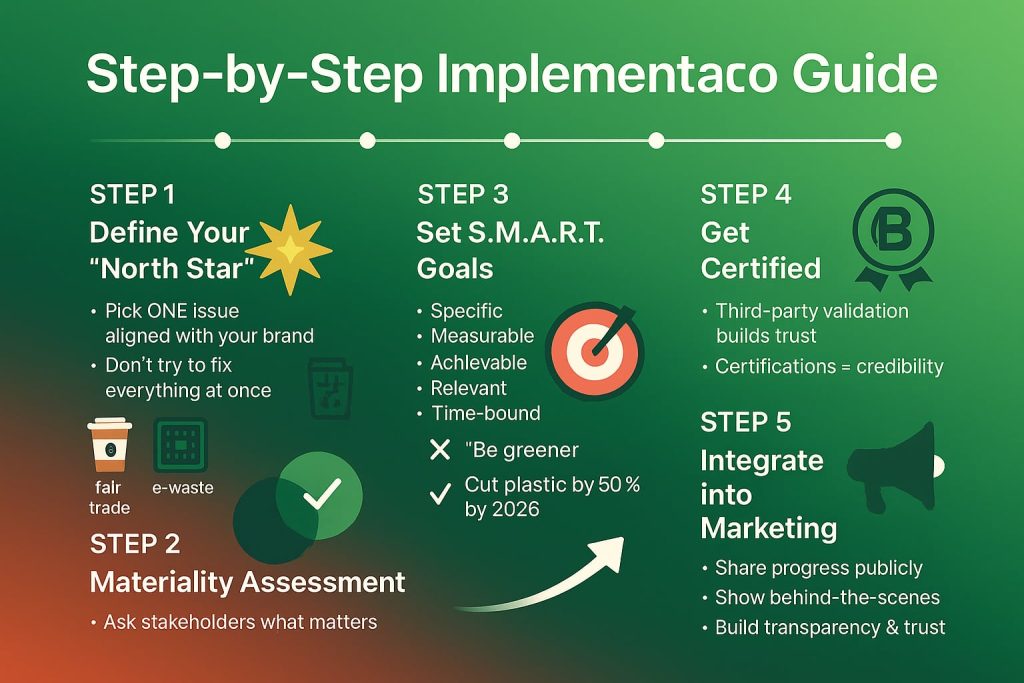
Step 3: Set “S.M.A.R.T.” Goals
Specific, Measurable, Achievable, Relevant, Time-bound.
- Bad Goal: “We will be greener.”
- Good Goal: “We will reduce our plastic packaging by 50% by December 2026.”
Step 4: Get Certified
Third-party validation is powerful. Look into B Corp certification. It’s rigorous, but that little “B” logo on your footer builds instant credibility. It proves you aren’t just talking the talk.
Step 5: Integrate into Marketing
Once you have wins, share them. Write blog posts about your journey. Show behind-the-scenes videos of your factory. Be honest about the challenges. Consumers love the “Building in Public” approach.
Conclusion
Sustainability is no longer about philanthropy. It is about brand strategy and marketing strategy.
It is about future-proofing your business against resource scarcity. It is about aligning with the values of the most powerful consumer generation in history. It is about attracting the best talent who want to work for a company with a soul.
The companies that ignore this shift will find themselves fighting for scraps in a shrinking market. The ones that embrace sustainability as a competitive advantage will lead the market.
You have a choice. You can wait for regulations to force you to change, or you can lead the change and reap the rewards.
Start small. Measure everything. Be transparent.
The green wave isn’t coming; it’s already here. Time to ride it.