I remember my first major branding project.
It was for a mid-sized tech company that had a brilliant product but a name that sounded like a law firm and a logo designed in the ’90s. They were invisible. The CEO told me, “We’re the best at what we do, but no one knows it. Can you just make us look better?” I smiled. “We can do more than that,” I said. “We can make them feel something.”

That’s the heart of corporate brand strategy. It isn’t about picking a new color palette or a catchy tagline. It’s about architecture. It’s the meticulous process of designing and building a reputation, an identity, and a promise and a true brand development strategy that resonates so deeply with people that it becomes a permanent fixture in their minds. It’s the difference between being just another company and becoming an institution.
This isn’t a theoretical exercise. A strong corporate brand directly impacts the bottom line. It can increase a company’s value by an average of 12-15%. It’s a magnet for top talent, a buffer during crises, and a powerful driver of customer loyalty.
Over the years, I’ve guided countless organizations through this transformative journey. I’ve seen brands rise from obscurity to become industry leaders, and I’ve seen others with immense potential falter because they neglected their foundation. In this guide, I’m going to walk you through the blueprint—the same frameworks, insights, and strategic steps I use with my own clients. We’ll move from the foundational “why” of your existence to the tangible assets that represent you in the world. We’ll cover:
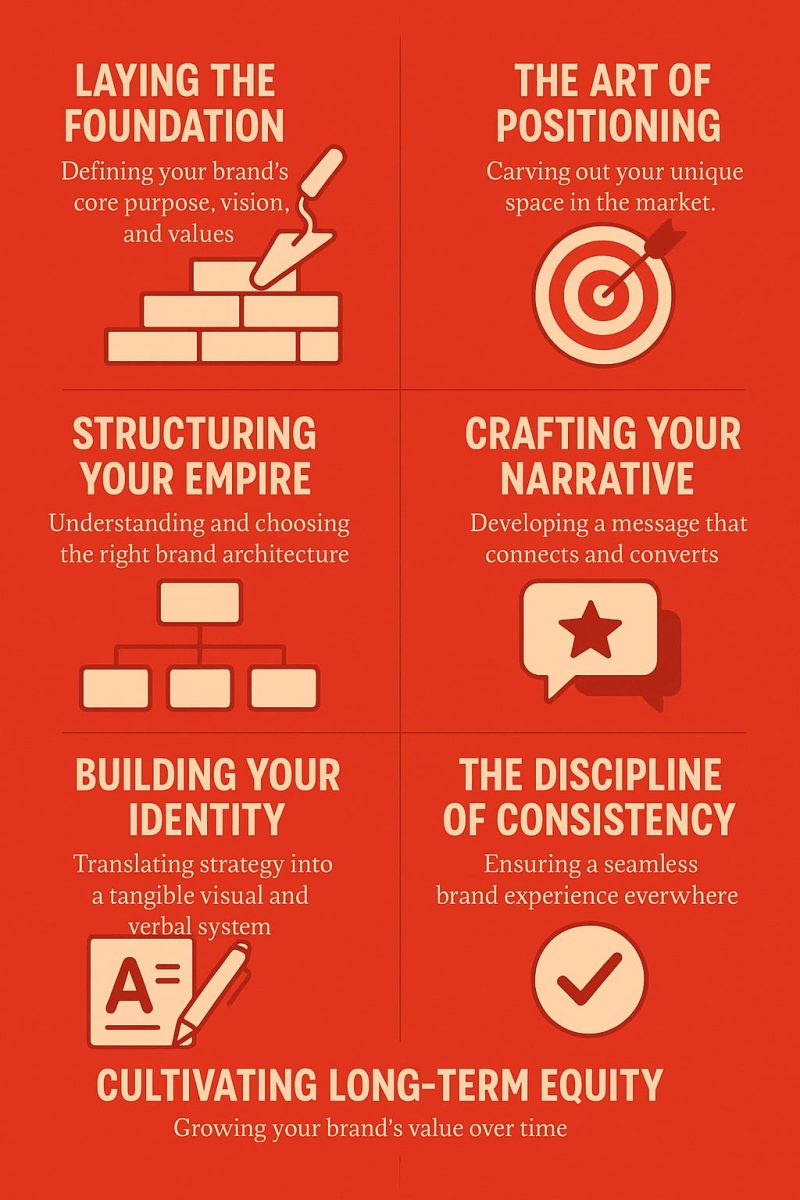
- Laying the Foundation: Defining your brand’s core purpose, vision, and values.
- The Art of Positioning: Carving out your unique space in the market.
- Structuring Your Empire: Understanding and choosing the right brand architecture.
- Crafting Your Narrative: Developing a message that connects and converts.
- Building Your Identity: Translating strategy into a tangible visual and verbal system.
- The Discipline of Consistency: Ensuring a seamless brand experience everywhere.
- Cultivating Long-Term Equity: Growing your brand’s value over time.
So, grab a coffee. Let’s start building.
Laying the Foundation: The Core of Your Brand
Before you can build anything, you need to survey the land and lay a solid foundation. Branding in business, this foundation isn’t concrete and steel; it’s purpose, vision, and values. Many companies rush past this part, eager to get to the “fun stuff” like logos and websites. That’s a critical mistake. Without this core, your brand is just a decorative facade, destined to crumble under the slightest pressure.
Your Brand Purpose: The “Why” Beyond Profit
Your purpose is your reason for being, beyond making money. It’s the answer to the question, “Why do we exist?” Simon Sinek famously called this “Starting with Why.” He was right. Profit is a result, not a purpose. Your purpose is the impact you want to have on your customers, your industry, and the world.
Let’s look at a real-world example: Patagonia. Their purpose isn’t just “to sell outdoor gear.” It’s “We’re in business to save our home planet.” This single, powerful statement informs everything they do. It dictates their product development (using recycled materials), their marketing (the “Don’t Buy This Jacket” campaign), and their corporate activism (donating 1% of sales to environmental causes). Their purpose attracts not just customers who need a fleece, but a community of people who share their values.
Actionable Framework: The Purpose Statement
To unearth your purpose, gather your leadership team and ask these questions:
- What problem did our founders originally set out to solve?
- If we disappeared tomorrow, what would the world lose?
- What are we uniquely good at? What is our superpower?
- What gets us out of bed in the morning, besides a paycheck?
Distill the answers into a single, concise, and inspiring statement. This isn’t a marketing tagline for public consumption. It’s your internal North Star.
Your Brand Vision: The Future You’re Building
If your purpose is your “why,” your vision is your “where.” It’s a vivid picture of the future you are working to create. A powerful vision statement inspires action and provides direction. It should be ambitious but not impossible.
Consider Microsoft under Satya Nadella. Their vision isn’t about putting a PC on every desk anymore. It’s “to empower every person and every organization on the planet to achieve more.” This is a broad, aspirational, and deeply human vision. It shifted the company’s focus from selling software licenses to creating tools (like Azure and Microsoft 365) that enable productivity and innovation for everyone, from a solo entrepreneur to a global enterprise.
Your Brand Values: The Rules of the Road
Values are the non-negotiable principles that guide your behavior, decisions, and culture. They are the filter through which every action, from a hiring decision to a marketing campaign, must pass. Vague, generic values like “Integrity,” “Excellence,” and “Teamwork” are meaningless without clear definitions and observable behaviors.
A company that lives its values is Zappos. One of their core values is “Deliver WOW Through Service.” This isn’t just a poster on the wall. It’s embedded in their operations. Their call center reps aren’t timed or given scripts. They are empowered to spend as long as they need to help a customer, famously including a record-breaking 10-hour customer service call. This value drives legendary customer loyalty and has become the cornerstone of their brand.
Actionable Framework: Defining Your Values
- Brainstorm: List words that describe your company culture at its best.
- Group and Refine: Group similar words and narrow the list down to 3-5 core concepts.
- Define and Describe: For each value, write a short definition. Then, list 2-3 specific, observable behaviors that demonstrate that value in action. For example, for a value of “Embrace Curiosity,” a behavior might be “We ask ‘why’ at least three times before settling on a solution.”
With your purpose, vision, and values established, you have your foundation. This is the bedrock upon which you will build the rest of your corporate brand.
The Art of Positioning: Claiming Your Territory
Imagine walking into a crowded party. To be noticed, you can’t just stand in the middle of the room and blend in. You need to find a corner, start a compelling conversation, and become the center of a small, engaged group. That’s brand positioning. It’s the art of deliberately occupying a specific, unique, and valuable place in the mind of your target audience.
Positioning is not what you do to a product. It’s what you do to the mind of the prospect. It’s about creating a mental shortcut. When someone thinks of “electric cars,” they think of Tesla. When they think of “fast, affordable furniture,” they think of IKEA. This mental real estate is priceless, and it’s won through strategic positioning.
Finding Your Differentiator
The core of positioning is differentiation. You must answer the question: “Why should someone choose us over every other available option?” Your differentiator must be:
- Relevant: It has to matter to your target audience.
- Unique: No one else can (or does) claim it in the same way.
- Credible: You must be able to deliver on the promise.
Volvo is a masterclass in differentiation. For decades, while other car companies competed on speed, luxury, or fuel economy, Volvo owned a single, powerful concept: safety. Every ad, every engineering innovation, every press release reinforced this position. Even as their cars became more stylish and powerful, the core promise of safety remained, giving them a distinct and unshakable place in the market.
The Positioning Statement Framework
A positioning statement is an internal tool that succinctly articulates your unique value proposition. It’s a formula that brings clarity and focus to your entire marketing and communications strategy.
The classic framework is:
For [Target Audience], [Your Brand] is the only [Category/Frame of Reference] that [Point of Difference] because [Reason to Believe].
Let’s break it down:
- Target Audience: Be specific. “Small business owners” is too broad. “Growth-stage e-commerce founders struggling with inventory management” is better.
- Category/Frame of Reference: This is the box you put yourself in. Are you a “CRM software,” a “project management tool,” or a “customer communication platform”? It sets the context for your audience.
- Point of Difference: This is your secret sauce. It’s the single most compelling benefit you offer that your competitors don’t.
- Reason to Believe: This is the proof. What features, data, or testimonials support your claim?
Let’s create one for a hypothetical company, “Flow,” a project management tool.
For creative agency teams who are overwhelmed by client feedback, Flow is the only project management platform that visually centralizes all comments directly on creative assets, because it integrates a proprietary visual annotation tool that eliminates confusing email chains.
This statement is a strategic weapon. It tells the product team what to prioritize (visual annotation), the marketing team what message to amplify (ending email chaos), and the sales team who to target (creative agencies).
Perceptual Mapping: Visualizing the Battlefield
A powerful exercise in positioning is creating a perceptual map. This is a simple 2×2 matrix where you plot your brand and your competitors based on two key attributes that are important to your customers. For the automotive industry, the axes might be “Price” (from Economy to Luxury) and “Performance” (from Practical to Sporty).
Drawing this map forces you to see the market from your customer’s perspective. Where do your competitors cluster? More importantly, where are the open spaces? That open quadrant is your opportunity. It’s the unclaimed territory where you can establish a unique and defensible position. Maybe it’s the “Affordable Luxury” space, or the “Practical Sporty” niche. Finding that blue ocean is the first step to owning it.
Structuring Your Empire: The Blueprint of Brand Architecture
As companies grow, they acquire new businesses, launch new products, and expand into new markets. This growth often happens organically, resulting in a confusing jumble of names, logos, and messages. This is where brand architecture comes in. It’s the logical, strategic structure that organizes the relationship between your corporate brand and its sub-brands, products, and services.
Getting your architecture right is crucial. It provides clarity for customers, enables cross-selling, and creates efficiencies in marketing. A messy architecture leads to internal turf wars, customer confusion, and diluted marketing spend.
There are three primary models of brand architecture.
1. The Branded House (Monolithic)
In a Branded House model, the master brand is the dominant force, and all sub-brands are extensions of it. They share the same name, identity, and promise. Think Google. You have Google Search, Google Maps, Google Drive, Google Calendar. The master brand, Google, provides the credibility and the sub-brands describe the function.
- Pros: Very efficient. Marketing spend on the master brand benefits all sub-brands. It creates a strong, unified, and easily recognizable brand. New product launches are easier as they inherit the trust of the parent brand.
- Cons: A failure or scandal in one sub-brand can damage the entire portfolio. It can be restrictive if you want to enter a market that is completely different from your core identity (e.g., if Google wanted to launch a luxury fashion line).
- Best for: Companies with a strong, single-minded brand promise that can extend across all their offerings.
2. The House of Brands (Pluralistic)
This is the opposite of the Branded House. The parent company is largely invisible to the consumer, and each brand in the portfolio is managed independently, with its own unique identity, audience, and marketing strategy. The classic example is Procter & Gamble (P&G). Most consumers know Tide, Gillette, Pampers, and Crest, but few could tell you they are all owned by P&G.
- Pros: Allows a company to dominate a category by targeting different market segments with different brands (e.g., P&G has multiple laundry detergents). A negative event with one brand does not impact the others. It offers the flexibility to acquire and sell brands without disrupting the core business.
- Cons: It’s incredibly expensive. Each brand requires its own dedicated marketing budget, team, and strategy. There are few, if any, synergies between the brands.
- Best for: Large conglomerates operating in diverse markets (like consumer-packaged goods) where targeting niche audiences is key.
3. The Hybrid Model (Endorsed or Sub-branded)
The Hybrid model is a mix of the two, where a master brand provides a quiet endorsement or link to a sub-brand. There are two main variations:
- Endorsed Brand: The sub-brand has its own identity but is explicitly endorsed by the master brand. Think of Courtyard by Marriott. “Courtyard” is the primary brand, but the “by Marriott” endorsement provides a halo of quality and trust.
- Sub-brand: The master brand name is part of the sub-brand name. Think Apple with the iPhone, iPad, and Apple Watch. Or Sony with the Sony PlayStation. The master brand is a driver, but the sub-brand has its own distinct equity.
- Pros: Offers a balance of leverage and flexibility. The sub-brand can have its own personality while still benefiting from the parent’s reputation. It allows companies to stretch into new territories without diluting the master brand.
- Cons: Can become complex and confusing if not managed with strict guidelines. Requires careful decisions about how prominent the master brand’s endorsement should be.
- Best for: Most large, diversified companies. It allows for targeted marketing while maintaining a thread of unity.
Choosing the right architecture is a decision that will shape your company’s future for years. It requires a deep analysis of your business strategy, your brand portfolio, and your long-term growth ambitions. Don’t be afraid to bring in an expert to help navigate this complexity. It’s one of the most important strategic decisions you will ever make.
Crafting Your Narrative: The Voice of Your Brand
If your strategy is the skeleton of your brand, your messaging is its voice. It’s the narrative you tell the world. Great brand messaging isn’t just about what you say; it’s about how you say it. It’s the consistent tone, language, and story that brings your brand’s personality to life across every touchpoint.
Your messaging should be born directly from your positioning. It’s the creative expression of your strategic intent. A common mistake is to develop messaging in a vacuum, resulting in clever taglines that are disconnected from the core brand promise.
The Messaging Framework: From Pillar to Proof
A robust messaging framework ensures consistency and clarity. It acts as a guide for anyone creating content for your brand, from a marketing intern writing a social media post to the CEO giving a keynote speech.
Here’s a simple yet powerful framework:
- Core Narrative (The Big Idea): This is a 2-3 sentence story that encapsulates your brand’s purpose and value proposition. It’s your elevator pitch. It should be emotional, memorable, and repeatable. For Slack, their core narrative might be: “Work is overwhelming. Information is scattered across emails, files, and apps. Slack brings all your communication together in one place, creating a more organized, focused, and productive way for teams to work.”
- Messaging Pillars (The Key Themes): These are 3-4 key themes that support your core narrative. They are the main chapters of your brand story. For Slack, these pillars could be:
- Pillar 1: Break Free from Email.
- Pillar 2: Centralize All Your Tools.
- Pillar 3: Foster a Collaborative Culture.
- Proof Points (The Evidence): For each pillar, you need tangible proof. These are the features, facts, statistics, and testimonials that make your claims believable.
- For Pillar 1 (Break Free from Email): “Channels replace messy email chains,” “Reduces internal email by an average of 32%,” “Customer story from a company that eliminated internal email entirely.”
- For Pillar 2 (Centralize All Your Tools): “Integrates with over 2,200 apps like Google Drive and Asana,” “Customizable workflows to automate routine tasks.”
Finding Your Brand Voice and Tone
Your voice is your brand’s personality. It’s consistent over time. Your tone is the mood or emotion you express in a specific context. Your voice doesn’t change, but your tone adapts to the situation. For example, your voice might be “expert and approachable,” but your tone when writing a technical support document would be more formal and direct than your tone on social media, which might be more playful and conversational.
To define your voice, think of your brand as a person.
- What are their defining personality traits? (e.g., witty, nurturing, authoritative, irreverent)
- How would they describe themselves in three words?
- What kind of language do they use? (e.g., simple and direct, technical and precise, poetic and evocative)
- What kind of language do they avoid? (e.g., jargon, slang, overly formal corporate-speak)
Mailchimp has a famously distinct voice. It’s quirky, encouraging, and human. Their style guide even has a section on “Writing about monkeys,” because their mascot, Freddie, is a chimp. They define their voice as “fun but not silly,” “confident but not cocky,” and “smart but not stodgy.” This clear guidance ensures that everyone writing for Mailchimp sounds like Mailchimp.
Building Your Identity: The Look and Feel
While strategy and messaging are the soul of your brand, your identity is its body. It’s the tangible sensory experience—the collection of visual and verbal elements that represent your brand in the world. This includes your logo, color palette, typography, photography style, and more.
A common pitfall is treating identity design as a purely aesthetic exercise. A great brand identity is strategy made visible. Every design choice should be a deliberate reflection of your brand’s purpose, personality, and positioning.
The Key Components of a Visual Identity System
A comprehensive visual identity system goes far beyond just a logo.
- Logo: The most recognizable mark of your brand. A great logo is simple, memorable, timeless, and versatile. Think of the Nike swoosh or the Apple logo. They are instantly recognizable even without the company name.
- Color Palette: Color is a powerful emotional trigger. Your color palette should evoke the desired feeling. Blue often conveys trust and professionalism (used by many financial and tech companies), while green suggests health, nature, and growth. Your palette should include primary colors for broad use and secondary colors for accents.
- Typography: The fonts you choose say a lot about your brand. A traditional serif font (like Times New Roman) can feel classic and authoritative, while a clean sans-serif font (like Helvetica or Arial) feels modern and approachable. Your system should define fonts for headlines, body copy, and callouts.
- Imagery (Photography & Illustration): Your style of imagery should be consistent. Are your photos bright, optimistic, and full of people? Or are they moody, atmospheric, and abstract? Are your illustrations hand-drawn and whimsical, or are they geometric and precise? This choice should align with your brand’s personality.
- Iconography & Data Visualization: These are the small visual elements that help communicate information quickly. Your icons should share a consistent style, and your charts and graphs should use your brand’s colors and fonts.
The Airbnb Story: A Rebrand Rooted in Strategy
In 2014, Airbnb undertook a massive rebranding. They didn’t just design a new logo. They started with their core purpose: to create a world where anyone can “Belong Anywhere.” Their new logo, the “Bélo,” was designed to symbolize people, places, love, and the “A” of Airbnb. It was a visual manifestation of their core idea. This strategic foundation made the identity powerful and meaningful, even if it was initially controversial.
The Discipline of Consistency: Delivering a Seamless Experience
You have a powerful strategy, a clear message, and a beautiful identity. Now comes the hardest part: execution. Brand consistency is the relentless, disciplined practice of ensuring that every single interaction a person has with your brand feels like it comes from the same place.
Why is consistency so important? Because it builds trust. Every time a customer experiences your brand in a way that aligns with their previous experiences, you are reinforcing their mental model of who you are. Inconsistency creates cognitive dissonance. It makes your brand feel unreliable and unprofessional.
Imagine if you visited an Apple store and it was cluttered and the staff were unhelpful. Or if you received an email from Nike filled with typos and using a goofy font. It would shatter the perception of the brand that was so carefully built.
The Brand Guidelines: Your Constitution
The most critical tool for ensuring consistency is a set of comprehensive brand guidelines. This is the single source of truth for your brand. It’s a living document that should be accessible to everyone in your organization, as well as your external partners and agencies.
A good set of brand guidelines includes:
- The Foundation: Your purpose, vision, and values.
- Positioning: Your positioning statement and target audience personas.
- Brand Architecture: A clear map of your brand portfolio.
- Messaging: Your core narrative, pillars, proof points, and voice/tone guidelines.
- Visual Identity: Detailed rules for using your logo, colors, typography, imagery, and other visual elements. This should include “do’s and don’ts” to prevent misuse.
- Application Examples: Mockups showing how the brand should be applied across key touchpoints, such as business cards, presentations, websites, social media, and advertisements.
Cultivating a Brand-First Culture
Guidelines are essential, but they are not enough. True brand consistency comes from culture. It happens when every employee understands the brand and feels empowered to be a brand ambassador.
This requires ongoing effort:
- Onboarding: New hires should receive thorough brand training.
- Internal Communication: Regularly share brand success stories and highlight examples of great brand stewardship.
- Brand Champions: Appoint a central brand management team or a network of brand champions throughout the organization who can act as resources and guardians of the brand.
- Tools and Templates: Make it easy for people to do the right thing. Provide easy-to-use templates for presentations, documents, and emails that are already on-brand.
Cultivating Long-Term Equity: Growing Your Brand’s Value
Brand equity is the ultimate goal of all this work. It’s the commercial value that derives from consumer perception of the brand name of a particular product or service, rather than from the product or service itself. It’s why you’ll pay more for a coffee from Starbucks than from a no-name gas station. It’s why a white t-shirt with a Supreme logo can sell for hundreds of dollars.
Building brand equity is a long-term game. It’s the cumulative result of years of consistent strategy, positive experiences, and meaningful connections.
The Four Pillars of Brand Equity (Aaker’s Model)
Brand strategist David Aaker identified four key components of brand equity:
- Brand Awareness: The simplest level. Do people know you exist? This is built through marketing, PR, and consistent presence.
- Perceived Quality: Is your product or service seen as good? This is about delivering on your promise, consistently and reliably. It’s the foundation of customer satisfaction.
- Brand Associations: What thoughts, feelings, and images come to mind when people think of your brand? This is built through your positioning, messaging, and identity. Are you associated with innovation, luxury, fun, or reliability?
- Brand Loyalty: The holy grail. This is the measure of how attached a customer is to your brand. It’s built by going beyond satisfaction to create an emotional connection. Loyal customers are less price-sensitive, they act as advocates, and they forgive you when you make mistakes.
These are the foundational elements that define your brand’s identity and purpose. They typically include values, voice, vision, and promise. Understanding and refining your brand pillars helps you stay consistent while connecting with your audience effectively. Regularly revisiting these brand pillars ensures your brand evolves with changing consumer expectations and market dynamics.
Nurturing Your Brand for the Future
Your brand is not a static project with a beginning and an end. It’s a living asset that needs to be managed, measured, and nurtured over time.
- Measure What Matters: Track brand health metrics. Use surveys to measure brand awareness, perception, and preference. Monitor social media sentiment. Keep an eye on your Net Promoter Score (NPS).
- Evolve, Don’t Revolutionize: Markets change, customers evolve, and your brand must adapt. However, these evolutions should be gradual and rooted in your core purpose. Drastic, reactive changes can destroy decades of brand equity. Think of the infamous “New Coke” disaster or Gap’s failed logo change in 2010.
- Invest in the Experience: The single most powerful way to build brand equity is through the customer experience. Every touchpoint—from your website’s user interface to your customer service interactions to your product’s packaging—is an opportunity to reinforce your brand promise and build loyalty.
The Final Word
Building a powerful corporate brand is one of the most challenging and rewarding endeavors in business. It requires the rigor of a strategist, the creativity of a designer, the empathy of a storyteller, and the discipline of an operator.
It’s a journey that begins with a single question: “Why do we exist?” From that simple, profound answer, an entire world can be built a world of meaning, connection, and lasting value.
The blueprint is now in your hands. It’s time to start building.