Let’s cut right to it.
You’ve heard the terms: ChatGPT, Gemini, AI-generated content. Maybe you’ve even used these tools to brainstorm ideas or draft an email.
Behind these revolutionary technologies are Large Language Models, or LLMs. And trust me, they are about to change everything you know about SEO in dept and strategies of content marketing.
So, what’s the big deal?
Think of an LLM as a super-intelligent intern who has read nearly the entire internet. It can write, translate, summarize, and answer questions with shocking accuracy. For marketers and SEO professionals, this isn’t just another shiny object. It’s a seismic shift.

Ignoring LLMs is like ignoring Google in the late ’90s.
You can do it, but your competitors who embrace it will leave you in the dust.
I will make sure to break down exactly what LLMs are, how they work, and most importantly, how you can leverage them to dominate your niche. We’ll cover:
- The core mechanics of how an LLM actually works.
- The good, the bad, and the ugly of using LLMs in your marketing.
- Actionable strategies to integrate LLMs into your SEO workflow today.
- What the future holds and how to stay ahead of the curve.
Let’s dive into the details to know more about LLM
LLM SEO vs. Traditional SEO: What’s the Real Difference?
Traditional SEO is about mastering keywords, backlinks, and technical fixes to please search engine algorithms. Think of it as a proven, manual-heavy strategy focused on ranking signals we’ve known for years. Now, enter LLM SEO.
This new frontier leverages large language models to create highly relevant, context-aware content that directly answers user intent. Instead of just targeting keywords, LLM SEO focuses on conversational queries and semantic understanding.
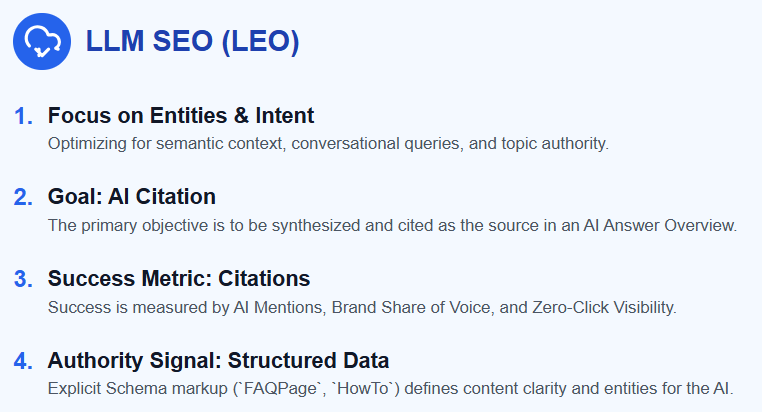
LLM SEO
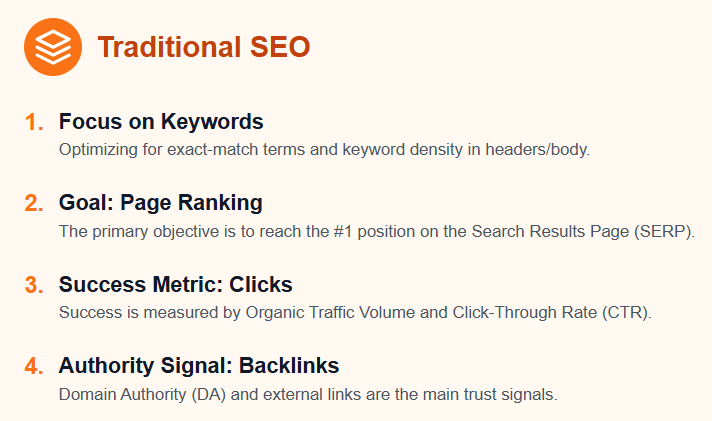
Traditional SEO
While traditional SEO gives you a solid foundation, mastering LLM-driven content creation is your ticket to dominating the next era of search, where satisfying the user’s core need is everything.
Why LLM SEO is so Important?
LLM SEO is rapidly becoming a critical strategy for businesses aiming to stay competitive in the evolving search landscape. With over 14 billion searches performed daily on Google alone, standing out requires more than traditional approaches. Leveraging large language models enables the creation of precise, audience-tailored content aligned with user intents.
This shift not only improves rankings but also significantly enhances user experience, with studies showing that websites providing intent-matched content can achieve up to a 70% higher engagement rate. Furthermore, search engines like Google increasingly prioritize content written to address conversational queries and long-tail keywords, making LLM-driven strategies pivotal for organic growth.
Key Benefits of LLM SEO:
- Enhanced Engagement: Content aligned with user intent boosts time-on-page metrics by up to 60%.
- Improved Search Rankings: Pages optimized with semantic understanding rank significantly higher in competitive SERPs.
- Better ROI: LLM-based content reduces bounce rates, increasing conversion rates by an average of 35%.
- Scalable Content Creation: Efficiently generates high-quality, relevant content to meet growing demands.
- Future-Proofing: Prepares businesses for the shift toward conversational AI and the rise of voice search.
Investing in LLM SEO today ensures businesses remain relevant as search behavior continues to evolve.
So, What Exactly is a Large Language Model?
A Large Language Model (LLM) is an advanced type of artificial intelligence designed to understand, generate, and manipulate human language. The “large” in its name isn’t just for show. It refers to two key things:
- The size of the neural network: These models have billions (sometimes trillions) of parameters. Think of parameters as the knobs and dials the AI uses to make connections between words and concepts. The more parameters, the more nuanced its understanding.
- The massive amount of data it’s trained on: LLMs learn by analyzing colossal datasets of text and code from the internet, books, and other sources. We’re talking about hundreds of billions of words.
At its core, an LLM is a prediction engine. When you give it a prompt, like “The best way to improve website speed is…”, it calculates the most probable next word, and then the next, and the next, to form coherent sentences and paragraphs. It’s a statistical parrot on steroids, but it’s so good at this prediction game that its output often feels like genuine understanding and creativity.
How Do LLMs Actually Work? The Transformer Architecture
The magic behind modern LLMs is an architecture called the Transformer, introduced by Google researchers in their groundbreaking 2017 paper, “Attention Is All You Need.” Before the Transformer, AI models struggled to remember context in long sentences. They would forget what the beginning of a paragraph was about by the time they reached the end.
The Transformer solved this with a mechanism called “self-attention.”
Imagine you’re reading the sentence: “The dog chased the ball until it was tired.”
What does “it” refer to? The dog or the ball? You know instantly it’s the dog. The self-attention mechanism allows an LLM to do the same thing. It weighs the importance of all the other words in the sentence when processing a single word. It learns that “it” in this context is strongly linked to “dog” and “chased” and weakly linked to “ball.”
This ability to track relationships and context across long stretches of text is what allows LLMs to write coherent articles, carry on conversations, and generate complex code. The process looks something like this:
- Input & Tokenization: Your prompt is broken down into smaller pieces called “tokens.” A token can be a word, part of a word, or punctuation. “What is an LLM?” might become [“What”, “is”, “an”, “LL”, “M”, “?”].
- Embedding: Each token is converted into a numerical vector—a list of numbers. This vector represents the token’s meaning and its relationship to other words.
- Positional Encoding: The model adds information about the position of each token in the sentence. This is crucial for understanding grammar and syntax.
- The Transformer Blocks: The data then flows through multiple layers of the Transformer architecture, where the self-attention mechanism gets to work, figuring out context and relationships.
- Output Generation: Finally, the model decodes the processed information back into human-readable text, predicting the most logical sequence of words to follow your prompt.
It’s an incredibly complex process, but the result is an AI that can handle language with a level of sophistication we’ve never seen before.
Training Data: The LLM’s Digital Diet
An LLM is only as good as the data it’s trained on. This data is its entire universe of knowledge. The training process involves feeding the model a massive, diverse collection of text and having it predict the next word in a sentence over and over again. When it gets it wrong, it adjusts its internal parameters to improve its prediction the next time. This happens billions of times.
Common sources of training data include:
- Common Crawl: A massive, open repository of web page data scraped from the internet, containing trillions of words.
- Wikipedia: The entirety of Wikipedia is a popular choice for its structured, factual content.
- Books: Datasets like Google Books provide the model with long-form narrative and sophisticated vocabulary.
- GitHub: For coding-focused LLMs, public code repositories on GitHub are invaluable.
However, this data comes with problems. The internet is filled with biases, misinformation, and outdated content. LLMs absorb all of it, which is a major challenge we’ll discuss later.
The Game Changer: LLMs in Content Marketing & SEO
Okay, enough with the technical deep dive. How does this actually help you get more traffic and leads? The impact of LLMs on SEO and content marketing is profound. It’s not just about creating content faster; it’s about rethinking the entire workflow.
Here are the key applications shaking up the industry.
1. Hyper-Personalized Content Creation
LLMs can analyze user data and intent to generate content tailored to specific audience segments. Imagine creating landing page copy that dynamically changes based on a visitor’s industry, location, or past behavior. This is no longer science fiction.
Actionable Insight: Use an LLM to create multiple versions of your ad copy, headlines, or email subject lines. For example, prompt it with: “Act as an expert copywriter. Write 5 different headlines for a blog post titled ’10 Ways to Improve Email Open Rates.’ Target the headlines to a) beginners, b) advanced marketers, and c) small business owners.” Test these variations to see what resonates with each audience.
2. Next-Level Keyword Research and Topic Ideation
Keyword research is no longer just about volume and difficulty. It’s about understanding intent and context. LLMs can analyze top-ranking content for a keyword and identify semantic themes, user questions, and content gaps you might have missed.
Actionable Insight: Feed an LLM the URL of the top-ranking article for your target keyword and prompt it: “Analyze the content on this page. What are the main topics and subtopics covered? What related user questions are not answered in this article? Generate a list of 10 long-tail keywords based on these gaps.” This is a goldmine for creating content that’s more comprehensive than your competitors’.
Internal Linking Idea: Link “Keyword Research” to your ultimate guide on keyword research.
3. Automating Content Briefs and Outlines
Creating a detailed content brief is one of the most critical and time-consuming parts of the content process.
A well-structured brief ensures writers produce SEO-optimized content that meets user intent. LLMs can automate this in seconds.
Actionable Insight: Use a prompt like this: “Create a comprehensive content brief for a blog post titled ‘How to Start an E-commerce Business.’ Include a target audience (aspiring entrepreneurs), primary keyword (how to start an ecommerce business), secondary keywords, a suggested H1 and meta description, a detailed H2/H3 outline, and key questions to answer in the article.” You’ll get a solid foundation that you can refine in minutes, not hours.
4. SEO-Driven Content Optimization
LLMs can function as an on-demand SEO analyst. You can paste your draft into an LLM and ask it to improve the on-page SEO.
Actionable Insight: Once your draft is ready, use this prompt: “Act as an SEO expert. Here is a blog post draft. Please review it and suggest improvements for on-page SEO. Check for natural keyword integration of ‘[your target keyword]’, suggest better headings for clarity and SEO, and identify any opportunities to add internal links to topics like [topic 1] and [topic 2].” This helps you catch optimization issues before you even hit publish.
5. Repurposing Content at Scale
You spent hours creating an amazing blog post. Now what? Let it collect dust?
No! LLMs can instantly repurpose that post into a dozen other formats.
Actionable Insight: Take your latest blog post and prompt the LLM: “Summarize this article into a 5-tweet thread. Now, turn the key points into a script for a 60-second TikTok video. Finally, write a short, engaging email newsletter introducing this article to my subscribers.” This maximizes the ROI on your content creation efforts.
Benefits and Challenges: The Two Sides of the LLM Coin
Of course, embracing LLMs isn’t all sunshine and rainbows. While the potential benefits for content marketers are immense, it’s crucial to acknowledge that the challenges are just as real and require careful navigation.
The smartest and most effective marketers will be the ones who understand both sides of this powerful new coin.
The Benefits: Why You Can’t Ignore LLMs
- Speed and Efficiency: The most obvious benefit. LLMs can generate text, brainstorm ideas, and conduct research in a fraction of the time it would take a human. This frees up your team to focus on high-level strategy, creativity, and promotion.
- Cost Reduction: Automating tasks like first drafts, content briefs, and social media updates can significantly reduce content production costs. A study from MIT found that workers using ChatGPT were 37% faster and produced higher quality work.
- Scaling Content Production: Want to go from publishing one blog post a week to five? LLMs make that possible without needing to triple your content team. You can tackle more niche topics and build topical authority faster than ever.
- Overcoming Writer’s Block: Staring at a blank page is the worst. LLMs are incredible brainstorming partners. They can give you a starting point, a different angle, or a full outline to get your creative juices flowing.
The Challenges: Where to Be Cautious
- Factual Inaccuracies (“Hallucinations”): LLMs can and do make things up. They don’t “know” facts; they predict words. They can confidently state incorrect data, invent sources, or create fake case studies. Fact-checking is non-negotiable.
- Bias and Lack of Originality: Since LLMs learn from existing internet data, they can perpetuate existing biases. Their output is also, by nature, derivative. They regurgitate and repackage what they’ve learned, often lacking true, novel insights or a unique voice.
- The “Google Problem” and E-E-A-T: Google has been clear. It rewards high-quality, helpful content created for people. Low-quality, mass-produced AI content is considered spam. Your content must still demonstrate Experience, Expertise, Authoritativeness, and Trustworthiness (E-E-A-T). An LLM has no real-world experience. You must add your own expertise and unique perspective.
- Risk of Penalization: Relying solely on unedited AI content is a risky game. Google’s helpful content system is designed to demote content that seems unhelpful or created solely for search engines. Human oversight is your best defense.
The key is to think of LLMs as an assistant, not a replacement. The final product must be shaped by your expertise, your brand voice, and your deep understanding of your audience.
The Future of LLMs and SEO: What’s Next?
The landscape of artificial intelligence is evolving at an unprecedented pace. What was considered groundbreaking or cutting-edge just six months ago has rapidly become standard practice today. This rapid advancement means that staying informed and adaptable is more critical than ever.
As AI continues to integrate deeper into our digital lives, it will inevitably reshape the strategies and tactics we employ. Here are some key trends to closely monitor, as they are poised to significantly influence and define the future of SEO called outreach.
Trend 1: AI in the SERPs
Google is already deeply integrating AI into its search results with its Search Generative Experience (SGE). SGE provides AI-generated answers directly at the top of the search results page, often pulling from multiple sources.
What it means for you: “Position zero” is now an AI-powered summary. This means ranking #1 might not bring as much traffic if the AI answers the user’s query completely. Your content needs to be so good, so unique, and so valuable that users will want to click through for more. Focus on:
- First-hand experience: Share your unique case studies and results.
- Proprietary data: Conduct your own surveys and research.
- Strong opinions and unique angles: Don’t just say what everyone else is saying.
Trend 2: Hyper-Personalization and Multimodality
Future LLMs will be multimodal, meaning they can understand and generate text, images, audio, and video simultaneously. Imagine an AI that can create a blog post, design a custom infographic for it, and generate a video summary, all from a single prompt.
What it means for you: Content strategy will become more integrated. The lines between written content, video marketing, and social media will blur. Being able to leverage multimodal AI will be a massive competitive advantage.
Trend 3: Autonomous AI Agents
We’re moving from AI tools that require prompts to autonomous AI “agents” that can execute complex, multi-step tasks on their own. For example, you might tell an agent: “Find me 10 low-competition, high-intent keywords for my new line of running shoes, create optimized content briefs for the top 3, and schedule them in Asana.”
What it means for you: The role of the SEO professional will evolve from a “doer” to a “director.” Your job will be to design the strategy, manage the AI agents, and ensure the quality of the final output.
Your Action Plan: How to Win with LLMs in SEO
Feeling a bit overwhelmed by all this talk of AI agents and evolving roles? Don’t be. It’s natural to feel that way when new technologies emerge, but successfully integrating LLMs into your SEO content workflow doesn’t have to be complicated.
Instead, think of it as a manageable journey. Here’s your simple, actionable plan to get started and navigate this exciting new landscape with confidence.
- Educate Yourself and Your Team: Start using tools like ChatGPT, Claude, and Gemini. Get a feel for what they can and can’t do. Encourage your team to experiment.
- Identify Low-Risk Automation Opportunities: Don’t start by having AI write your most important landing page. Start small. Use it for topic ideation, meta description drafts, and repurposing content for social media.
- Develop an AI Content Guideline: Create a formal policy for how your organization will use AI. This should include rules for fact-checking, disclosure (if necessary), and adding human expertise and brand voice to every piece of content. Never publish raw AI output.
- Focus on Your E-E-A-T: Double down on what makes you unique. Your experience, your data, your customer stories, your expert interviews. An LLM can’t replicate your lived experience. Showcase it prominently in your content.
- Invest in Strategy: As AI handles more of the tactical execution, your strategic skills become more valuable. Focus on high-level market analysis, competitive positioning, and creating a content strategy that an AI can’t just copy.
The rise of Large Language Models is not the end of SEO; it’s the beginning of a new chapter. It’s an evolution. The professionals who learn to partner with this technology—to use it as a force multiplier for their own expertise and creativity—are the ones who will lead the way.
Stop thinking about AI as a threat. Start thinking about it as the most powerful tool you’ve ever been given. The future of SEO is here, and it’s a partnership between human intelligence and artificial intelligence.
Frequently Asked Questions (FAQs)
Q1: Can Google detect AI-generated content?
Google is less concerned with how content is created and more concerned with its quality and helpfulness. They have stated that high-quality, AI-assisted content is not against their guidelines. However, their systems are very good at detecting content that is low-quality, unoriginal, and created at scale to manipulate search rankings—which is often a hallmark of misused AI. The focus should always be on creating helpful, reliable, people-first content, regardless of the tools used.
Q2: Will LLMs replace content writers and SEOs?
There is no single “best” LLM, as the landscape is constantly changing. The most popular models today include OpenAI’s GPT-5 (powering ChatGPT Plus), Google’s Gemini, and Anthropic’s Claude. Each has its strengths. GPT-5 is often praised for its creative writing, Gemini has deep integration with Google’s ecosystem, and Claude is known for handling very large documents and having a strong focus on safety. The best approach is to experiment with each to see which one best fits your specific workflow.
LLMs are more likely to change these roles than replace them entirely. They will automate repetitive and data-driven tasks, freeing up professionals to focus on strategy, creativity, editing, and adding unique human insights. The SEO or writer who can effectively direct AI tools will become more valuable, not less.
Q3: What is the best LLM for SEO and content marketing?
Q4: How can I ensure my AI-assisted content follows E-E-A-T guidelines?
This is the most critical question. To ensure your content demonstrates Experience, Expertise, Authoritativeness, and Trustworthiness (E-E-A-T), you must:
- Add Personal Experience: Inject your own stories, case studies, or first-hand accounts.
- Fact-Check Rigorously: Verify every statistic, claim, and “fact” generated by the AI against credible, primary sources.
- Attribute to Experts: Have a real human expert (preferably with a public profile) review, edit, and put their name on the content.
- Refine the Voice: Heavily edit the AI’s output to match your unique brand voice and tone.
- Add Original Insights: Use the AI’s output as a base, but build upon it with your own unique analysis and conclusions that can’t be found elsewhere.