Search is undergoing its most significant transformation in decades.
For years, the formula for online visibility was clear: master Search Engine Optimization (SEO) to rank on Google. But the rise of Large Language Models (LLMs) like ChatGPT, Gemini, and Perplexity is rewriting the rules.
These AI-powered answer engines are becoming the new starting point for discovery, and if your brand isn’t visible in their responses, you risk becoming invisible.
This is where LLM Optimization (LLMO) comes in. It’s the next frontier of digital marketing, focused on ensuring your brand is not just found, but recommended by AI. Forgetting SEO is not an option, but ignoring LLMO means willingly surrendering visibility, authority, and customers to your competitors. The brands that act now will secure a powerful first-mover advantage that will be difficult to challenge later.
This guide will break down exactly what LLM Optimization is and why it’s critical for your business. We’ll explore actionable strategies to improve your brand’s performance and get 10X benefits, accuracy, and efficiency within AI ecosystems.
You’ll learn how to adapt your existing SEO efforts and implement new tactics to dominate this emerging landscape, complete with real-world examples and data-driven tips to guide your strategy.
What Is LLM Optimization (LLMO)?
LLM Optimization (LLMO) is the practice of enhancing a brand’s visibility and positive portrayal within the answers generated by Large Language Models. It’s about strategically positioning your brand, products, and content to be mentioned, cited, and recommended by AI chatbots.
Think of it as the evolution of SEO for the AI era. While SEO focuses on ranking your website in a list of search results, LLMO aims for something more powerful: direct inclusion in a conversational, authoritative answer.
When an LLM responds to a user’s query, it synthesizes information from a vast training dataset, which includes a huge portion of the public internet.
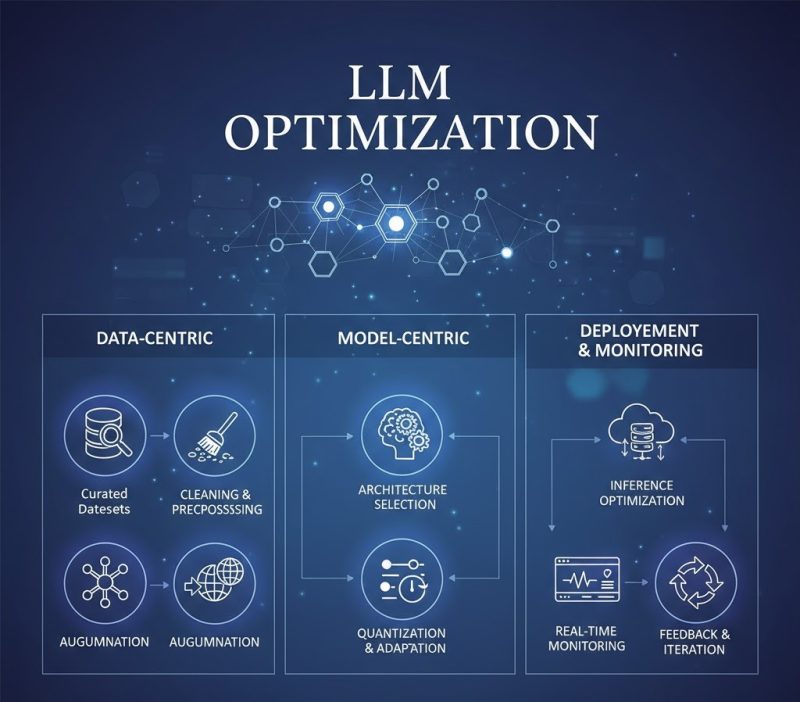
Retrieval-Augmented Generation (RAG) models can also pull live information from the web in real time. LLMO involves influencing both of these information sources so that the AI views your brand as a credible and relevant entity for specific topics.
The goal is to move from simply being an option in a list of blue links to becoming the answer.
Why LLM Optimization Is No Longer Optional
Ignoring LLMO is like refusing to build a website two decades ago. AI-powered search is not a fleeting trend; it’s a fundamental shift in how people access information and make decisions. Here’s why getting ahead with LLMO is critical for survival and business growth.
- Future-Proofs Your Brand’s Visibility: As more users turn to AI for answers, visibility in traditional search results will decline. LLMO ensures you remain part of the conversation, capturing attention where it’s increasingly focused.
- Gains a Powerful First-Mover Advantage: The LLM landscape is still new. By establishing your brand as an authority now, you build a “reputational moat” that makes it harder for competitors to catch up. Early mentions create a compounding effect, as LLMs often reference and reinforce information they already trust.
- Increases Brand Recommendations and Revenue: LLMs don’t just provide information; they make recommendations. When a user asks, “What’s the best CRM for a small business?” and the AI mentions your product, that’s a high-intent endorsement that directly influences purchasing decisions and drives revenue.
- Generates High-Quality Referral Traffic: Many LLMs, particularly those using RAG technology, cite their sources with direct links. Appearing as a cited source not only boosts your credibility but also sends highly qualified referral traffic to your site from users seeking more in-depth information.
- Enhances Your SEO Efforts by Proxy: The strategies that work for LLMO creating high-quality content, building topical authority, and earning mentions on reputable sites are the same principles that fuel strong SEO. Optimizing for LLMs inherently strengthens your organic search performance.
Failing to engage with LLMO means you are allowing AI to define your brand for you, or worse, to ignore it completely.
How to Optimize for Large Language Models: 10 Actionable Strategies
Optimizing for LLMs is not a one-size-fits-all solution; it demands a comprehensive, multi-faceted approach. This involves strategically blending time-tested classic SEO principles, such as technical optimization, robust keyword research, and strong backlink profiles with innovative, AI-focused tactics specifically designed for how large language models process and synthesize information.
By integrating these two powerful methodologies, the goal is to position your brand as an “AI favorite,” meaning your content is consistently recognized and prioritized by AI models as a reliable, authoritative source of information.
To achieve this crucial advantage in the evolving digital landscape, here are ten powerful strategies to make your brand a go-to for AI.
1. Master E-E-A-T: The Foundation of Trust
E-E-A-T—Experience, Expertise, Authoritativeness, and Trustworthiness—is Google’s quality benchmark, and it’s just as crucial for LLMs. AI models are designed to prioritize information from sources that demonstrate deep knowledge and credibility.
- Show, Don’t Just Tell: Showcase firsthand experience. Instead of writing a generic article about a product, feature case studies, user testimonials, and detailed reviews.
- Lean on Experts: Feature contributions from recognized experts in your field. Author bios, credentials, and links to their professional profiles signal authority.
- Publish Original Research: Conduct your own studies, surveys, and data analysis. Proprietary data and statistics are highly citable and position you as a primary source of information.
Example in Action: Ahrefs is frequently cited by LLMs for marketing queries because their blog consistently publishes data-backed studies on topics like link building and keyword research, establishing them as an undisputed authority.
2. Build Unshakeable Topical Authority
LLMs don’t just look at a single piece of content; they assess your entire digital footprint to see if you are a true expert on a subject. Building topical authority means creating a comprehensive ecosystem of content around a core theme.
The “pillar-and-cluster” model is perfect for this.
- Pillar Page: Create one definitive, long-form guide on a broad topic (e.g., “The Ultimate Guide to Content Marketing”).
- Cluster Content: Write multiple, more specific articles that cover subtopics related to your pillar (e.g., “How to Create a Content Calendar,” “10 Tips for Writing Blog Headlines”).
- Internal Linking: Link from your cluster articles back to your pillar page and to other relevant clusters. This internal web signals to both search engines and LLMs that you have deep, interconnected knowledge on the subject.
Actionable Tips: Use tools like AnswerThePublic or browse Reddit and Quora to find all the questions your audience is asking about a topic. Create a piece of content for each one and link them all back to your central pillar guide.
3. Structure Your Content for AI Consumption
LLMs need to easily parse and understand your content. Complex, unstructured text is harder for an AI to digest and summarize.
- Use Clear Headings: Employ a logical hierarchy of H1, H2, and H3 tags to break up your content. Frame subheadings as direct questions (e.g., “What Is LLM Optimization?”) to align with user queries.
- Implement Schema Markup: Schema is a form of microdata that explicitly tells AI and search engines what your content is about. Use
FAQPageschema for Q&A sections,HowToschema for step-by-step guides, andArticleorProductschema where appropriate. - Use Lists and Tables: Bullet points, numbered lists, and tables organize information into clean, digestible formats that are easy for an LLM to “grab” and feature in a response.
4. Optimize for Conversational and Long-Tail Keywords
People talk to AI chatbots differently than they type into a search bar. Queries are often longer, more natural, and phrased as complete questions and this conversational style automatically produces long-tail keywords. These detailed, specific phrases reveal clearer intent, making it easier for businesses and search engines to understand exactly what users want. As a result, optimizing for these natural long-tail variations can significantly improve relevance, rankings, and conversions.
- Mine “People Also Ask”: Google’s “People Also Ask” boxes are a goldmine of conversational queries. Integrate these questions directly into your content as subheadings.
- Think in Questions: Frame your content strategy around answering the “who, what, where, when, why, and how” of your industry.
- Analyze Community Forums: Spend time on Reddit, Quora, and industry-specific forums. The language and questions used there are exactly how real people will query LLMs.
5. Invest in Digital PR and High-Authority Mentions
When trusted, authoritative websites mention your brand or link back to your content, these act as incredibly powerful trust signals for Large Language Models. Digital PR helps grow this recognition, and guest blogging outreach is excellent for building quick, trusted link juice.
The AI, in its process of understanding and evaluating information, learns to associate your brand with credibility, especially when it sees that other highly credible sources are actively vouching for your content or expertise. This demonstrates a broader recognition of your authority within your industry
This demonstrates a broader recognition of your authority within your industry.
- Target Commonly Cited Sites: Identify the websites that LLMs frequently cite in your niche. Use digital PR and guest posting strategies to earn mentions and links from these key sources.
- Launch Link-Worthy Campaigns: Create original research, infographics, or free tools that other sites will want to reference. This is more effective than asking for links directly.
- Be a Source for Journalists: Sign up for services like Help a Reporter Out (HARO) to provide expert quotes to journalists writing about your industry. Each mention builds your brand’s authority.
6. Dominate Your Niche on Wikipedia
Wikipedia is a significant part of the training data for many major LLMs. Having a well-sourced, neutral, and accurate Wikipedia page for your brand or key personnel can directly influence how AI perceives your entity.
- Meet Notability Guidelines: Your brand must have significant coverage in reliable, independent sources to qualify for a page. Focus on earning media coverage first.
- Maintain a Neutral Point of View: Wikipedia articles must be written from a neutral, encyclopedic tone. Avoid marketing language and stick to verifiable facts.
- Ensure Verifiability: Every claim on your page must be backed by a citation from a reputable source.
7. Become an Entity, Not Just a Keyword
LLMs think in terms of “entities” real-world objects, people, places, and concepts and the relationships between them. LLMO requires you to think beyond keywords and manage how AI perceives your brand as an entity.
- Conduct an Entity Audit: Use tools like Google’s Natural Language API or Inlinks’ Entity Analyzer to see which entities are associated with your brand and content.
- Build Strong Associations: Through your content and PR efforts, consistently build connections between your brand entity and your core topics. For example, if you sell running shoes, you want the entity “Nike” to be strongly associated with entities like “marathon running,” “foot support,” and “athletic performance.”
8. Encourage and Manage User-Generated Content (UGC)
LLMs are increasingly trained on forum discussions and reviews from platforms like Reddit and Quora. Positive, authentic conversations about your brand to maintain communication in these communities can significantly boost your LLM visibility.
- Build a Community: Actively participate in relevant subreddits. Host “Ask Me Anything” (AMA) sessions with your company leaders to build trust and generate authentic brand content.
- Encourage Reviews: A steady stream of positive online reviews on sites like G2, Capterra, or Trustpilot reinforces your brand’s reputation.
- Manage Your Online Reputation: Respond quickly and professionally to all reviews, both positive and negative. How you handle feedback tells both customers and LLMs a lot about your brand’s trustworthiness.
9. Create Multi-Format Content
AI models are rapidly evolving, with a clear trend towards increased multimodality. This means they are no longer limited to processing just text; instead, they are becoming proficient at understanding and integrating information from various data types, including text, images, and videos.
This capability allows them to grasp a more comprehensive and nuanced understanding of content, much like humans do.
Incorporate Rich Media: Don’t just rely on text. Embed relevant images, infographics, and videos into your articles. This provides more context and “hooks” for the AI to understand your topic.
- Optimize Your Visuals: Use descriptive alt text for images and provide transcripts for videos. This makes your visual content accessible and understandable to AI crawlers.
10. Provide Direct Feedback to LLMs
Most large language models (LLMs) come equipped with an integrated feedback mechanism, often presented as simple icons like a thumbs-up or thumbs-down button. It is highly recommended that you actively utilize this feature whenever you interact with these models.
- Reinforce Good Answers: If an LLM provides an accurate and positive mention of your brand, give it a thumbs-up. This reinforces the correct association.
- Correct Bad Answers: If you see inaccurate information about your brand or a competitor being unfairly promoted, provide corrective feedback. While it won’t change things overnight, this feedback is used to fine-tune future versions of the model.
Measuring Success: How to Track Your LLM Optimization Efforts
Unlike SEO, which has established metrics like rankings and traffic, LLMO tracking is still an emerging discipline. However, you can use a combination of tools and methods to measure your visibility.
- Share of Voice (SOV) Tracking: Use emerging LLM tracking tools (like those in development by Ahrefs, Semrush, and Ubersuggest) to monitor how often your brand is mentioned or cited for a set of high-intent queries compared to your competitors.
- Referral Traffic Analysis: In Google Analytics 4 (GA4), create custom reports to isolate traffic coming from known LLM domains (e.g.,
chat.openai.com). This shows you which content is successfully earning citations. - Branded Search Volume: Monitor your branded search traffic in Google Search Console. An increase can indicate that more people are discovering your brand in LLM responses and then searching for you directly to learn more.
- Manual Polling: Regularly ask a set of important, high-value questions to various LLMs and manually track when your brand and competitors appear. While not scalable, this provides valuable qualitative insights.
Your Next Move: Winning the Future of Search
LLM Optimization is not a “set it and forget it” task. It’s an ongoing strategic commitment that weaves together content, technical SEO, and public relations. The brands that will dominate the next decade are the ones that embrace this shift today, treating LLMs not as a threat, but as the single greatest opportunity for brand building and customer acquisition.
The path forward is clear: build trust and brand awareness, demonstrate authority, structure your knowledge, and engage with your audience wherever they are. By following the strategies outlined in this guide, you can move beyond just ranking in search results and become the definitive answer your customers are looking for.
The age of AI is here, and the race for visibility has already begun.