Let’s be honest. Pricing is one of the hardest things to get right in business.
Price too high, and you scare away potential customers. Price too low, and you leave money on the table, or worse, destroy your brand’s perceived value. It’s a tightrope walk that can make or break your company.

Most businesses guess their pricing. They look at a competitor, knock off 10%, and call it a day. That’s not a strategy; it’s a race to the bottom.
So, how do the big players do it? How does Apple command premium prices for iPhones while a competitor with similar specs struggles? How does Amazon dynamically change millions of prices every single day? It’s not magic. It’s strategy.
Here, I’m going to break down everything you need to know about pricing strategies. We’ll go from the basic models to the advanced psychological tricks the pros use.
By the end, you’ll have a clear framework to stop guessing and start pricing for maximum profit and growth.
What is the Pricing Strategy in Marketing?
Pricing strategy in marketing is the art and science of determining the right price to balance value for customers and profitability for the business. At its core, it’s about understanding your target audience, competitors, and market demands. For instance, Apple uses a value-based pricing strategy, leveraging their brand and innovation to justify higher prices.
By contrast, companies like Walmart adopt a penetration pricing strategy, aiming to attract price-sensitive customers with everyday low prices. Psychological pricing like $9.99 instead of $10 plays on consumer perceptions, subtly influencing buying decisions.
Dynamic pricing, powered by data, allows companies like Amazon to adjust prices in real time based on supply and demand. Every approach builds a narrative, turning price into a strategic driver of business growth.
Importance of Pricing Strategy in Marketing
Before we dive into the “how,” let’s talk about the “why.” Many marketers focus on traffic, leads, and conversions. Those are all crucial, but pricing multiplies the effect of everything else you do.
Think about it. A 1% improvement in price can increase your operating profit by 11.1%. That’s more impact than a 1% improvement in fixed costs (2.3%) or even sales volume (3.3%). This isn’t just a random stat; it’s from a classic study by McKinsey, and it holds true today. Pricing has a massive, direct impact on your bottom line.
Your price communicates your brand’s value. It positions you in the market. It defines your target customer. It’s not just a number on a tag; it’s the sum of your product, your brand, and your market perception, all rolled into one. Get it right, and you create a flywheel of growth. Get it wrong, and you’re fighting an uphill battle.
Ready to get it right? Let’s start with the foundational business models.
Types of Pricing Strategy in Marketing: Foundational Pricing Models
Most pricing strategies, no matter how complex they seem on the surface, are fundamentally built on one of four core pillars.
Grasping these foundational models is the crucial first step toward developing a more nuanced and sophisticated pricing approach that fits your specific business needs.
1. Cost-Plus Pricing (The “Safe” Bet)
This is the most straightforward model. You calculate the total cost to produce your product or service (your Cost of Goods Sold, or COGS), and then you add a percentage markup to get your selling price.
Formula: Selling Price = Cost of Product + Markup
For example, if it costs you $50 to manufacture a widget and you want a 50% markup, your price would be $75 ($50 + 50% of $50).
When to Use It:
- Manufacturing and Retail: Where costs are clear and predictable.
- Government Contracts: Often required for transparency.
- When you’re starting out: It’s simple and ensures you cover your costs.
The Downside: This model is completely internally focused. It ignores what customers are willing to pay and what competitors are charging. You could be pricing way too low if your product delivers massive value, or too high if the market won’t support it. It’s safe, but “safe” rarely leads to explosive growth.
Actionable Tip: Even if you use this model, calculate your costs meticulously. Include not just direct materials but also labor, shipping, and a portion of your overhead. The more accurate your cost base, the smarter your pricing decision.
2. Competitor-Based Pricing (The Market Follower)
This is the “look over your neighbor’s shoulder” approach. You research what your direct competitors are charging and set your prices in relation to theirs. You can price slightly lower, the same, or slightly higher.
How to Do It:
- Identify Key Competitors: Who are the top 3-5 players your customers compare you to?
- Analyze Their Pricing: Document their prices for comparable products. Don’t just look at the list price; check for discounts, bundles, and different tiers.
- Position Yourself: Decide where you want to fit. Are you the budget option, the premium alternative, or on par with the market leader?
When to Use It:
- Highly Saturated Markets: Think smartphones, airlines, or gasoline. Prices are a primary decision factor for consumers.
- When products are highly similar: If there’s little differentiation, price becomes a key battleground.
The Downside: This strategy ties your fate to your competitors. If they start a price war, you’re forced to join in, eroding profits for everyone. It also assumes your competitor knows what they’re doing—what if their pricing is just a guess, too? Furthermore, it distracts you from your unique value.
Actionable Tip: Use competitive analysis as a data point, not a directive. Tools like Price2Spy or SEMrush’s market analysis features can help you monitor competitor pricing automatically. Use this data to understand the market landscape, then make a decision based on your own value proposition.
3. Value-Based Pricing (The Customer-Centric Gold Standard)
This is where the magic happens. Instead of looking inward at your costs or sideways at your competitors, you look outward to your customers. Value-based pricing sets your price based on the perceived or estimated value your product or service provides to the customer.
It answers the question: “How much is solving this problem worth to my customer?”
Think about a SaaS tool that saves a company 10 hours of manual work per week for an employee earning $50/hour.
- Weekly savings: 10 hours * $50/hour = $500
- Monthly savings: $500 * 4 = $2,000
Is charging $199/month for that tool a no-brainer for the customer? Absolutely. The price is a fraction of the value delivered. That’s value-based pricing in action.
How to Implement It:
- Deeply Understand Your Customer: Identify their biggest pain points. What problem are you really solving?
- Quantify Your Value: How much time or money do you save them? How much revenue do you help them generate? How do you reduce their risk or improve their quality of life? Put a number on it.
- Communicate That Value: Your marketing and sales materials must clearly articulate this value proposition. If customers don’t understand the value, they won’t pay the price.
- Set Your Price: Price your product as a percentage of the value it provides. A common rule of thumb is the 10x rule: your product should provide at least 10 times the value of what you charge for it.
When to Use It:
- High-Value B2B Services/SaaS: Where the ROI is clear and quantifiable.
- Highly Differentiated Products: When your product is unique and offers benefits no one else can.
- Luxury Goods: The value is in the status and brand identity, not the raw materials.
The Downside: It requires significant market research. You can’t just guess your customers’ perceived value; you have to talk to them, survey them, and analyze their behavior. It’s more work, but the payoff is immense.
Actionable Tip: Run a value perception survey. Ask potential customers questions like:
- “At what price would you consider this product to be a great deal?”
- “At what price would you consider this product so expensive that you would not consider buying it?”
- “What is the most you would be willing to pay for this product?”
This is the Van Westendorp Price Sensitivity Meter, and it gives you a data-driven range for your value-based price.
4. Dynamic Pricing (The Algorithmic Approach)
Dynamic pricing involves changing prices in real-time based on supply and demand. Airlines and hotels are the classic examples. The price of a flight changes based on how many seats are left, how close it is to the departure date, and what competitors are charging.
Uber’s “surge pricing” is another famous (or infamous) example. When demand for rides outstrips the supply of drivers, the price goes up to incentivize more drivers to get on the road.
How It Works: This strategy relies on algorithms that analyze huge amounts of data: competitor pricing, demand levels, time of day, customer location, and even individual user behavior.
When to Use It:
- E-commerce: Amazon is the king of dynamic pricing, adjusting prices on millions of items.
- Travel and Hospitality: Flights, hotels, and rental cars.
- Ride-Sharing and Delivery Services: Managing real-time supply and demand.
The Downside: It can feel unfair to customers if not implemented carefully. Seeing a price change from one minute to the next can erode trust. It also requires a sophisticated data infrastructure to work effectively.
Actionable Tip: For most smaller e-commerce businesses, full-blown dynamic pricing is overkill. However, you can apply the principles. For example, you can run promotional pricing during low-demand periods (e.g., a “Tuesday slump” sale) or automatically adjust prices based on stock levels (e.g., slightly increase the price on the last 10 items in stock).
Psychological Pricing Strategy in Marketing
Once you have a baseline price from your chosen model, you can optimize it using psychological pricing. These are small tweaks that can have a big impact on how customers perceive your price and their willingness to buy.
This isn’t about tricking people. It’s about understanding how the human brain processes numbers and presenting your price in the most favorable way.
Charm Pricing: The Power of .99
The oldest trick in the book is still one of the most effective. Pricing something at $19.99 instead of $20.00 makes it feel significantly cheaper. This is called the “left-digit effect.” Our brains read from left to right and anchor on the first digit we see. “19” feels like a “teens” price, while “20” feels like a “twenties” price, even though the difference is just one cent.
A study by MIT and the University of Chicago tested a women’s clothing item at three prices: $34, $39, and $44. The item sold best at $39, even more than it did at the cheaper $34 price. The “9” ending signaled value.
Actionable Tip: Unless you are a premium luxury brand (where round numbers like $200 can signal quality), you should almost always end your prices in 9, 99, or 95. Test it for yourself.
Price Anchoring: Frame the Conversation
Price anchoring is a cognitive bias where people rely heavily on the first piece of information they receive when making a decision. You can use this to your advantage by showing a higher price first.
- “Was/Now” Pricing: “Was $199, Now Only $99.” The $199 price acts as an anchor, making the $99 price seem like an incredible deal.
- Tiered Pricing: When you present pricing plans, always lead with your most expensive option (or the one you want to highlight). For example:
- Pro Plan: $99/mo (This is the anchor)
- Plus Plan: $49/mo (Most Popular)
- Basic Plan: $19/mo
By seeing the $99 plan first, the $49 plan seems much more reasonable. Many customers will gravitate toward the middle “Most Popular” option, which is exactly what you want.
Actionable Tip: On your pricing page, list your tiers from most expensive to least expensive (left to right, or top to bottom). Use visual cues like a colored border and a “Most Popular” tag to guide customers to your preferred option.
Decoy Pricing: Making the Choice Easy
Decoy pricing is a brilliant strategy for nudging customers toward a specific option. It involves introducing a third, less attractive “decoy” option to make one of your other options look like a much better deal.
The Economist famously used this:
- Web-only subscription: $59
- Print-only subscription: $125
- Web + Print subscription: $125
Which would you choose? Almost nobody chose the “Print-only” option. It was a decoy. Its purpose was to make the “Web + Print” subscription look like a fantastic deal. For the same price as print-only, you get web access for free!
Without the decoy, the choice would be between $59 (web) and $125 (web + print). Many people would opt for the cheaper $59 plan. The decoy option dramatically shifted sales toward the more expensive $125 package.
Actionable Tip: Look at your pricing tiers. Can you introduce a decoy to make your target plan seem irresistible? If you have a “Standard” plan for $49 and a “Pro” plan for $99, consider adding a “Basic Plus” plan for $89 that has only slightly more features than the Standard plan. This makes the leap to the Pro plan for just $10 more seem like a great value.
Analysis Paralysis: The Danger of Too Many Choices
While tiers are great, too many options can overwhelm customers and lead to “analysis paralysis,” where they get so confused they don’t buy anything.
A famous study showed that a jam tasting booth with 24 flavors attracted more visitors, but the booth with only 6 flavors resulted in 10 times more sales. Fewer options made the decision easier.
Actionable Tip: Stick to 3-4 pricing tiers. Any more than that and you risk confusing your customers. Make the differences between the tiers crystal clear. Each tier should be designed for a specific customer persona (e.g., “For Freelancers,” “For Small Teams,” “For Enterprises”).
Advanced Strategies for Growth and Profitability
Once you’ve mastered the fundamentals, you can begin to incorporate more advanced strategies to further refine your pricing approach and align it with your specific business objectives. This could involve adjusting prices to target different customer segments, responding to market trends, or optimizing for profitability in specific product lines.
By building on the basics, these advanced techniques allow you to fine-tune your pricing to better support your unique goals and adapt to the evolving needs of your business.
Freemium: Hook Them with Free
The freemium model offers a basic version of your product for free, forever, with the hope that a percentage of free users will upgrade to a paid plan for more advanced features.
This is a powerful user acquisition strategy. Companies like Spotify, Dropbox, and HubSpot have built massive user bases with freemium.
Pros:
- Lowers Barrier to Entry: Anyone can try your product without risk.
- Viral Potential: Free users can become brand advocates.
- Creates a Large Top-of-Funnel: You build a huge email list and user base to market to.
Cons:
- High Cost: You have to support all those free users, which costs money.
- Low Conversion Rate: Typically, only 2-5% of free users convert to paid.
- Can Devalue Your Product: If the free version is “too good,” there’s no incentive to upgrade.
Actionable Tip: To make freemium work, the line between free and paid must be deliberate. The free plan should solve a small problem perfectly, but the paid plan must solve a much bigger, more painful problem. The value metric is key. For Dropbox, it’s storage space. For Mailchimp, it’s contacts or sends. When users hit that limit, the upgrade becomes necessary.
Penetration Pricing Strategy in Marketing: Grab Market Share Fast
Penetration pricing involves setting a very low initial price to quickly attract a large number of customers and gain market share. The goal is not immediate profit, but rapid adoption with proven penetration strategy. Once a strong customer base is established, the price can be gradually increased.
Streaming services are a great example. Disney+ and Peacock launched with very low monthly prices to compete with Netflix and build a subscriber base quickly.
When to Use It:
- Launching into a competitive market.
- When your business model relies on network effects (the more users, the more valuable the service).
- When you have a strong lifetime value (LTV) and can afford to lose money upfront.
The Danger: It can attract bargain-hunters who will leave as soon as the price goes up. It also sets a low price anchor, making it difficult to raise prices later without customer backlash.
Skimming Pricing Strategy in Marketing: Maximize Revenue from Early Adopters
This is the opposite of penetration pricing. Price skimming involves launching a new product at a very high price and gradually lowering it over time. This strategy aims to “skim” the maximum revenue from different segments of the market.
Apple is the master of this. A new iPhone launches at a premium price, capturing all the early adopters and die-hard fans who are willing to pay a premium. Months later, as demand from that segment wanes, the price is subtly dropped (or older models are discounted) to attract the more price-sensitive mainstream market.
When to Use It:
- For innovative, high-demand tech products.
- When you have a strong brand and little initial competition.
- When the product has a short life cycle.
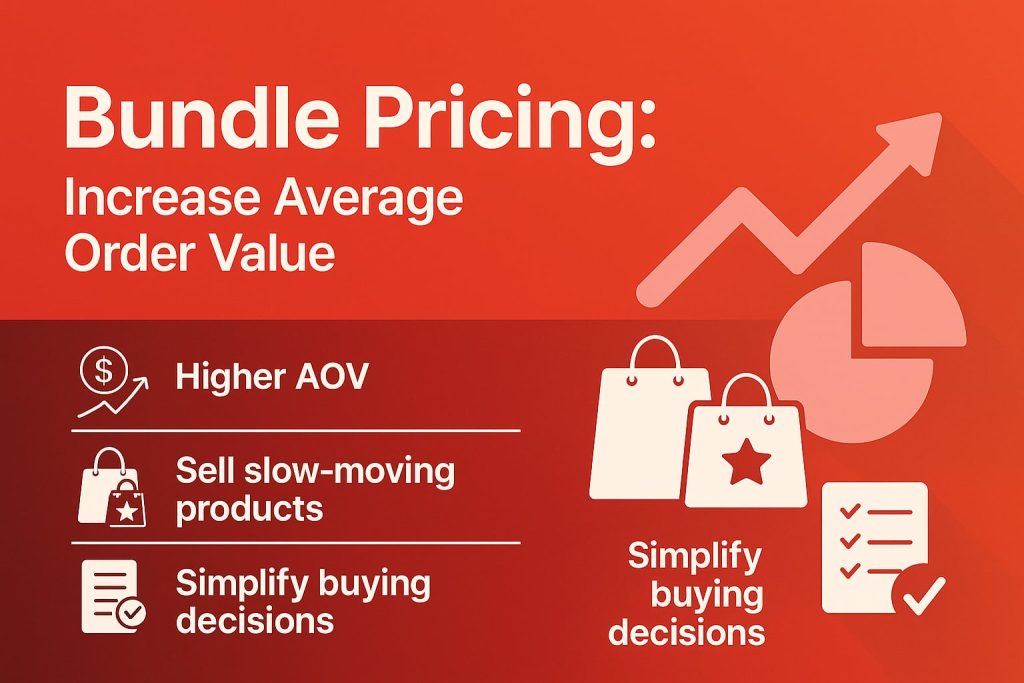
Bundle Pricing: Increase Average Order Value
Bundling refers to the practice of selling multiple products or services together as a single package, often at a discounted price compared to purchasing each item separately. This strategy is widely used to incentivize customers to buy more while perceiving greater value.
A well-known example is McDonald’s “Extra Value Meal,” where items like a burger, fries, and a drink are combined into one convenient package at a lower cost than ordering each item individually. This approach not only simplifies decision-making for customers but also encourages them to purchase additional items they might not have chosen on their own.
Benefits:
- Increases Average Order Value (AOV): Customers spend more per transaction.
- Sells Less Popular Products: You can package a slow-moving item with a bestseller.
- Simplifies the Buying Decision: A well-designed bundle can feel like the “complete solution.”
Actionable Tip: Create bundles that make sense. Don’t just randomly throw products together. Create a “Starter Kit” for new customers or a “Pro Bundle” for power users. Your bundle should solve a complete problem. For example, a camera bundle might include the camera, a lens, a memory card, and a bag—everything a new photographer needs to get started.
Putting It All Together: Your 5-Step Pricing Strategy Framework
Feeling overwhelmed by all these pricing options? It’s easy to see why, but don’t be. Building a pricing strategy doesn’t have to be a daunting task
Here’s a straightforward, step-by-step framework to help you construct your pricing strategy from the ground up, ensuring it aligns perfectly with your business.
Step 1: Define Your Business Goals
What are you trying to achieve? Your pricing strategy should align with your core business objectives.
- Goal: Maximize Profit: A value-based pricing or price skimming strategy might be best.
- Goal: Gain Market Share: Penetration pricing could be the right move.
- Goal: Drive User Acquisition: A freemium model is a strong contender.
Step 2: Understand Your Costs (Your Price Floor)
Calculate your Total Cost of Goods Sold (COGS) and your overhead. This number is your absolute price floor. You cannot price below this in the long run without going out of business. This is your reality check.
Step 3: Analyze Your Competitors and the Market (Your Price Range)
Research your top competitors. What are they charging? How do they position themselves? This analysis doesn’t dictate your price, but it gives you context. It helps you understand customer expectations and define the general price range for your product category.
Step 4: Talk to Your Customers and Quantify Your Value (Your Price Ceiling)
This is the most critical step. Conduct surveys, interviews, and focus groups. Use methods like the Van Westendorp analysis to understand the perceived value of your solution.
- What is the ROI of your product?
- How much is solving their pain point worth to them?
This value becomes your price ceiling—the maximum you can realistically charge.
Step 5: Choose Your Model, Set Your Price, and Test
You now have a floor (your costs), a range (the market), and a ceiling (customer value).
- If you’re in a commodity market, you’ll price closer to the market range (competitor-based).
- If you have a unique, high-value product, you’ll price closer to your ceiling (value-based).
Once you’ve chosen your model (e.g., value-based) and tactics (e.g., tiered pricing with a decoy and charm pricing), set your price.
But don’t stop there. Pricing is not a “set it and forget it” activity. You must continually test and iterate.
- A/B Test Prices: Test $49/mo vs. $59/mo on your website and see which one generates more total revenue (not just conversions).
- Monitor Your Metrics: Keep a close eye on conversion rates, churn, average revenue per user (ARPU), and customer lifetime value (LTV).
- Review Annually: Your costs, your competitors, and the value you provide will all change over time. Your pricing should, too. Review and adjust your pricing at least once a year.
Conclusion: Pricing is a Process, Not a Project
Pricing isn’t just about picking a number. It’s a strategic process that sits at the heart of your business to grow. It’s a powerful statement about who you are, what you’re worth, and who you serve.
By moving away from simple cost-plus or competitor-following models and embracing a value-centric approach, you unlock massive potential for growth. By layering on psychological buyer principles, you can make your value proposition even more compelling.
The perfect price doesn’t exist. But a smarter, more profitable, and data-driven pricing strategy is within your reach. Start with understanding your costs, research your market, and, most importantly, talk to your customers. Their perception of value is your most important guide.
Stop guessing. Start strategizing. Your bottom line will thank you for it.