Google’s search results page is undergoing its most significant transformation in over two decades.
The familiar list of ten blue links is making way for something far more dynamic, conversational, and intelligent: the Search Generative Experience, or SGE.
This AI-powered evolution isn’t just a new feature; it’s a fundamental shift in how information is found and consumed. For brands, digital marketers, and SEO professionals, understanding and adapting to this change is not just recommended, it’s critical for survival.

This article will serve as your comprehensive guide to navigating the new landscape of search. We will explore what SGE is, how it functions behind the scenes, and the profound impact it has on traditional SEO. We’ll also break down the new components of the search results page, from AI Snapshots to conversational prompts, and provide actionable strategies to ensure your brand remains visible and relevant in the age of generative AI.
What is Search Generative Experience (SGE)?
Search Generative Experience is Google’s integration of generative artificial intelligence directly into its search results. Instead of simply providing a list of links for you to sift through, SGE aims to provide a direct, comprehensive answer to your query at the very top of the page. This answer, known as an “AI Snapshot,” is a synthesized summary generated in real-time from multiple web sources.
Think of it as having a research assistant who reads the top articles on a topic and gives you the key points in a concise, easy-to-digest format. SGE is designed to handle complex, multi-step queries that would have previously required multiple searches. For example, instead of searching for “best hiking trails near me,” then “what to pack for a day hike,” and finally “kid-friendly restaurants near hiking trail,” you could ask SGE: “What are some good kid-friendly hiking trails near me, and what should I pack for a day trip?”
The AI would then generate a detailed snapshot that combines all of this information, complete with links to the sources it used.
This fundamentally changes the user’s journey, moving from a process of discovery through clicks to one of immediate gratification through a single, synthesized answer.
How SGE Works: The Engine Behind the Answers
To understand how to adapt to SGE, you must first understand how it works. SGE is powered by Google’s advanced large language models (LLMs), which are part of a broader AI framework. The process of generating an AI Snapshot involves several sophisticated steps.
Understanding User Intent
The first step is deciphering what the user truly wants. SGE’s underlying AI is highly proficient at understanding natural language and complex intent. It can interpret nuance, context, and the implicit questions within a query.
When you ask a question, the model analyzes the semantics to grasp the core informational need, even if the query is conversational or poorly phrased. It determines whether you’re looking for information, a product, a location, or a combination of these.
Information Retrieval and Synthesis
Once SGE understands your query, it doesn’t just “think” of an answer. Instead, it performs a rapid, large-scale search across its vast index of the web to find relevant, high-quality information. It identifies the most authoritative and trustworthy pages related to the topic. This is a crucial point: SGE still relies on the existing content of the internet. It is not creating information from scratch.
The model then reads and processes the content from these top-ranking sources. It identifies key facts, figures, opinions, and instructions. The final and most impressive step is synthesis. The AI weaves the information from these disparate sources into a single, coherent, and original narrative the AI Snapshot. It organizes the information logically, attributes the sources with clickable links, and presents it in a structured format.
The Role of Google’s Search Quality Rater Guidelines
Google’s AI models are trained to prioritize information that aligns with its long-standing Search Quality Rater Guidelines, which emphasize Experience, Expertise, Authoritativeness, and Trustworthiness (E-E-A-T).
- Experience: The content should demonstrate firsthand experience with the topic. For a product review, this means the author has actually used the product.
- Expertise: The content is created by someone with demonstrable knowledge in the field. A medical article should be written or reviewed by a medical professional.
- Authoritativeness: This refers to the overall reputation of the creator, the website, and the content itself. It’s about being a recognized authority in your niche.
- Trustworthiness: This is the most important factor. Users need to trust the content they are reading. This involves citing sources, having a secure website (HTTPS), and being transparent about who you are.
SGE is designed to favor content that excels in these areas. Therefore, creating high E-E-A-T content is more important than ever for being featured in an AI Snapshot.
The Transformation of SEO: How Ranking Signals are Shifting
For years, SEO has been a game of ranking for keywords to earn clicks. SGE disrupts this model entirely. While traditional ranking factors are not obsolete, their importance and function are evolving.
The goal is shifting from simply ranking #1 to becoming a trusted source for Google’s AI.
From Keywords to Concepts and Entities
Traditional SEO often involves a laser focus on specific keywords and keyword research is the fundamental of SEO growth. With SGE, the focus is broadening to concepts and entities. An “entity” is a specific person, place, organization, or thing that Google understands. For example, “Apple” is an entity that can refer to the tech company or the fruit, and Google uses context to differentiate them.
To be featured in SGE, your content must be structured around entities and the relationships between them. This means creating comprehensive content that covers a topic in its entirety, not just a single keyword. You need to answer all the related questions a user might have about a topic. This approach, known as topic clustering, aligns perfectly with how SGE gathers and synthesizes information.
The Rise of Zero-Click Searches
One of the biggest concerns for marketers is the potential increase in “zero-click searches.” Since SGE provides a direct answer on the results page, users may have no reason to click through to a website. If their question is fully answered in the AI Snapshot, their search journey ends there.
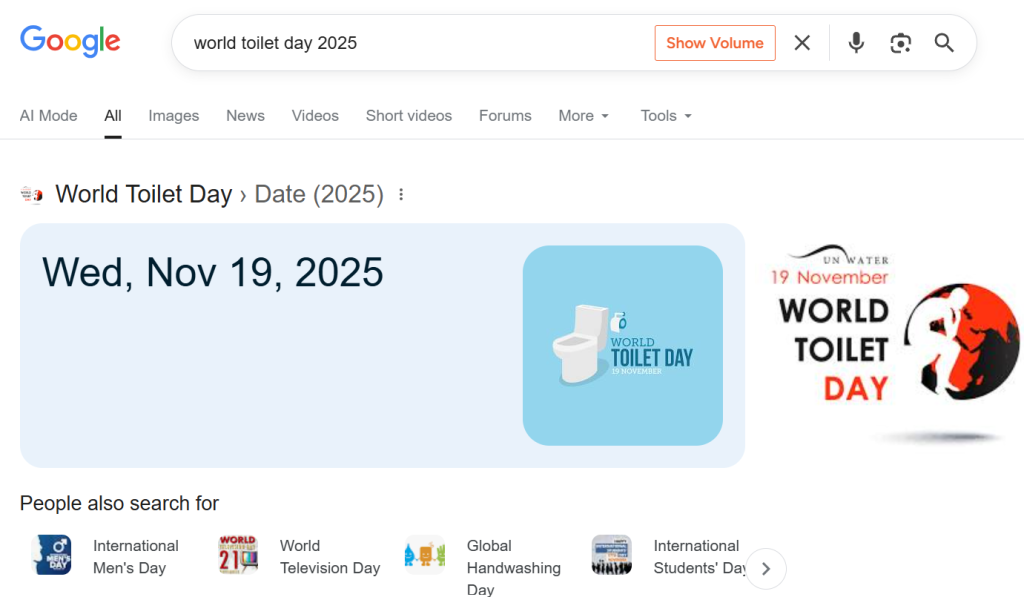
World Toilet Day 2025 — you can easily look it up on Google. This is ZERO click search
This presents a major challenge for businesses that rely on organic traffic for leads and revenue. However, it also presents an opportunity. While overall traffic may decrease for some informational queries, the traffic that does come through is likely to be more qualified.
A user who clicks a link within or after an AI Snapshot is probably seeking deeper information, indicating higher intent.
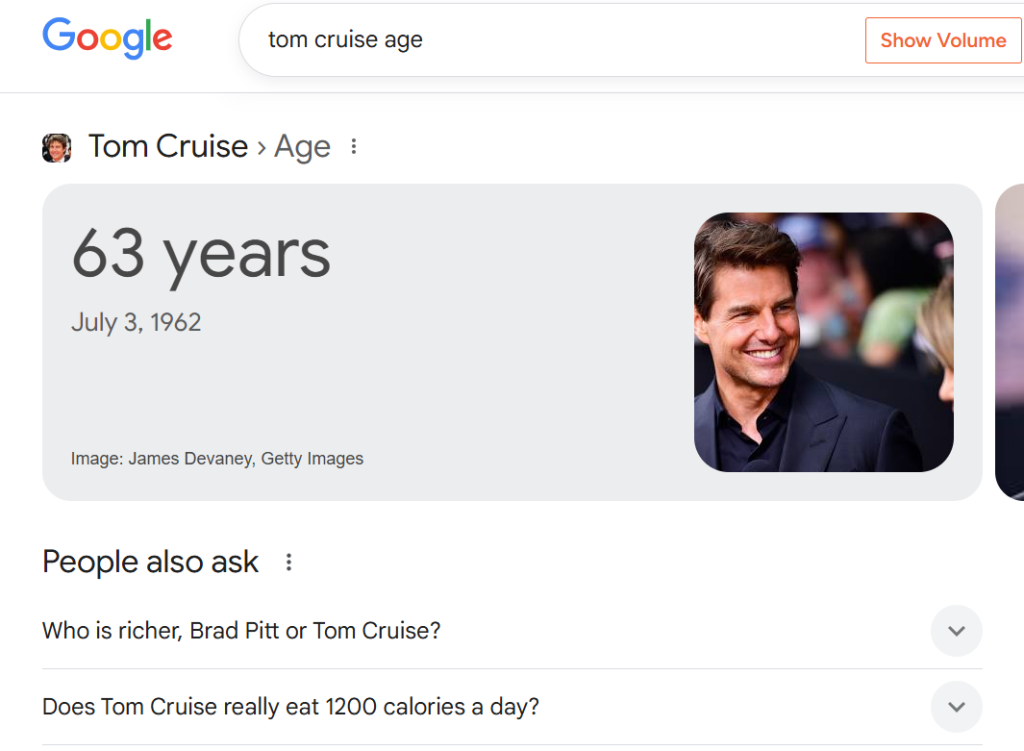
Searching Celebrity Age, net worth income etc types of ZERO search
Furthermore, being featured as a source within an AI Snapshot builds immense brand authority and trust, even if it doesn’t result in a direct click. Your brand becomes associated with the correct answer, which is a powerful form of marketing.
The New Importance of Structured Data
Structured data, or schema markup, is code that you can add to your website to help search engines understand your content more effectively. While it has always been an SEO best practice, its importance is amplified with SGE.
By using structured data for products, reviews, events, articles, and FAQs, you are essentially pre-packaging your information in a way that is easy for Google’s AI to parse and process. This can significantly increase your chances of being included in an AI Snapshot, especially for commercial or specific informational queries. Clear, well-structured data makes your content an ideal source for the generative model.
Marketing in the SGE Era: What You Need to Know
Adapting your marketing strategy for SGE requires a new way of thinking about content, user behavior, and the search results page itself. Let’s break down the new elements and how to approach them.
Mastering the AI Snapshot
The AI Snapshot is the main event of the SGE results page. Getting your content featured here should be a primary goal.
- How to Get Featured:
- Answer Questions Directly: Structure your content to provide clear, concise answers to common questions. Use headings formatted as questions (e.g., “How Does SGE Work?”) followed by a direct answer.
- Focus on E-E-A-T: As mentioned, produce content that showcases your experience, expertise, authority, and trustworthiness. Include author bios, cite credible sources, and display customer testimonials.
- Use Data and Statistics: SGE often pulls specific facts and figures into its summaries. Including well-researched data in your content makes it a more attractive source for the AI.
- Create Comprehensive Guides: Long-form content that covers a topic from multiple angles is more likely to be used as a source than a short, superficial article. Think of your content as the ultimate resource on a subject.
Leveraging Follow-Up Prompts
Below the AI Snapshot, SGE often suggests follow-up questions or prompts, encouraging users to continue the conversation. This feature is designed to guide the user deeper into their informational journey.
- Strategic Importance: These prompts reveal what Google’s AI considers to be logically related topics. Analyzing these suggestions is like getting direct insight into how Google connects concepts.
- How to Adapt:
- Anticipate the Next Question: When creating content, think about what the user will want to know next. If your article is about “how to bake sourdough bread,” anticipate follow-up questions like “how to care for a sourdough starter” or “common sourdough baking mistakes.”
- Incorporate Follow-Up Questions into Your Content: Use these anticipated questions as H2s or H3s within your articles. This creates a comprehensive resource that satisfies the entire user journey, making your page a one-stop-shop for the AI.
Understanding Contextual Summaries and Conversational Search
SGE maintains context throughout a search session. If you ask a follow-up question, it remembers your initial query and uses that context to provide a more relevant answer. This enables a truly conversational search behavior, where users can refine their search through dialogue.
For example, after a search for “best laptops for video editing,” a user might follow up with, “which of those are under $1500?” SGE understands that “those” refers to the laptops from the previous query.
- Impact on Content Strategy: Your content needs to be organized logically to support this conversational flow. Each piece of content should not exist in a vacuum. Instead, it should be part of a larger, interconnected web of information on your site.
- How to Win:
- Build Topic Clusters: Create a “pillar page” for a broad topic (e.g., “Digital Marketing”) and surround it with “cluster pages” that delve into specific subtopics (e.g., “SEO,” “Content Marketing,” “PPC Advertising”). Link these pages together intelligently. This structure mirrors the way SGE connects ideas and makes your entire website a more authoritative source.
- Optimize for Long-Tail, Conversational Keywords: People are more likely to use full sentences and natural language when interacting with SGE. Optimize your content for these longer, more specific queries. Use tools to find out what questions people are actually asking about your industry.
Why Brands Must Adapt Immediately
Waiting to see how SGE plays out is not a viable strategy. The foundational elements of this new search experience are already being integrated, and early adopters will gain a significant competitive advantage. Brands that adapt now will be positioning themselves to become the authoritative sources that Google’s AI trusts and features.
The shift to SGE will likely reduce the total volume of organic traffic for many websites. The competition will no longer be about getting a click from a list of ten links; it will be about being the source for the single answer Google provides. The visibility and building topical authority that come from being featured in an AI Snapshot will be immensely valuable, driving more qualified leads and establishing your brand as a leader in your field.
Brands that fail to adapt risk becoming invisible. If your content is not optimized for AI consumption—if it lacks E-E-A-T, is not comprehensive, and isn’t structured logically—Google’s generative model will simply pass it over in favor of a competitor’s content that is. In the SGE era, relevance is defined by your usefulness to the AI.
Conclusion: Your Action Plan for the Future of Search
The Search Generative Experience is more than just an update; it’s the beginning of a new chapter for digital marketing. While it presents challenges, it also offers incredible opportunities for brands willing to evolve. The future of SEO is less about technical tricks and more about creating genuinely valuable, authoritative, and human-centric content.
Here are your key takeaways and next steps:
- Prioritize E-E-A-T: Double down on creating content that proves your experience, expertise, authoritativeness, and trustworthiness. This is your ticket to being featured by the AI.
- Think in Topics, Not Just Keywords: Build comprehensive topic clusters that cover a subject from every angle. Anticipate and answer every potential question a user might have.
- Optimize for Conversational Queries: Embrace long-tail keywords and structure your content to answer questions directly and conversationally.
- Implement Structured Data: Use schema markup to make it as easy as possible for Google’s AI to understand and categorize your content.
- Analyze SGE Features: Pay close attention to the AI Snapshots and follow-up prompts in your industry. Use them as a guide for your content strategy.
The principles of good marketing have not changed. Providing value and building trust are still at the core of what we do. SGE simply raises the bar, demanding higher quality and greater authority than ever before. By embracing this change and focusing on creating the best possible content on the web, you can ensure your brand not only survives but thrives in the new era of search.