In the world of Software-as-a-Service, a great product isn’t always enough to guarantee success. With countless competitors often just a click away, how does a SaaS company stand out? The answer lies in a powerful, intentional brand.

This is more than just a memorable logo or a catchy name; it’s the entire experience and perception customers have of your company. It’s what makes them choose you, trust you, and stay with you. Understanding the importance of branding is crucial, as it’s how brands communicate with consumers at every touchpoint.
Let me guide you through the essentials of building a formidable SaaS brand. We will explore why branding is a non-negotiable for long-term business growth, dive deep into the specific strategies that work, and show you how to measure your success.
Meanwhile let’s build a brand that not only attracts customers but turns them into loyal advocates.
The Importance of SaaS Branding
In a crowded marketplace, branding is the North Star that guides your company. For SaaS businesses, it’s not a “nice-to-have” marketing function; it’s a core business asset that drives sustainable growth.
A strong brand fundamentally shapes how potential customers perceive your software before they even sign up for a trial. It builds the foundation for trust, sets you apart from a sea of similar solutions, and ultimately impacts your bottom line.
Building Customer Trust in an Intangible World
When customers buy software, they aren’t just purchasing lines of code. They are investing in a solution to their problems, a tool to make their work easier, and a partner for their business goals. Unlike a physical product, they can’t touch or hold it. This is where brand trust becomes paramount. A consistent and professional brand signals reliability and quality. It tells customers that you are a stable, trustworthy company that will be there to support them, secure their data, and continuously improve the product.
Think of Slack. Its brand isn’t just about its logo; it’s about the promise of a more productive and collaborative workday. This promise is delivered through a user-friendly interface, a helpful tone of voice, and reliable performance. This consistency builds an incredible amount of trust, making businesses feel confident integrating Slack into their core operations. Without that trust, asking a company to migrate its internal communications to your platform would be an impossible task.
Differentiation in a Crowded Market
How many project management tools can you name? How many CRMs?
The SaaS market is saturated with companies offering similar features and functionalities. In this environment, competing on features alone is a race to the bottom. Someone will always be able to copy your new feature or undercut your price. Your brand is your most defensible competitive advantage.
A strong brand differentiates you on an emotional branding strategy and psychological level. It gives you a unique personality and a story that resonates with a specific audience. Mailchimp, for example, stood out in the email marketing space by being quirky, friendly, and approachable. While competitors were corporate and technical, Mailchimp used its mascot, Freddie, and a playful brand voice to appeal to small businesses and creatives who felt intimidated by other platforms. This brand identity, not just its features, allowed it to carve out a massive and loyal customer base.
Fueling Long-Term Growth and Loyalty
Finally, effective branding is a powerful engine for long-term growth. A memorable brand reduces customer acquisition costs over time. As brand awareness grows, you become the default choice in your category, relying less on paid advertising and more on organic traffic and word-of-mouth referrals. People search for your brand by name, a clear indicator of strong brand equity.
Furthermore, branding fosters customer loyalty. Customers who connect with your brand’s mission and values are more likely to stick around, even when a cheaper competitor emerges. They become advocates, recommending your software to their network and providing valuable feedback.

This creates a virtuous cycle: a strong brand attracts great customers, who in turn help strengthen the brand. For a SaaS business built on recurring revenue, this loyalty is the key to sustainable profitability and long-term success.
Top 7 Branding Strategies for SaaS Companies
Building a powerful SaaS brand takes more than just a great product—it demands a deliberate and multi-faceted approach that connects with users on every level. At its core, it’s about creating a cohesive and authentic identity that extends into every touchpoint of your business in branding. This means everything from the design of your product’s user interface, which should be intuitive and visually aligned with your brand, to the tone of your customer support emails, which must reflect your values and build trust.
The most successful SaaS companies understand that a strong brand isn’t just about recognition, it’s about building an emotional connection with users and consistently delivering an experience that wins hearts, earns trust, and captures markets.
Here are the essential strategies these companies rely on to create brands that stand out and resonate deeply with their audiences.
1. Find Your Unique Position in the Market
Positioning is the act of defining where your brand fits in the market and in the minds of your target customers. It’s the foundation upon which all other branding efforts are built.
A clear brand positioning statement answers three critical questions: Who is your customer? What unique value do you provide? Why are you different from the alternatives?
To find your position, you must first deeply understand your ideal customer profile (ICP). Go beyond basic demographics. What are their biggest pain points? What are their professional aspirations? What other tools do they use? Once you know who you’re talking to, you can analyze your competitors. Don’t just look at their features; analyze their brand messaging, their target audience, and their pricing. Look for gaps in the market. Is everyone targeting large enterprises? Perhaps there’s an opportunity to serve small businesses. Is everyone focused on being the “all-in-one” solution? Maybe you can win by being the best at one specific thing.
Example: Look at the CRM space. Salesforce positioned itself as the comprehensive, enterprise-grade solution for large sales teams. This left a gap for a simpler, more user-friendly tool for small and medium-sized businesses. HubSpot filled that gap perfectly, positioning itself as an all-in-one growth platform built on the philosophy of inbound marketing. Its brand is about education and empowerment, not just software. This clear positioning allowed HubSpot to thrive in a market dominated by a giant.
2. Differentiate Beyond Features
As we’ve discussed, relying on features to differentiate your SaaS is a short-term game. True differentiation comes from your brand’s personality, its values, and the unique experience it offers. Your goal is to create a preference for your brand that transcends a simple feature-by-feature comparison.
Consider these avenues for differentiation:
- Design and Aesthetics: A beautiful, intuitive design can be a powerful differentiator.
- Customer Experience: Offer unparalleled support and service that your competitors can’t match.
- Brand Voice and Personality: Are you witty and playful like Mailchimp? Authoritative and professional like Salesforce? Empathetic and helpful like Notion?
- Company Mission and Values: Connect with customers on a deeper level by standing for something bigger than just software.
- Community: Build a thriving community around your product where users can connect, learn, and support each other.
Example: Figma revolutionized the design tool space not just with its collaborative, browser-based technology, but with its brand. While competitors like Adobe were seen as legacy, closed-off ecosystems, Figma built its brand around openness and community. They actively engaged with designers on Twitter, hosted community events (Config), and made their platform accessible. This community-first approach differentiated them and created a passionate user base that felt a sense of ownership over the product’s success.
3. Weave a Compelling Brand Story
Humans are wired for stories. A great brand story transforms your company from a faceless corporation into a relatable entity with a purpose. As a key part of your overall B2B brand strategy, your story should explain why your company exists, what problem you set out to solve, and what future you are trying to create.
It’s not just a marketing tactic; it’s the narrative that unites your employees and connects with your customers on an emotional level.
Your brand story should have a clear hero—and it’s not your company, it’s your customer. Your company is the guide, the mentor who provides the hero with the tool (your software) they need to overcome their challenges and achieve their goals. This narrative structure makes your brand more relatable and customer-centric.
This story should be woven into every piece of content you create: your “About Us” page, your blog posts, your social media updates, and even your product onboarding. Consistency is key. Every touchpoint should reinforce the core narrative.
Example: Atlassian, the company behind Jira and Trello, has a powerful brand story centered on the mission to “unleash the potential of every team.” Their story isn’t about selling software; it’s about enabling teamwork. They consistently message how their tools help teams of all kinds—from software developers to marketing departments—collaborate more effectively and achieve ambitious goals. This mission-driven story elevates their brand beyond simple project management tools and positions them as a partner in their customers’ success.
4. Embrace Product-Led Branding
For SaaS companies, the product itself is often the most powerful branding tool. Product-led branding means the experience of using your software is a primary driver of how your brand is perceived. A clunky, confusing, or unreliable product will undermine even the most brilliant digital marketing strategies and high value campaign. Conversely, an intuitive, delightful, and valuable product experience can create die-hard fans.
This starts with a deep commitment to user experience (UX) and user interface (UI) design. Every interaction a user has within your product—from the initial onboarding flow to the way error messages are displayed—is a brand touchpoint. Does the product feel empowering? Does it save the user time? Is it enjoyable to use?
A product-led branding strategy often ties into a product-led growth (PLG) model, where the product itself is the main vehicle for customer acquisition, conversion, and expansion. Freemium tiers and free trials allow users to experience the brand’s value firsthand before making a purchase decision. The quality of that experience is what drives conversion.
Example: Dropbox is a classic example of product-led branding. Its brand promise was simple: “your files, anywhere.” The product delivered on this promise flawlessly. The “magic” of a file saving on your desktop and instantly appearing on your phone created a powerful and memorable brand experience. The referral program, which rewarded users with more storage for inviting friends, was built directly into the product, turning users into brand evangelists. The product experience was so strong that it became the brand.
5. Build Your UX as a Core Part of Your Identity
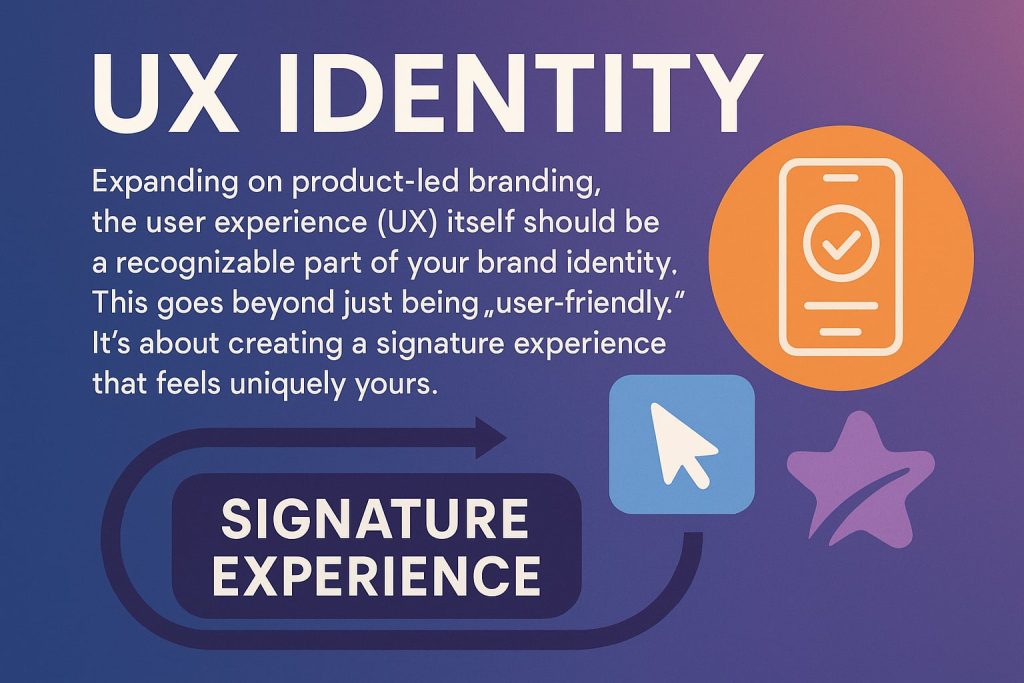
Expanding on product-led branding, the user experience (UX) itself should be a recognizable part of your brand identity. This goes beyond just being “user-friendly.” It’s about creating a signature experience that feels uniquely yours. This is your UX Identity.
Think about the distinct feel of using certain apps. The clean, minimalist, and focused writing environment of Notion is a core part of its brand. The cheerful animations and satisfying checkmarks in Asana contribute to its brand identity of making work feel less like a chore. These are not accidental details; they are intentional design choices that reinforce the brand’s core attributes.
Your UX identity is comprised of many elements:
- Interaction Design: How do animations, transitions, and micro-interactions feel? Are they smooth and professional, or fun and bouncy?
- Information Architecture: Is your product’s navigation intuitive and logical, reinforcing a brand promise of simplicity?
- Content and Microcopy: What is the tone of your in-app messages, button labels, and help text? Is it formal, casual, humorous?
- Visual Language: The consistent use of colors, typography, and iconography within the app.
Example: Duolingo has one of the most recognizable UX identities in the world. Its brand is all about making language learning fun and accessible. This is perfectly reflected in its UX. The gamified lessons, the encouraging mascot “Duo,” the streak counts, and the playful sound effects all work together to create an experience that is unmistakably Duolingo. This strong UX identity has been a key factor in its massive growth and user loyalty.
6. Engineer Trust at Every Touchpoint
We’ve already established that trust is crucial. But trust isn’t built with a single action; it’s the cumulative result of hundreds of small, positive interactions. You must proactively engineer trust-building moments into every stage of the customer journey.
This starts with transparency. Be open about your pricing, your data security practices, and your product roadmap. Use social proof liberally: showcase customer testimonials, case studies, and logos of well-known clients. Display security certifications and compliance badges prominently.
Customer support is another critical trust-building pillar. When a user runs into a problem, your response can either solidify their trust or shatter it. Fast, empathetic, and effective support demonstrates that you value your customers and are committed to their success.
Finally, be reliable. Your software needs to work as advertised, and your uptime should be consistently high. Unplanned downtime erodes trust faster than almost anything else. Communicating proactively about scheduled maintenance or unexpected issues is essential to maintaining trust even when things go wrong.
Example: Zoom built its brand on a foundation of trust and reliability, especially during a period of unprecedented demand. While its initial security issues were a major challenge, the company’s response was a masterclass in trust-building. They responded with transparency, taking ownership of the problems, communicating a clear 90-day plan to fix them, and providing frequent updates. This transparent and decisive action rebuilt customer trust and solidified its position as a market leader.
7. Nail Your Brand Messaging and Voice
Your brand messaging is the set of core ideas you want your audience to associate with your company. It’s your value proposition, your key differentiators, and your mission, all distilled into clear, concise language. Your brand voice is the personality you use to deliver that message with proper strategy . Is it authoritative, friendly, quirky, or sophisticated?
First, define your messaging framework. This should include your tagline, your value proposition, and a few key messaging pillars (e.g., “ease of use,” “powerful collaboration,” “enterprise-grade security”). These pillars should be the foundation for all your marketing and sales content.
Next, define your brand voice. A good way to do this is to describe your brand as a person. Is it a helpful mentor? A witty friend? A trusted expert? Create a brand voice guide with clear do’s and don’ts. For example: “Do use simple language. Don’t use industry jargon. Do use active voice. Don’t be overly formal.” This guide will ensure consistency across all writers and all channels, from your website copy to your social media posts.
Example: Intercom has a very distinct brand voice that is helpful, personal, and conversational. Their messaging focuses on “real-time, personal connections with customers.” This is reflected in their product (a messaging platform) and their content. Their blog posts, product updates, and even their marketing copy are written in a direct, friendly tone, as if they are having a one-on-one conversation with the reader. This consistent voice and messaging reinforce their brand’s core purpose and make it highly recognizable.

Measuring Branding Success
Branding can feel intangible, making it tempting to label it a “soft” marketing activity. However, the impact of a strong brand is very real and can be measured. While you can’t always draw a straight line from a single branding activity to a sale, you can track a set of key metrics over time to gauge the health and effectiveness of your brand-building efforts. Measuring success allows you to understand what’s working, justify investment, and make data-informed decisions to refine your strategy.
To get a holistic view, you should look at a combination of qualitative feedback and quantitative data. These metrics can be grouped into several key areas: brand awareness, brand perception, customer loyalty, and market position.
Metrics for Brand Awareness
Brand awareness measures how familiar your target audience is with your company. If people don’t know you exist, they can’t buy from you. The goal is to move from an unknown entity to the first name that comes to mind when a potential customer has a problem your software can solve.
- Direct Traffic: This is the number of visitors who type your website URL directly into their browser. An increase in direct traffic over time is a strong signal that your brand recall is growing. People know you by name.
- Branded Search Volume: Using tools like Google Search Console or Ahrefs, you can track how many people are searching for your brand name and product names. A steady increase in branded search queries indicates rising brand awareness.
- Social Media Mentions: Monitor the volume of mentions your brand receives on platforms like X (Twitter), LinkedIn, and Reddit. Are more people talking about you this quarter than last quarter? Tools like Brand24 or Mention can automate this tracking.
- Share of Voice (SOV): This metric compares your brand’s visibility to that of your competitors. It can be calculated by tracking your brand mentions, media placements, and organic search visibility relative to others in your category. An increasing share of voice means you are capturing more of the conversation in your market.
Metrics for Brand Perception and Engagement
Simply being known by people is not sufficient for building a strong brand; you also need to have a clear understanding of what they truly think and feel about you. This is where brand perception metrics come in.
These specific measurements are designed to help you gauge the overall emotional response and the specific sentiment—whether it’s positive, negative, or neutral that is associated with your brand in the public eye.
- Net Promoter Score (NPS): This is a classic metric for measuring customer satisfaction and brand loyalty. By asking customers, “On a scale of 0-10, how likely are you to recommend our brand to a friend or colleague?”, you can classify them as Promoters, Passives, or Detractors. A high NPS is a strong indicator of a positive brand perception.
- Sentiment Analysis: Use social listening tools to analyze the sentiment (positive, negative, neutral) of online conversations about your brand. Is the tone of discussions generally favorable? Tracking sentiment over time helps you spot trends and address potential reputational issues before they escalate.
- Brand Recall and Association Surveys: Periodically survey your target market (not just your customers) to measure brand recall. An “unaided recall” question might be, “When you think of email marketing software, which brands come to mind?” An “aided recall” question would be, “Which of the following brands have you heard of?” You can also ask what attributes they associate with your brand (e.g., “easy to use,” “expensive,” “innovative”).
Metrics for Customer Loyalty and Business Impact
Ultimately, the real value of cultivating a strong brand identity must be reflected in tangible business results. This is especially true for a SaaS company, given its reliance on a subscription-based model where recurring revenue is not just important, but absolutely fundamental to sustained growth and profitability.
A powerful brand can significantly impact a company’s ability to attract, retain, and expand its customer base, directly influencing these crucial financial metrics.
- Customer Lifetime Value (CLV): This metric calculates the total revenue a business can expect from a single customer account. A strong brand that fosters trust and loyalty directly increases CLV, as customers are more likely to stay longer, upgrade their plans, and purchase additional products.
- Customer Retention Rate & Churn Rate: Your retention rate is the percentage of customers who continue their subscription over a given period. The inverse of this is your churn rate. High retention and low churn are powerful indicators that your brand is delivering on its promise and keeping customers happy. Branding builds the loyalty that keeps these numbers healthy.
- Customer Acquisition Cost (CAC): While many factors influence CAC, a strong brand can lower it over time. As brand awareness and word-of-mouth grow, you become less reliant on expensive paid advertising channels, and your organic acquisition channels become more efficient.
Metrics for Market Position
These metrics provide valuable insights into how your brand compares to competitors and reveal its overall position within the marketplace. By analyzing these measurements, you can better understand where your brand excels, where it may fall short, and how it fits into the broader industry landscape.
This awareness is key to identifying opportunities for growth and staying competitive in an ever-evolving market.
- Market Share: While sometimes difficult to calculate precisely, tracking your market share gives you a clear indication of your brand’s strength relative to competitors. Growth in market share is a definitive sign that your brand is resonating with customers and winning business.
- Website Traffic and Rankings: Monitor your organic search rankings for key non-branded keywords in your industry. Improving your position for these terms shows that search engines (and by extension, users) see your brand as an authority in the space.
By consistently tracking this mix of metrics, you can move from “hoping” your branding is working to “knowing” its impact. This data provides invaluable feedback, helping you double down on successful strategies and refine those that aren’t hitting the mark, ensuring your brand remains your most valuable asset.