A strong brand is more than just a memorable logo or a catchy tagline. It’s the very soul of your business, a powerful combination of perception, emotion, and experience that lives in the minds of your audience. But how do you build a brand that not only stands out but also builds deep, lasting connections? Understanding the nuances of brand strategy is key to achieving this.
The answer lies in a robust creative brand strategy.

This guide is your roadmap to building a brand that resonates. We will explore the essential components of a creative brand strategy, from foundational frameworks and the art of storytelling to developing a compelling visual identity. You’ll gain actionable insights and learn from real-world examples to transform your brand from a simple name into a powerful asset. We’ll cover everything you need to build a brand that people not only recognize but truly believe in.
Understanding Creative Brand Strategy
At its core, a creative brand strategy is the intentional plan that shapes how your audience perceives your business. It’s the “why” behind your “what.” It’s not about random creative acts; it’s about making deliberate choices that align your company’s mission with your customers’ values.
This strategy integrates your business goals with creative execution to build brand equity the value your brand holds in the marketplace.
Think of it as the blueprint for your brand’s personality, voice, and visual expression. It ensures every tweet, every advertisement, and every customer interaction feels consistent and authentic. A successful strategy turns passive customers into loyal advocates by creating an emotional connection that transcends simple transactions.
Why It’s Crucial for Business Growth
A clear creative brand strategy is your primary differentiator in a crowded market. It enables you to carve out a unique space and communicate your value in a way that competitors can’t easily replicate. By aligning with a well-defined business growth strategy in entrepreneurship, this approach not only sets you apart but also guides decision-making across all departments from marketing and sales to product development and customer service.
This alignment creates a seamless customer experience that builds trust and loyalty. When customers trust your brand, they are more likely to choose you, stay with you, and recommend you to others. This directly translates into sustainable growth, increased market share, and a healthier bottom line. It’s the engine that drives long-term business success.
Foundational Frameworks for Brand Strategy
Before you can get creative, you need a solid foundation. Strategic frameworks provide the structure necessary to build a brand with purpose and clarity. They help you analyze your market, define your identity, and create a plan for bringing your brand to life.
The Brand Key Model
The Brand Key is a classic framework that helps you define your brand’s essence in eight concise steps. It forces you to think critically about every aspect of your brand, moving from the outside market to your core values.
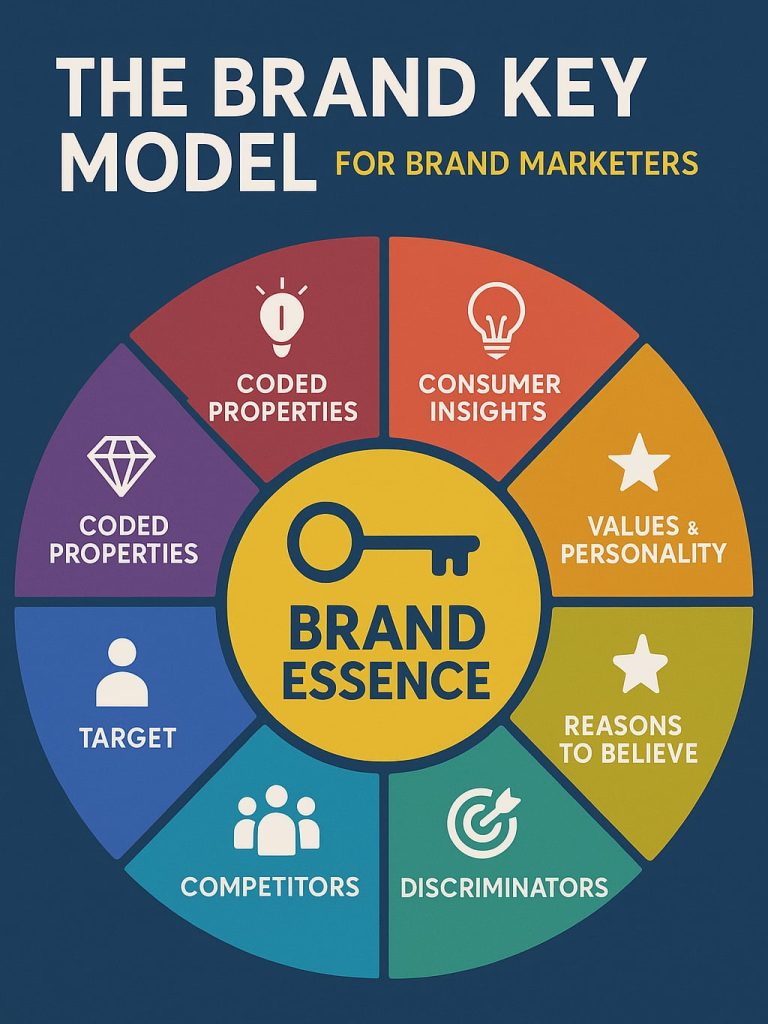
- Competitive Environment: Who are your competitors? What are their strengths and weaknesses? This step sets the stage by analyzing the landscape you operate in.
- Target Audience: Define your ideal customer. Go beyond demographics to understand their psychographics—their values, aspirations, and pain points.
- Insight: What is the fundamental human truth or need that your brand addresses for your target audience? This insight is the emotional hook. For example, Nike’s insight isn’t that people need shoes, but that everyone desires to unlock their inner athlete.
- Benefits: How does your brand improve your customer’s life? List the functional benefits (what your product does) and the emotional benefits (how it makes them feel).
- Values & Personality: What does your brand stand for? If it were a person, how would you describe its personality? Is it rugged and adventurous like Patagonia, or innovative and sleek like Apple?
- Reasons to Believe: What proof do you have to support your claims? This could be product features, customer testimonials, or industry awards.
- Discriminator: What is the one single thing that makes you different from everyone else? This is your unique selling proposition (USP).
- Essence: Condense everything into a short, powerful phrase that captures the soul of your brand. For Volvo, it’s “Safety.” For Disney, it’s “Magic.”
The Golden Circle
Developed by Simon Sinek, The Golden Circle is a simple but powerful model for brand communication. It flips the traditional “what, how, why” marketing message on its head. Most companies start by explaining what they do, then how they do it. Sinek argues that inspiring brands communicate from the inside out.
- Why: This is your purpose, your cause, or your belief. Why does your company exist beyond making a profit? This is the core of The Golden Circle. Apple’s “Why” is to challenge the status quo and think differently.
- How: This explains how you fulfill your “Why.” These are your specific processes, values, or proprietary methods that set you apart. Apple does this by designing beautiful, simple-to-use products.
- What: This is what you actually do—the products you sell or the services you offer. For Apple, it’s computers, phones, and watches.
By starting with “Why,” you connect with customers on an emotional level. People don’t buy what you do; they buy why you do it. This framework is incredibly effective for creating a brand message that inspires loyalty and action.
The Brand Archetype Framework
Based on Carl Jung’s psychological archetypes, this framework assigns a human-like personality to your brand. There are 12 primary archetypes, each with its own set of values, motivations, and characteristics. Choosing an archetype helps you create a consistent and relatable brand identity.
Here are a few examples:
- The Hero: Brands that want to inspire courage and overcome challenges (e.g., Nike, Duracell). Their motto is “Where there’s a will, there’s a way.”
- The Sage: Brands focused on knowledge, wisdom, and truth (e.g., Google, Harvard University). They seek to understand the world and share their findings.
- The Jester: Fun-loving brands that want to bring joy to the world (e.g., M&M’s, Old Spice). They live in the moment and don’t take themselves too seriously.
- The Caregiver: Brands that are compassionate, nurturing, and protective (e.g., Johnson & Johnson, TOMS). Their goal is to help and serve others.
By identifying your brand’s archetype, you can develop a consistent voice, visual style, and messaging strategy that resonates deeply with your target audience. It provides a shortcut to a rich and authentic brand personality.
The Art of Brand Storytelling
Facts tell, but stories sell. Brand storytelling is the practice of using narrative to connect your brand to your customers. A good story creates an emotional bond, making your brand more memorable and relatable. It’s not just about your company’s history; it’s about weaving a narrative that places your customer at the center.
Elements of a Compelling Brand Story
Every great story, including a brand story, has a few key elements. Mastering these will allow you to craft a narrative that captivates your audience.
- The Hero: Your customer is the hero of the story, not your brand. The story should be about their journey, their struggles, and their triumphs. Your brand plays a supporting role.
- The Goal: What does the hero want to achieve? This goal should align with a deep-seated human desire, such as belonging, security, or self-improvement.
- The Obstacle: What stands in the hero’s way? This conflict creates tension and makes the story engaging. The obstacle could be a practical problem or an internal struggle.
- The Mentor: This is your brand’s role. The mentor provides the hero with the tools, knowledge, or confidence they need to overcome the obstacle.
- The Resolution: How does the hero’s life improve after using your product or service? A satisfying resolution shows a clear transformation, solidifying the value of your brand.
Case Study: Airbnb’s Story of Belonging
Airbnb could have positioned itself as a cheap alternative to hotels. Instead, they built their brand around the story of “Belong Anywhere.” Their narrative isn’t about renting a room; it’s about experiencing a destination like a local and finding a sense of community wherever you go.
- The Hero: The traveler who yearns for authentic experiences, not tourist traps.
- The Goal: To feel like they truly belong in a new place.
- The Obstacle: Impersonal hotels that isolate them from the local culture.
- The Mentor: Airbnb, which provides access to unique homes and local hosts.
- The Resolution: The traveler enjoys a rich, authentic experience and feels a genuine connection to the place and its people.
This powerful narrative is woven into every aspect of their marketing. Their campaigns feature real stories from hosts and guests, reinforcing the idea of a global community. By focusing on a universal human desire belonging Airbnb created a brand that people feel emotionally connected to.
Actionable Tip: Define Your Brand’s Narrative
Use the storytelling elements above to map out your brand’s narrative. Start by asking:
- Who is our customer (the hero)?
- What is their primary goal or desire?
- What is preventing them from achieving it?
- How does our brand help them overcome this obstacle?
- What does their success look like?
Write this narrative down. This story will become a guiding document for your marketing campaigns, website copy, and social media content, ensuring a consistent and compelling message.
Crafting a Distinctive Visual Identity
Your visual identity is the tangible, sensory expression of your brand. It includes your logo, color palette, typography, and imagery. A strong visual identity makes your brand instantly recognizable and communicates your personality without a single word. It’s the “look” that complements your brand’s “feel.”
Components of a Visual Identity System
A comprehensive visual identity system is more than just a logo. It’s a cohesive set of visual elements that work together to create a unified brand experience.
Logo Design
Your logo is the cornerstone of your visual identity. It should be simple, memorable, and versatile. A great logo works well in different sizes and contexts, from a massive billboard to a tiny favicon. Consider the three main types of logos:
- Wordmarks: Logos that consist solely of the company’s name in a stylized font (e.g., Google, Coca-Cola).
- Symbols/Icons: Abstract or pictorial marks that represent the brand (e.g., the Apple apple, the Nike swoosh).
- Combination Marks: Logos that combine a wordmark and a symbol (e.g., Adidas, Mastercard).
Color Palette
Color psychology is a powerful tool in branding. The colors you choose evoke specific emotions and associations. A well-defined palette should include primary colors for consistency and secondary colors for flexibility.
- Red: Passion, excitement, urgency. Often used for sales and fast-food brands.
- Blue: Trust, security, professionalism. Popular with financial institutions and tech companies.
- Green: Nature, health, growth. Used by organic brands and financial services.
- Yellow: Optimism, youth, warmth. Catches the eye and creates a feeling of happiness.
Typography
The fonts you use are your brand’s voice in written form. Your typography should be legible and reflect your brand’s personality. A typical typography system includes:
- Primary Typeface: Used for headlines and key messages. This font should be distinctive and character-filled.
- Secondary Typeface: Used for body copy. This font should be highly readable and complement the primary typeface.
Choose fonts that are accessible and work well on both web and print. Services like Google Fonts and Adobe Fonts offer a wide range of high-quality options.
Imagery and Iconography
The style of photography, illustration, and icons you use contributes significantly to your brand’s feel. Do you use professional, high-contrast photos of people, or soft, nature-inspired illustrations? Your imagery should be consistent in tone, style, and subject matter. Create a clear set of guidelines for any imagery used to represent your brand.
Example: Mailchimp’s Visual Rebrand
Mailchimp’s rebrand serves as a masterclass in building a visual identity that is both quirky and professional, effectively supporting their leading email marketing strategy work. They successfully transitioned from a relatively simple corporate look to a much more vibrant, expressive, and memorable system.
This new aesthetic not only better reflects their unique brand personality but also enhances their role in empowering businesses with effective email communication.
- Logo: They refined their chimp mascot, Freddie, and paired it with a friendly, rounded wordmark.
- Color Palette: Their signature yellow, “Cavendish Yellow,” is cheerful and energetic. It’s paired with a simple black-and-white base to maintain a clean, modern feel.
- Typography: They use a distinctive, hand-drawn-style font for headlines that feels creative and human, balanced with a clean sans-serif for body text.
- Imagery: Their use of quirky, surreal illustrations sets them apart from the sterile look of many tech companies. It communicates creativity and fun, aligning with their mission to empower small businesses.
This cohesive system makes Mailchimp instantly recognizable and communicates their brand personality—creative, approachable, and a little bit weird at every touchpoint.
Mastering Brand Positioning
Brand positioning is the strategic process of defining how you want your brand to be perceived in relation to your competitors. It’s about occupying a unique and valuable space in the mind of your target customer. A clear positioning statement acts as your internal North Star, guiding your marketing and business decisions.
The Positioning Statement Formula
A classic and effective way to articulate your positioning is with this simple formula:
For [Target Audience], [Your Brand] is the [Category of Business] that provides [Brand Promise/Benefit] because only [Your Brand] is [Reason to Believe].
Let’s break it down:
- Target Audience: The specific group of people you are trying to reach.
- Category of Business: The frame of reference or market you operate in.
- Brand Promise/Benefit: The primary value you offer to your customers.
- Reason to Believe: Your unique differentiator or evidence that supports your promise.
Example: Tesla’s Positioning
Let’s apply this formula to Tesla:
For [tech-savvy, environmentally conscious consumers], Tesla is the [electric car manufacturer] that delivers [exhilarating performance and cutting-edge technology without compromise] because only [Tesla] offers [a proprietary Supercharger network and industry-leading battery technology].
This statement clearly defines who Tesla is for, what it offers, and why it’s a superior choice. It carves out a position that isn’t just about being an electric car, but about being the best electric car, combining sustainability with high performance.
Perceptual Mapping
A perceptual map is a visual tool used to understand how your brand is perceived in the market relative to competitors. You choose two key attributes that are important to customers in your industry and plot your brand and your competitors on a two-by-two matrix.
For example, in the automotive industry, you might use “Price (Economy vs. Luxury)” on one axis and “Performance (Conservative vs. Sporty)” on the other. This exercise helps you:
- Identify gaps in the market where a new brand could thrive.
- Understand your current position from a customer’s perspective.
- Track how your positioning changes over time.
By visualizing the competitive landscape, you can make more informed decisions about where you want to position your brand and what messages will be most effective in getting you there.
The Creative Process in Branding
Building a brand is not something you do just once and consider finished; it’s an ongoing, ever-evolving creative process. This journey requires a careful balance of strategy, creativity, and flawless execution to bring a brand to life and keep it relevant. While the exact methods may differ from one agency to another, most creative branding efforts follow several essential phases, each designed to shape and refine how the brand connects with its audience.
From defining the core identity to crafting visuals and messaging, every step plays a crucial role in building a meaningful and impactful brand presence, with brand pillars serving as a critical foundation for creating a strong and lasting identity.
Phase 1: Discovery and Research
This is the foundation of the entire process. It’s about deep-diving into the brand, the market, and the audience. Activities in this phase include:
- Stakeholder Interviews: Talking to leadership, employees, and key partners to understand the business goals, vision, and internal culture.
- Competitive Analysis: Auditing competitors’ branding, messaging, and market position.
- Audience Research: Conducting surveys, interviews, and focus groups to understand the needs, wants, and perceptions of your target customers.
- Brand Audit: Evaluating your existing brand assets to identify strengths, weaknesses, and inconsistencies.
The goal of this phase is to gather all the information needed to inform the strategy. You can’t chart a course without first knowing where you are.
Phase 2: Strategy and Positioning
In this phase, you take the insights gathered during the discovery phase and transform them into a well-defined and actionable brand strategy. This step is all about organizing and synthesizing the research to create a clear direction for the brand. Here, you develop and refine the core components we’ve discussed, ensuring they align with the brand’s goals and values while addressing the needs of the target audience. This process lays the foundation for a cohesive and impactful brand identity moving forward.
Defining your brand purpose, vision, and values.
- Crafting your brand positioning statement.
- Choosing your brand archetype and defining your brand personality and voice.
- Outlining your brand story and key messaging themes.
The output of this phase is a comprehensive brand strategy document, often called a brand platform or brand blueprint. This document will guide all creative work moving forward.
Phase 3: Creative Exploration and Design
This is the stage where the strategy takes shape and becomes something real and visible. The design team starts developing and exploring visual concepts that will define the brand’s identity. This is an iterative process, meaning ideas are created, tested, refined, and revisited multiple times to ensure they align with the brand’s vision and goals. It involves careful consideration of elements like colors, typography, and imagery to create a cohesive and impactful identity that resonates with the target audience.
- Mood Boarding: Creating visual collections of images, colors, and textures to explore different creative directions.
- Logo Sketching and Concepting: Developing a range of logo options that align with the brand strategy.
s* Visual System Development: Once a logo direction is chosen, the team expands it into a full visual system, defining the color palette, typography, and imagery style.
This phase is highly collaborative. The creative team works closely with the client, presenting concepts and gathering feedback to refine the direction.
Phase 4: Implementation and Governance
Once the final brand identity is approved, the focus shifts to implementation. This involves:
- Creating a Brand Style Guide: This is the brand’s rulebook. It documents all aspects of the brand strategy, voice, and visual identity, providing clear guidelines on how to use brand assets correctly. A good style guide ensures consistency across all touchpoints.
- Applying the New Brand: Rolling out the new identity across all assets, including the website, marketing materials, social media profiles, and physical spaces.
- Brand Governance: Establishing a process for managing and evolving the brand over time. This might involve a brand manager or a committee responsible for approving new creative and ensuring long-term consistency.
A brand is a living entity. This process isn’t linear; it’s a cycle. Successful brands continually revisit their strategy and creative expression to stay relevant and connected to their audience.
Building a Brand That Lasts
A creative brand strategy is not a luxury; it is a fundamental requirement for building a successful, enduring business. It is the thoughtful integration of purpose, personality, and perception that elevates a company from a mere commodity to a cherished brand, highlighting the true importance of branding.
By using frameworks like the Brand Key and The Golden Circle, you can build a solid strategic foundation. By mastering the art of storytelling, you can create emotional connections that foster loyalty. By developing a distinctive visual identity and a clear positioning, you can ensure your brand is both memorable and meaningful.
The journey to building a great brand is a marathon, not a sprint. It requires commitment, consistency, and a deep understanding of who you are and who you serve. Start today by taking one actionable step. Define your “Why.” Map out your customer’s story. Audit your visual identity. Every small, deliberate action you take to build your brand is an investment in your company’s future success. Create a brand that doesn’t just sell a product, but one that people are proud to be a part of.