The landscape of digital search is undergoing its most significant transformation in over a decade. For years, Search Engine Optimization (SEO) has been the undisputed king of digital marketing, a complex game of keywords and backlinks aimed at securing the top spot on a results page.
But the rise of artificial intelligence is redrawing the map.

AI-powered tools like Google’s Search Generative Experience (SGE), Bing Copilot, and Perplexity are shifting the paradigm from a list of links to a single, direct answer. This evolution demands a new approach: Answer Engine Optimization (AEO).
This guide will explore what AEO is, why it’s now essential for visibility, and how you can adapt your strategy to thrive in this new era of search.
What is Answer Engine Optimization (AEO)?
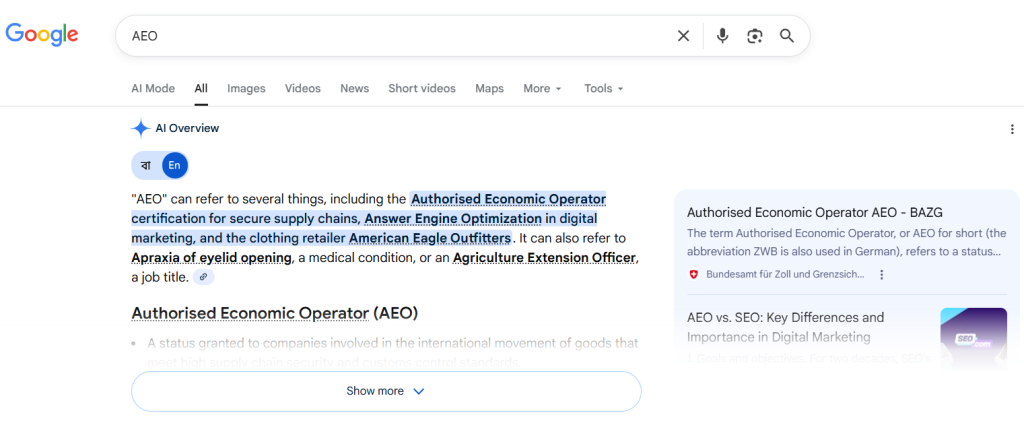
Answer Engine Optimization (AEO) is the process of creating and structuring content so that it can be easily understood, verified, and presented as a direct, authoritative answer by AI-driven search engines and large language models (LLMs).
Unlike traditional SEO, which focuses on ranking web pages, AEO focuses on becoming the source of truth for the answers themselves.
Think of it this way:
- SEO: Helps a search engine find your article about “how to bake a sourdough loaf.”
- AEO: Helps an AI model extract your specific recipe and instructions to present directly to a user asking the same question.
The goal is no longer just to rank number one; it’s to be the definitive answer that an AI selects and synthesizes for its user. This means your content must be clear, concise, factually accurate, and structured for machine readability.
SEO vs. AEO: Understanding the Key Differences
While AEO is an evolution of SEO, not a replacement, their priorities differ significantly. SEO is built on a foundation of keywords, links, and technical signals to improve a page’s ranking. AEO builds on this by adding a layer of semantic keywords and structural optimization aimed at LLMs.
| Feature | Traditional SEO | Answer Engine Optimization (AEO) |
|---|---|---|
| Primary Goal | Rank a URL on a Search Engine Results Page (SERP). | Become the source for a direct answer within an AI-generated summary. |
| User Interaction | User clicks a link to find the answer on a webpage. | User receives the answer directly, often without clicking any links. |
| Content Focus | Long-form content, keyword density, and broad topic coverage. | Clear, concise, factual information structured for easy parsing. |
| Key Elements | Backlinks, domain authority, meta tags, page speed. | Schema markup, structured data, factual accuracy, clear entities, E-E-A-T. |
| Measurement | Organic traffic, keyword rankings, click-through rate (CTR). | Brand mentions in AI answers, visibility in generative summaries, assisted conversions. |
AEO requires a mental shift from “How can I rank for this keyword?” to “How can I provide the best, most direct answer to this question?”
Why is AEO Important?
AEO is critical because it ensures your content is effectively indexed and utilized by AI systems to provide precise answers to user queries. With the growing reliance on voice search, virtual assistants, and generative AI tools, businesses must adapt to this shift in how information is consumed.
By strategically focusing on both AEO (Answer Engine Optimization) and Geotargeted Engine Optimization (GEO), brands can significantly enhance their visibility within AI-driven search results. This dual approach not only builds stronger trust with users by providing immediate, relevant answers but also effectively drives highly qualified traffic.
Unlike traditional SEO, which often relies on keyword density and backlinks, AEO prioritizes delivering clear, concise, structured, and highly informative content that directly addresses specific user queries. Simultaneously, robust GEO ensures that this valuable content is surfaced to local users searching for nearby services or products, a critical factor as AI snapshots increasingly integrate local business information and recommendations.
Click Rates from AI Overviews
- AI Overviews reduce total organic clicks by 28%–42% depending on query type (Ahrefs, 2025).
- Position #1 CTR drops from 7%+ to 2–3% when an AI Overview appears.
- AI-generated answers now appear on 85%+ of informational searches (SGE tests).
- 60%+ of all searches end in zero-click results due to AI snapshots (SparkToro, 2025).
- Branded queries are least affected; informational queries lose the most clicks.
- AI Overviews heavily favor authoritative domains with strong E-E-A-T signals.
- Long-tail queries trigger more AI snapshots than short, generic keywords.
- AI Overviews pull content from 3–8 high-authority sources per answer segment.
- Websites with structured data and clear answer formatting appear more frequently.
- User behavior shifts: more scrolling inside AI modules, fewer website visits.
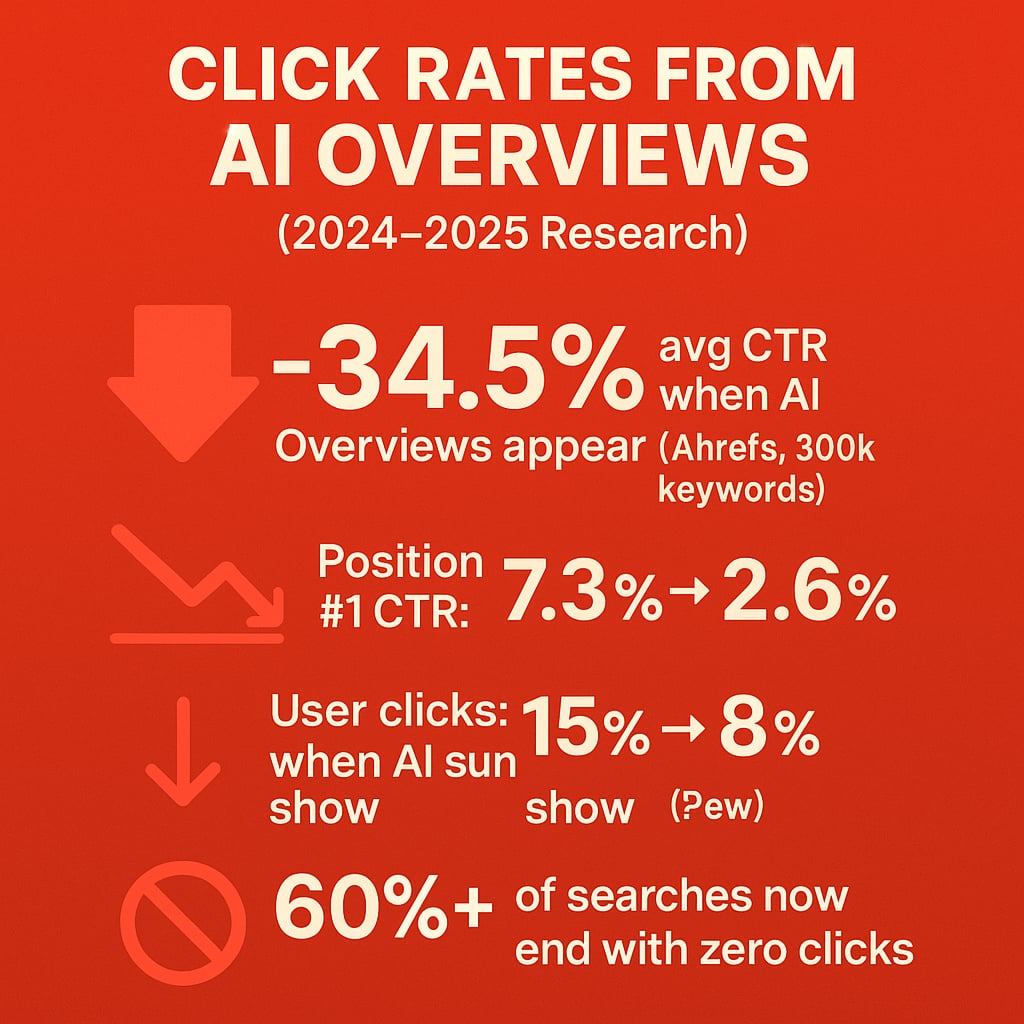
Click Rates form AI Overviews
In the new SGE landscape, combining a direct answer strategy with meticulous local optimization becomes essential for capturing both informational and transactional intent, ensuring your brand stands out in increasingly personalized search experiences.
This approach not only improves discoverability but also positions businesses as authoritative sources in their domain, ensuring relevance in an increasingly AI-dominated search landscape.
The Rise of Answer Engines and the Decline of the Blue Link
The shift towards answer engines isn’t some distant future concept; it’s a present reality actively reshaping how we consume information online. We are witnessing this transformation unfold rapidly, with the seamless integration of artificial intelligence into the core functionalities of major search platforms.
Integration is undeniably accelerating this fundamental change in information retrieval at an unprecedented rate, influencing how users expect to receive direct and concise answers to their queries.
Google SGE: The Game Changer
Google’s Search Generative Experience (SGE) represents the most profound shift. When a user enters a query, SGE often presents an AI-generated snapshot at the very top of the page and above all organic results. This snapshot directly answers the user’s question, pulling information from multiple sources and citing them with small, clickable links.
This has a massive impact on user behavior. Why would a user scroll down and click on ten blue links when a comprehensive answer is provided instantly? This phenomenon directly contributes to the rise of “zero-click searches,” where the user’s query is resolved on the results page itself. Before SGE, nearly 26% of Google searches were zero-click. With AI-generated answers becoming the norm, this number is projected to climb significantly, potentially siphoning off a substantial portion of organic traffic growth.
Beyond Google: Bing Copilot, Perplexity, and ChatGPT
This trend isn’t just something we’re seeing with Google; it’s also becoming increasingly common among other major players in the search and AI industries. Companies like Microsoft and Amazon, for example, are similarly exploring and adopting strategies that reflect this shift, further emphasizing its widespread impact across the tech landscape.
- Bing Copilot: Microsoft integrated OpenAI’s technology into its search engine intent, transforming Bing into a “copilot for the web.” It provides summarized answers, helps draft content, and offers a conversational search experience.
- Perplexity AI: This platform positions itself as an “answer engine,” designed from the ground up to provide direct, cited answers to complex questions. It has rapidly gained millions of users who prefer its straightforward, ad-free answer format.
- ChatGPT and other LLMs: Millions of users now turn directly to conversational AI like ChatGPT to get information, bypassing traditional search engines altogether. They ask for recipes, travel plans, coding solutions, and business advice, receiving instant, synthesized responses.
The common thread is the user’s desire for efficiency. They don’t want a research project; they want a trusted, immediate answer. As this behavior becomes ingrained, businesses that fail to optimize for answer engines will become invisible.
How AEO Impacts Rankings, Visibility, and Zero-Click Behavior
The shift to an AEO-centric world fundamentally alters how we measure success in the digital landscape and, more importantly, what it takes for a business or brand to maintain visibility online. This paradigm shift means that traditional metrics for online performance are being re-evaluated, as the path from query to answer increasingly bypasses conventional search result pages.
The New Meaning of “Ranking”
In an AEO world, “ranking” is no longer about being the first link. It’s about being featured within the AI-generated answer. Your content might be pulled for a single sentence, a statistic, or a step-by-step guide. Visibility is achieved by becoming a building block for the AI’s response.
This means a single article could contribute to dozens of different AI-generated answers. While this might not drive a direct click, it establishes your brand as an authority in the eyes of both the user and the AI. This “source authority” is the new currency of digital visibility.
The Inevitable Rise of Zero-Click Searches
Zero-click behavior is the most direct consequence of answer engines. When an AI provides a perfect summary, the user’s need to click through to a website diminishes. This is a terrifying prospect for businesses reliant on organic traffic for leads and ad revenue.
However, it also presents an opportunity. While overall clicks may decrease, the value of the clicks that do happen will increase. Users who click a source link within an AI snapshot are likely doing so because they want to go deeper. They are more qualified, more engaged, and further down the funnel.
A study on Featured Snippets, a precursor to SGE, found that while they reduced clicks to the #1 organic position, they also created opportunities for sites ranking lower on the page to gain visibility. AEO follows a similar pattern, but on a much larger scale. Your goal should be to become the source link that a highly motivated user clicks for more detail.
A Case Study: The Recipe Blogger
Consider a food blogger who has an article titled “The Ultimate Guide to Gluten-Free Brownies.”
- Traditional SEO Approach: The blogger optimizes for keywords like “gluten-free brownies recipe,” builds backlinks from other food blogs, and ensures their page loads quickly. They aim for the top three organic spots.
- AEO-Enhanced Approach: In addition to SEO basics, the blogger structures their content for an AI.
- They use Recipe schema markup to label ingredients, cooking times, and nutritional information.
- The instructions are presented in a numbered list with clear, simple steps.
- They include a distinct FAQ section with H3 headings like “Can I substitute almond flour?” and “How to store gluten-free brownies?”
- Factual claims, like “Using xanthan gum prevents crumbling,” are clearly stated and easy to verify.
When a user asks Perplexity AI, “How do I make chewy gluten-free brownies?”, the AI can now easily parse the blogger’s content. It might pull the exact ingredient list and the first three steps of the instructions, citing the blog as the source.
Even if the user doesn’t click through, the blogger’s brand is presented as the authority. Another user asking, “How to store gluten-free brownies?” might get an answer sourced directly from the FAQ section. This is AEO in action.
Core Pillars of a Successful AEO Strategy
Adapting to AEO requires a strategic and disciplined approach. It’s about creating content for both humans and machines. Here are the foundational pillars of effective Answer Engine Optimization.
1. Build on a Foundation of E-E-A-T
E-E-A-T (Experience, Expertise, Authoritativeness, and Trustworthiness) is more critical than ever. AI models are designed to prioritize information from sources they deem credible. Without a strong foundation of trust, your content is unlikely to be selected.
- Experience: Demonstrate firsthand knowledge. Use phrases like “in my experience,” “as a professional with 10 years in the field,” or “our tests showed.”
- Expertise: Showcase credentials, qualifications, and deep knowledge of your subject. Author bios, case studies, and detailed guides are essential.
- Authoritativeness: Build your reputation within your industry. This includes getting mentioned on other reputable sites, securing authoritative backlinks, and having a well-maintained Wikipedia page for your brand or key personnel.
- Trustworthiness: Be transparent. Have clear contact information, privacy policies, and a professional website. Cite your sources and ensure your information is factually accurate.
2. Master Structured Data and Schema Markup
Structured data is a standardized format for providing information about a page and classifying its content. It’s like adding labels to your content that machines can read.
Schema.org provides a vocabulary of tags you can add to your HTML to tell search engines exactly what your content is about.
For AEO, this is non-negotiable. Key schema types to implement include:
- Article/BlogPosting: Defines the author, publication date, and headline.
- FAQPage: Marks up question-and-answer sections, making them prime candidates for AI sourcing.
- HowTo: Structures step-by-step instructions for processes.
- Recipe: Details ingredients, prep time, and nutritional info for recipes.
- Person: Establishes the identity and credentials of authors or experts.
- Organization: Provides clear information about your company, including its official name, logo, and contact details.
Implementing schema markup turns your unstructured prose into a structured database that AI can easily query.
3. Embrace Entity-Based Optimization
Entities are specific, well-defined things or concepts like a person, place, organization, or product. Search engines are moving away from simple keyword matching toward understanding the relationships between entities. This is known as the “Knowledge Graph.”
To optimize for entities:
- Be Specific: Instead of writing about “cars,” write about the “2025 Tesla Model 3.”
- Define Your Entities: Clearly identify the key people, products, and concepts central to your business. Create dedicated pages or content hubs for them.
- Build Connections: Internally link between related entities on your site. For example, an article about a CEO (a “Person” entity) should link to their company page (an “Organization” entity).
- Claim Your Knowledge Panel: If your brand is notable enough, Google may create a Knowledge Panel for it. Claim and manage this panel to ensure the information is accurate.
By focusing on entities, you help AI understand who you are, what you do, and how you relate to the broader world of information.
4. Write for Clarity and Conciseness
AI models favor content that is easy to understand and parse. Overly complex prose, jargon, and vague statements are likely to be ignored.
- Answer the Question Immediately: Structure articles using the inverted pyramid model. Put the most important information first.
- Use Simple Language: Aim for a Flesch reading-ease score of 60 or higher. Use short sentences and paragraphs.
- Format for Scannability: Use headings (H2, H3), bullet points, and numbered lists to break up text. This helps both humans and machines quickly identify key information.
- Be Direct: Instead of “It might be beneficial to consider…,” write “Do this…” Active voice and direct commands are easier for an AI to interpret as instructions.
5. Prioritize Factual Accuracy and Verifiability
AI models are under immense pressure to provide accurate information and combat misinformation. They are being trained to cross-reference claims against multiple trusted sources.
Content that is factually incorrect or cannot be verified will be filtered out.
- Cite Your Sources: When presenting data or statistics, link out to the original source (e.g., a research paper, government report, or industry study). This demonstrates transparency and allows the AI to verify your claims.
- Update Your Content Regularly: Information goes out of date. Regularly review and update your articles to ensure they remain accurate. Add an “Last updated on…” date to signal freshness.
- Avoid Ambiguity: State facts clearly. Instead of “Many users prefer this product,” write “In a 2025 survey of 1,000 users by [Source], 78% preferred this product.”
The Future of AEO: What’s Next?
The world of AEO is just beginning to take shape, but its trajectory is clear. The future of search is less about finding pages and more about getting answers.
We can expect AI models to become more sophisticated in how they attribute sources. Instead of small, footnote-style links, we may see more prominent brand mentions and logos embedded directly within AI answers. This will make “source of topical authority” a more tangible and valuable asset.
Furthermore, metrics for success will need to evolve. Marketers will need to move beyond tracking organic traffic and keyword ranks. New key performance indicators (KPIs) will emerge, such as:
- Share of Answer: What percentage of AI-generated answers for your target topics feature your brand?
- Source Impressions: How many times is your brand shown as a source, even without a click?
- Answer-Assisted Conversions: How many users who convert first interacted with your brand through an AI-generated answer?
Answer Engine Optimization is not a trend; it is the necessary evolution of digital marketing strategy in an AI-first world. The businesses and marketers who act now to build authority, structure their content for machines, and prioritize factual, clear communication will be the ones who remain visible.
The era of simply optimizing for keywords is over. The era of optimizing for answers has begun.