Profitability is often misunderstood, yet market data shows it remains the primary driver of long-term valuation. Many entrepreneurs look at their top-line revenue and celebrate, but savvy business owners know that revenue is vanity while profit is sanity. Current industry analysis suggests that the bridge between the money you bring in and the money you actually keep is largely determined by a single, crucial metric: Cost of Goods Sold (COGS). Understanding your COGS isn’t just about accounting; it’s about leveraging competitive intelligence to optimize your margins and stay ahead of shifting consumer demand.
COGS is more than just a line item on an income statement; it is a diagnostic tool for the health of your production process, a lever for your pricing strategy, and a major factor in your tax liability. Whether you are running a boutique retail shop, a large-scale manufacturing plant, or a software company, understanding COGS is non-negotiable for financial literacy.
This comprehensive guide explores exactly what COGS is, how to calculate it accurately using different accounting methods, and how managing it effectively can transform your bottom line.
Defining Cost of Goods Sold (COGS)
Cost of Goods Sold refers to the direct costs of producing the goods sold by a company. This figure includes the cost of the materials and labor directly used to create the good. It excludes indirect expenses, such as distribution costs and sales force costs.
Think of COGS as the “hurdle” your product must clear before it starts contributing to the company’s operating expenses. If you sell a handmade watch for $500, but the parts and the labor to assemble it cost $300, your COGS is $300. The remaining $200 is your gross profit, which must then be used to pay for rent, marketing, administrative salaries, and eventually, net profit.
The “Matching Principle” in Accounting
COGS is driven by the matching principle of Generally Accepted Accounting Principles (GAAP). This principle states that expenses should be recorded in the same period as the revenues they helped generate.
If you manufacture 1,000 units in January but only sell 200 of them, you do not expense the cost of all 1,000 units in January. You only recognize the cost of the 200 units sold. The remaining 800 units sit on your balance sheet as inventory assets until they are sold.
Why Is Cost of Goods Sold (COGS) Important?
COGS is a crucial metric for assessing a company’s profitability and operational efficiency. It represents the direct costs of producing the goods sold during a specific period, such as materials and labor, excluding indirect expenses like marketing or distribution. By accurately calculating COGS, businesses gain insight into their gross margin, enabling them to analyze how efficiently they are managing production and supply chains. Additionally, COGS plays a key role in financial reporting and tax calculations, as it directly impacts net income.
For companies to maintain competitiveness, profitability, and achieve sustainable business growth, understanding and controlling COGS is essential. It allows for strategic pricing and cost management decisions that align with long-term financial goals.
What Is Included in COGS?
Determining what qualifies as a “direct cost” can often be a nuanced process, as it depends on the specific context of the business and its operations. However, in general, the Cost of Goods Sold (COGS) is built around three main pillars that form the basis for calculating these expenses. Understanding these pillars is essential for accurately assessing the direct costs associated with producing goods or services.
1. Direct Materials
These are the raw materials that physically become part of the finished product. For a furniture maker, this is wood, screws, varnish, and upholstery. For a bakery, it is flour, sugar, and eggs. If you can trace the material directly to a specific unit of production, it belongs here.
2. Direct Labor
This includes the wages and benefits of the employees who are physically making the product. This is not the salary of the HR manager or the receptionist; it is the hourly wage of the assembly line worker, the seamstress, or the machine operator. If the employee touches the product during its creation, their labor cost is likely part of COGS.
3. Manufacturing Overhead
This is where things can get a bit more complex. Manufacturing overhead refers to all the costs associated with running the production facility that cannot be directly tied to the production of a specific unit. These are essential expenses that support the overall manufacturing process but don’t directly contribute to creating one particular product. For example, this category might include expenses like utility bills for the factory, maintenance of machinery, or the wages of supervisors who oversee multiple production lines. While these costs are crucial to keeping the facility running smoothly, they are indirect and must be allocated across all units produced.
- Factory Rent & Utilities: The electricity to run the machines and the rent for the warehouse (but not the corporate office).
- Production Supplies: Items used in production that are too insignificant to track individually, like glue, thread, or sandpaper.
- Depreciation: The wear and tear on manufacturing equipment.
What Is Excluded from COGS?
To calculate an accurate gross margin, it’s essential to clearly and strictly distinguish direct costs from operating expenses (OPEX), as they serve different purposes in financial analysis. Direct costs, or COGS (Cost of Goods Sold), are specifically tied to the production of goods or services, while OPEX refers to the ongoing costs of running the business that are not directly linked to production. It’s important to note that COGS does not include operating expenses such as rent, utilities, or administrative salaries, which fall under the category of OPEX. Maintaining this separation ensures a more precise understanding of your business’s profitability.
- Selling Expenses: Commissions, advertising, and marketing campaigns.
- General & Administrative (G&A): Salaries of executives, legal fees, accounting fees, and office rent.
- Research & Development (R&D): The cost of designing new products is usually treated as an operating expense, not COGS.
- Interest Expenses: The cost of debt financing.
The COGS Formula
The standard formula for calculating COGS (Cost of Goods Sold) over an accounting period is relatively straightforward, as long as you maintain accurate and consistent tracking of your inventory. Proper inventory management is key to ensuring that the calculation reflects the true costs associated with producing or purchasing the goods you sell. For example, tracking inventory levels at the beginning and end of the period, along with any purchases made, allows you to apply the formula effectively and gain a clear picture of your business’s cost structure.
COGS = Beginning Inventory + Purchases during the period − Ending Inventory
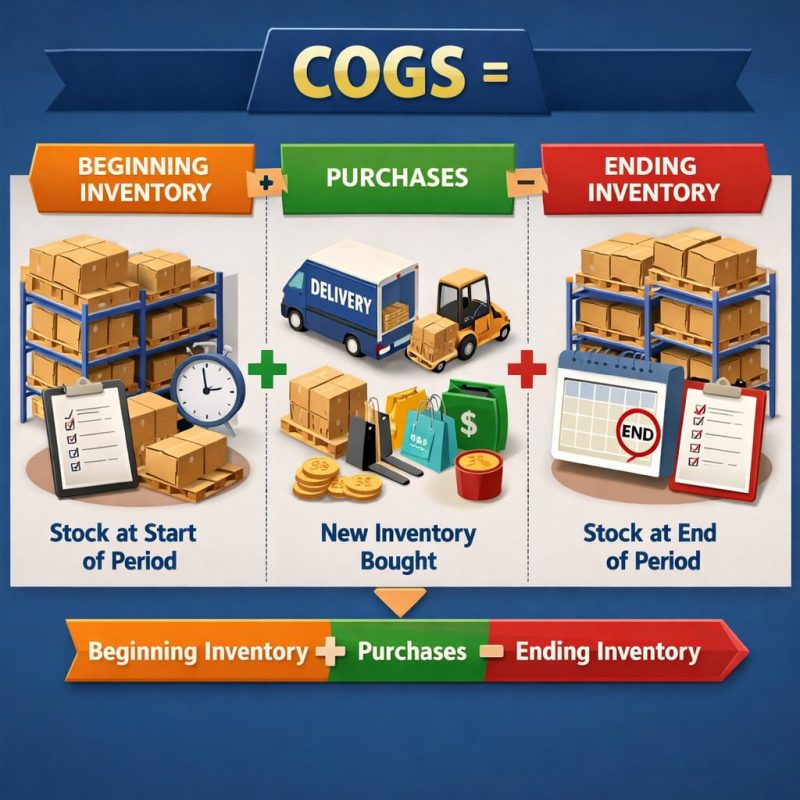
Here is how the variables break down:
- Beginning Inventory: The value of the inventory you had on hand at the start of the period (this must match the ending inventory of the previous period).
- Purchases: The cost of any new inventory or raw materials bought during the period, including freight-in (shipping costs to get materials to you).
- Ending Inventory: The value of inventory remaining unsold at the end of the period.
A Practical Example
Imagine you own a store that sells high-end speakers.
- On January 1st, you have inventory worth $10,000.
- During January, you buy $5,000 worth of new speakers.
- On January 31st, you do a stocktake and find you have $3,000 worth of speakers left.
Calculation: $10,000 + $5,000 – $3,000 = $12,000.
Your Cost of Goods Sold for January is $12,000.
Inventory Valuation Methods: FIFO, LIFO, and Average Cost
The formula above relies heavily on the value of your inventory. However, the cost of acquiring inventory changes over time due to inflation or supply chain fluctuations. This brings us to inventory valuation methods. The method you choose can significantly alter your reported COGS and, consequently, your taxable income.
1. First-In, First-Out (FIFO)
FIFO assumes that the oldest inventory items are recorded as sold first.
- Scenario: You bought 100 widgets at $10 in January, and 100 widgets at $15 in February. In March, you sold 100 widgets.
- FIFO COGS: Under FIFO, you assume you sold the January batch first. Your COGS is $10 per unit.
- Impact: In an inflationary environment (where prices rise), FIFO results in lower COGS and higher reported profit. This looks good to investors but results in higher taxes.
2. Last-In, First-Out (LIFO)
LIFO assumes that the most recently purchased items are sold first.
- Scenario: Using the same example above.
- LIFO COGS: Under LIFO, you assume you sold the February batch first. Your COGS is $15 per unit.
- Impact: In an inflationary environment, LIFO results in higher COGS and lower reported profit. Companies often choose this to reduce their immediate tax burden. (Note: LIFO is allowed under US GAAP but banned under International Financial Reporting Standards – IFRS).
3. Weighted Average Cost
This method smooths out price fluctuations by averaging the cost of all inventory available for sale.
- Calculation: Total Cost of Goods Available for Sale / Total Units Available for Sale.
- Impact: This prevents drastic spikes or drops in COGS caused by temporary supply chain pricing issues.
Real-World Examples by Industry
The application of COGS (Cost of Goods Sold) can vary widely depending on the specific business model being used. Different industries or business types may calculate and allocate COGS differently to reflect the cost of producing or acquiring the goods they sell. For example, a manufacturing business might include raw materials and labor in their COGS calculation, while a retail business would focus on the direct cost of inventory purchased for resale. Retail COGS optimization, such as negotiating better supplier terms or reducing inventory carrying costs, can significantly improve overall profitability. Understanding these variations is essential to accurately assess profitability and financial performance.
The Retailer
For a clothing boutique, COGS is relatively simple. It is essentially the wholesale price paid for the clothes plus shipping costs to get them to the store. There is no manufacturing labor involved, only the purchase cost.
- Key Component: Merchandise inventory.
The Manufacturer
For a car manufacturer, COGS is highly complex. It involves thousands of raw materials (steel, glass, rubber), direct labor (assembly line workers), and significant overhead (factory power, equipment depreciation).
- Key Component: Raw materials + Work-in-Progress (WIP) + Finished Goods.
The Service Business (Cost of Services)
Technically, service businesses (law firms, consultants, SaaS companies) do not sell “goods,” so they often use the term “Cost of Revenue” or “Cost of Services.” However, the logic is the same.
- For a SaaS company, this includes the server hosting costs (AWS/Azure) required to deliver the software and the support team’s salaries. It does not include the software developers who wrote the code (usually R&D).
- For a consulting firm, it includes the billable hours of the consultants delivering the work.
The Impact of COGS on Business Health
Monitoring COGS is far more than just a routine accounting task; it serves as a crucial indicator of your business’s overall performance and health. By keeping a close eye on COGS, you can gain valuable insights into areas like cost efficiency, pricing strategy, and profit margins. For example, noticing a steady rise in COGS might signal inefficiencies in production or sourcing, allowing you to address issues before they impact profitability.
1. Pricing Strategy
If you do not know your accurate COGS, you cannot price your product effectively. Many businesses fail because they price based on competitors without realizing their own COGS is higher than their competitor’s. To ensure profitability, your price must cover COGS and provide enough margin to cover operating expenses.
2. Gross Margin Analysis
Gross Margin is calculated as: (Revenue – COGS) / Revenue.
This percentage tells you how efficient your production process is. If your revenue goes up but your gross margin goes down, it indicates that your COGS is rising faster than your prices—a warning sign of inefficiency or supplier price hikes.
3. Tax Liability
Since COGS is an expense, a higher COGS reduces your net income. While no business wants lower profits, a higher COGS strictly in accounting terms reduces the amount of taxable income reported to the IRS. This is why accurate inventory valuation (LIFO vs. FIFO) is a critical tax planning discussion.
Strategies to Reduce COGS
Reducing your Cost of Goods Sold (COGS) is a powerful strategy because it directly boosts your profit margins without the need to generate more sales or sell a single additional unit. By lowering the direct costs associated with producing your goods, more money from each sale flows straight to your bottom line. Here are some practical ways to lower these costs and improve your company’s financial health:
- Negotiate with Suppliers: Bulk buying or long-term contracts can often secure lower per-unit costs for raw materials.
- Improve Manufacturing Efficiency: Lean manufacturing principles can reduce waste. Every scrap of material thrown away is money lost from COGS.
- Automation: Investing in machinery can be expensive upfront (increasing depreciation overhead), but it often drastically reduces direct labor costs over time.
- Substitute Materials: Can a cheaper material be used without compromising the quality of the final product?
Cost of Goods Sold vs. Operating Expenses
Distinguishing between COGS and Operating Expenses (OPEX) is where many business owners make mistakes. The easiest way to differentiate them is to ask: “If I stopped producing/selling today, would this cost disappear?”
If the cost disappears when production stops (e.g., you stop buying raw wood), it is likely COGS. If the cost continues regardless of production (e.g., the CEO’s salary or the lease on the headquarters), it is likely OPEX.
COGS Example:
- Fabric for a clothing line.
- Wages for the sewing machine operator.
- Electricity for the sewing machines.
OPEX Example:
- Facebook ad spend.
- Rent for the design studio.
- Salary for the accountant.
Analyzing COGS on the Income Statement
On a standard income statement, you will find COGS listed as the second line item, appearing immediately below your Total Revenue or Gross Sales. By placing it here, it can be subtracted directly from your total earnings to calculate your Gross Profit, providing a clear snapshot of how much it costs to produce what you sell.
| Item | Amount |
|---|---|
| Total Revenue | $1,000,000 |
| Less: Cost of Goods Sold | ($600,000) |
| Gross Profit | $400,000 |
| Less: Operating Expenses | ($250,000) |
| Operating Income (EBIT) | $150,000 |
By positioning it here, the statement highlights that Gross Profit is the money available to run the business after the product has been paid for. If the Gross Profit is insufficient, no amount of cutting OPEX will make the business viable in the long term.
Improving Financial Health Through COGS Accuracy
Cost of Goods Sold is the bedrock of business accounting. It influences how you price, how you pay taxes, and how investors view your efficiency. By keeping a tight rein on COGS, through smart sourcing, efficient labor management, and strategic inventory valuation within you move beyond simply selling products to building a sustainable, profitable financial engine.
Take the time to audit your current COGS calculations. Are you allocating overhead correctly? Is your inventory valuation method serving your tax strategy? The answers to these questions are often where the hidden profit in your business lies.
Frequently Asked Questions
Is shipping included in COGS?
It depends on which shipping. “Freight-in” (shipping costs to get raw materials or inventory to your warehouse) is included in COGS. “Freight-out” (shipping costs to send the product to the customer) is usually considered a selling expense and part of OPEX.
Can salaries be included in COGS?
Only if the salary is for someone directly involved in the production. An assembly line manager’s salary might be included in manufacturing overhead (COGS), but a salesperson’s salary is always an operating expense.
Does COGS change if I don’t sell anything?
Technically, no. COGS is only triggered when a sale occurs. If you manufacture 100 units but sell zero, your COGS is zero. Those costs remain trapped in your inventory asset account until a sale releases them.
What is the difference between COGS and Cost of Sales?
These terms are often used interchangeably. Retailers and manufacturers tend to use “Cost of Goods Sold,” while service providers or contractors often use “Cost of Sales” or “Cost of Revenue.”