What if I told you that one of the biggest secrets to long-term profitability has nothing to do with cutting costs or outspending your competitors on advertising? What if, instead, it was about doing good? It sounds a little counterintuitive, I know. Business is supposed to be about the bottom line, and the importance of branding has traditionally focused on profit.
This is where sustainable branding comes in. And no, this isn’t just about putting a recycling logo on your packaging and calling it a day. This is a deep, strategic commitment to building a brand that is environmentally responsible, socially conscious, and economically resilient. It’s about weaving purpose into the very fabric of your business, and effectively communicating this brand purpose to consumers.
This is where sustainable branding comes in. And no, this isn’t just about putting a recycling logo on your packaging and calling it a day. This is a deep, strategic commitment to building a brand that is environmentally responsible, socially conscious, and economically resilient. It’s about weaving purpose into the very fabric of your business.
In this comprehensive guide, we’re going to break down exactly how you can harness the power of sustainable branding in business to create incredible long-term value. We’re not just talking theory here; we’re talking actionable strategies, proven frameworks, and real-world examples.
Here’s what we’ll cover:
- The true meaning of sustainable branding (it’s a three-legged stool).
- How to define your brand pillars to build a solid foundation.
- Crafting a brand development and messaging strategy rooted in purpose.
- Using sustainability to build unbreakable consumer trust and brand equity.
- The nuts and bolts of ESG and why investors are paying close attention.
- Step-by-step methods to create a purpose-driven strategy that wins.
- Telling compelling stories that create an emotional connection.
- Challenges to watch out for and the future trends you need to know.
By the end of this article, you will have a complete blueprint to transform your brand into a force for good that also drives sustainable growth. Let’s dive in.
What is Sustainable Branding, Really?
First things first, let’s get our definitions straight. Sustainable branding is not the same as green marketing. Green marketing is a promotional tactic focused on highlighting the environmental benefits of a specific product. Sustainable branding is a holistic business philosophy.
Sustainable branding is the process of building a brand with goals that integrate environmental, social, and economic responsibility into every single aspect of its operations.
Think of it as a sturdy, three-legged stool. If any one leg is weak, the whole thing topples over.
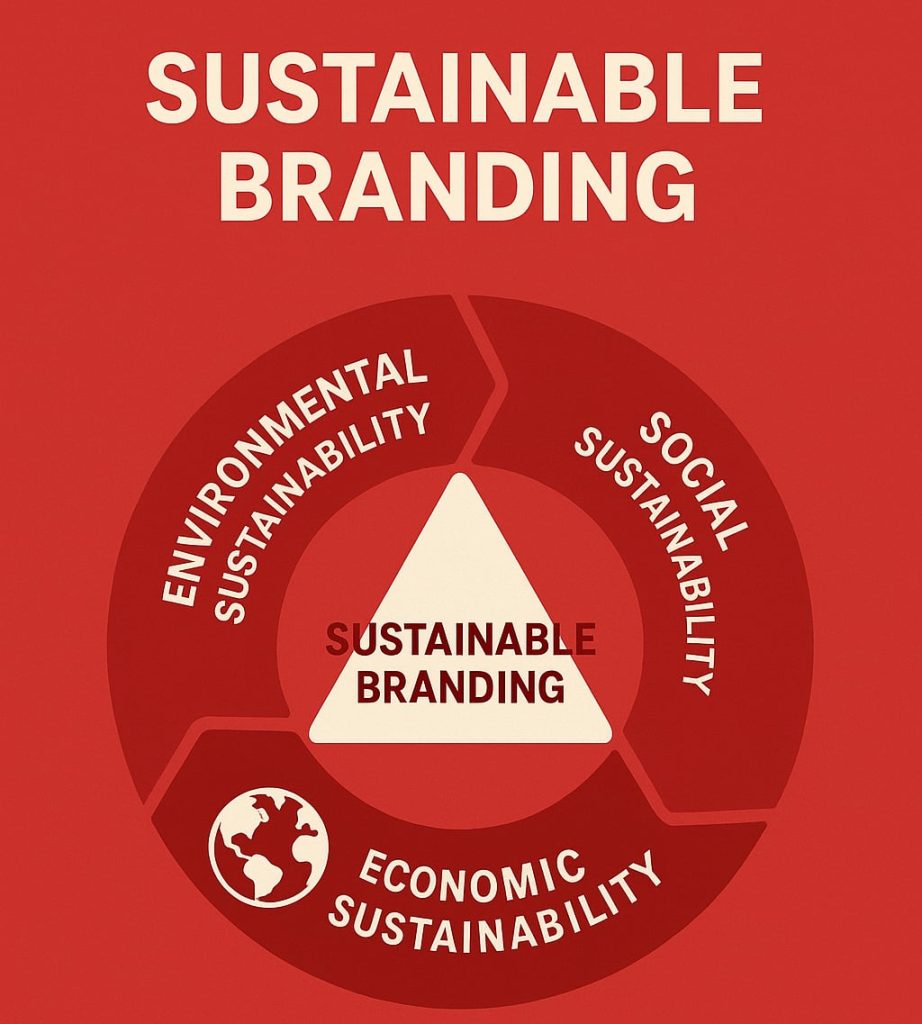
- Environmental Sustainability (Planet): This is the most obvious one. It’s about minimizing your negative impact on the planet. This includes everything from reducing your carbon footprint and waste to using renewable energy, conserving water, and protecting biodiversity. It’s about being a good steward of our natural resources.
- Social Sustainability (People): This leg focuses on your brand’s impact on all people it touches—your employees, the workers in your supply chain, your customers, and the communities you operate in. This means fair labor practices, championing diversity and inclusion, ensuring product safety, and making a positive contribution to society.
- Economic Sustainability (Profit): This is the leg that often gets overlooked in sustainability conversations, but it’s crucial. A business cannot be a force for good if it goes out of business. This is about building a resilient, profitable business model that can thrive for the long term without sacrificing the other two pillars. It’s about creating lasting value, not just chasing short-term profits.
When these three pillars—Planet, People, and Profit—work in harmony, you create a brand that isn’t just surviving, it’s set up to lead. A 2021 report showed that companies with a strong focus on ESG (Environmental, Social, and Governance) actually outperformed their peers, proving that purpose and profit are two sides of the same coin.
Defining Your Foundation: Brand Pillars for a Sustainable Future
Before you can build a sustainable brand, you need a solid foundation. This foundation is made up of your brand pillars: the 3-5 core ideas or values that your brand stands for. These pillars are a key part of your brand strategy and positioning, defining who you are, what you do, and why it matters. They are the non-negotiable truths that guide every decision, from product development to your marketing campaigns.
For a sustainable brand, these pillars must be infused with your purpose. They move beyond simple attributes like “quality” or “innovation” and connect to a deeper meaning.
Think of it this way:
- A traditional brand pillar: “Innovation”
- A sustainable brand pillar: “Innovation for a Circular Future”
See the difference? The sustainable pillar gives the concept of innovation a direction and a purpose. It tells your team and your customers why you innovate.
To define your brand pillars, ask yourself:
- What are our most unshakeable beliefs as a company?
- What unique value do we bring to our customers and the world?
- If we had to describe our brand in five words, what would they be?
- How does our purpose connect to each of these words?
Example: A sustainable coffee company’s pillars might be:
- Exceptional Quality: Sourcing and roasting the world’s best single-origin, specialty-grade coffee.
- Farmer Prosperity: Ensuring our partner farmers earn a living wage through direct trade relationships.
- Regenerative Practices: Championing farming methods that restore soil health and protect biodiversity.
- Community Connection: Creating cafes that are welcoming hubs for local communities.
These pillars provide a clear and powerful framework. They inform the brand’s entire strategy, ensuring that every action taken reinforces its core identity and its commitment to sustainability.
Crafting Your Strategy: Brand Development and Messaging
With your foundational pillars in place, you can now build your brand development and messaging strategy. This is the “how” that follows your “why.” It’s the roadmap for how you will build, grow, and communicate your brand in a way that is authentic, consistent, and impactful.
Brand Development Strategy in a Sustainable Context
Brand development is the long-term process of creating and strengthening your brand. For a sustainable brand, this process is about embedding your purpose and pillars into every touchpoint. It’s about making your brand tangible.
Your sustainable brand development strategy should focus on:
- Product and Service Innovation: How can your core offerings be a direct reflection of your sustainable pillars? This means designing for durability, repairability, and recyclability (the circular economy). It involves using materials that are recycled, renewable, or regenerative. The product itself becomes a proof point of your brand’s commitment.
- Supply Chain Transformation: Your brand is only as sustainable as your supply chain. Brand development involves moving from a purely transactional relationship with suppliers to a collaborative partnership. This means co-investing in better practices, conducting audits to ensure fair labor, and working together to reduce the environmental footprint of your entire value chain.
- Employee Engagement and Culture: Your employees are your most important brand ambassadors. A key part of brand development is building a company culture where every team member understands and feels connected to the brand’s purpose. This involves training, incentive programs tied to sustainability goals, and creating opportunities for employees to participate in social and environmental initiatives.
Brand Messaging Strategy: Speaking Your Truth
If brand development is what you do, brand messaging is what you say. Your messaging strategy defines the core narrative of your brand and the key themes you want to communicate. It must be authentic, consistent, and directly tied to your brand pillars.
A powerful brand messaging strategy for a sustainable brand has three key components:
- Core Narrative: This is your big-picture story. What is the change you want to see in the world, and what is your brand’s role in making that change happen? This narrative should be inspiring and emotional, connecting with your audience on a values level.
- Key Messages: These are the specific, tangible points that support your core narrative. They should be tied directly to your brand pillars. For our coffee company example, a key message might be: “Every cup you drink supports a farmer’s future and a healthier planet.” These messages should be simple, memorable, and easy for your audience to repeat.
- Proof Points: This is the data and evidence that backs up your claims. Don’t just say you support farmers; show it. “We pay, on average, 50% above the Fair Trade minimum price.” Don’t just say your packaging is better; prove it. “Our new packaging uses 85% less plastic than our old design.” Proof points are crucial for building trust and avoiding the trap of greenwashing.
By aligning your brand development and messaging strategies, you create a seamless and authentic brand experience. What you do and what you say are in perfect harmony, building a powerful and coherent brand identity that resonates deeply with your target audience.
The Cornerstone of Value: Building Trust and Corporate Brand Equity
In business, trust is everything. It’s the currency of loyalty. Customers might buy from you once out of convenience, but they will only come back, recommend you, and forgive you for mistakes if they trust you. This kind of customer loyalty is built on a foundation of deep, resilient trust and sustainable branding is one of the most effective ways to build it.
When you operate with transparency and a genuine commitment to positive impact, you forge an emotional bond that transcends the transaction. This is the foundation of corporate brand equity.
Corporate Brand Strategy – Building Brand Equity
Brand equity is the intangible value and strength of your brand. It’s why people will happily pay more for a North Face jacket than a generic one. It’s a combination of building brand awareness, perceived quality, loyalty, and brand associations. A corporate brand strategy focused on sustainability is a powerful engine for building brand equity.
Here’s how sustainability directly boosts each component:
- Awareness and Positive Associations: A strong sustainability mission gets people talking. It generates positive PR, social media buzz, and word-of-mouth referrals. More importantly, it creates powerful associations. When people hear your brand name, they think “ethical,” “responsible,” “innovative,” and “caring.” These positive associations elevate your brand in a crowded market.
- Perceived Quality: There’s a powerful “halo effect” at play. Consumers increasingly believe that if a company is thoughtful and meticulous about its social and environmental impact, it must be equally meticulous about the quality of its products. Using better, more sustainable materials often leads to a genuinely superior product, reinforcing this perception.
- Brand Loyalty: This is where sustainable branding truly excels. The emotional connection built on shared values is the bedrock of true loyalty. It turns a repeat customer (who buys out of habit) into a brand advocate (who buys because they believe in you). These advocates will stick with you, pay a premium, and become your most effective marketers.
Patagonia: The Gold Standard of Trust and Equity
Patagonia has built a mountain of brand equity through radical transparency. Their “Footprint Chronicles” lets customers trace a product’s entire journey, warts and all. They openly discuss the environmental harm their products cause and what they’re doing to fix it.
They famously ran a Black Friday ad that said, “Don’t Buy This Jacket,” urging people to consume less and repair their old gear. This counterintuitive move cemented their reputation as a brand that genuinely puts the planet before profits. The result? Unbreakable customer loyalty and, ironically, soaring sales. This is the long-term payoff of building trust and equity through an authentic corporate brand strategy.
ESG: The New Language of Long-Term Value
If you want to talk to investors, board members, or anyone focused on the financial health of your business, you need to speak their language. In the world of sustainable business, that language is ESG.
ESG stands for Environmental, Social, and Governance. It is a data-driven framework used by the financial community to evaluate a company’s performance on a wide range of sustainability and ethical issues. It’s how you measure and report the “good” you’re doing in a way that the market understands.
E: Environmental
This criterion assesses how a company acts as a steward of the natural world. It’s the “Planet” leg of our stool. Key metrics include:
- Carbon Emissions: What is the company’s total carbon footprint, and do they have a science-based plan to reduce it?
- Resource Management: How efficiently does the company use water, energy, and raw materials? Are they investing in renewables?
- Waste and Pollution: What are the company’s policies on waste reduction, recycling, and preventing pollution?
A company with a strong “E” score is seen as being less risky and better prepared for future regulations and resource scarcity.
S: Social
This criterion examines how a company manages its relationships with its people. It’s the “People” leg. Key areas include:
- Labor Practices: Does the company ensure fair wages, safe working conditions, and respect for workers’ rights throughout its supply chain?
- Diversity, Equity, and Inclusion (DEI): Is the company committed to building a diverse and inclusive workforce and leadership team?
- Customer Welfare: Does the company produce safe products, market ethically, and protect customer data?
Strong “S” performance indicates a stable, well-managed company with a strong reputation that helps attract and retain top talent and loyal customers.
G: Governance
This criterion deals with how a company is run. It’s the framework that ensures accountability, fairness, and transparency. Key considerations include:
- Board Oversight: Is the board independent, diverse, and providing effective oversight of management and strategy?
- Executive Pay: Is executive compensation linked to long-term performance, including the achievement of ESG targets?
- Transparency and Ethics: Does the company have transparent accounting and strong policies against bribery and corruption?
Good governance is the bedrock of a trustworthy company. It assures investors that the company is built to last and that their capital is being managed responsibly. Integrating ESG into your core strategy is no longer optional; it’s how you demonstrate to the world that you are building a resilient, valuable, and future-proof business.
Actionable Framework: Crafting a Purpose-Driven Strategy
A purpose-driven strategy serves as the vital operational blueprint that transforms commendable intentions into concrete, measurable results. It’s the mechanism through which your vision for impact moves beyond abstract ideals and translates into tangible actions and verifiable outcomes, providing a clear pathway from aspiration to achievement.
Without the deliberate structure of a clear and well-defined strategy, even the most sincere sustainability efforts risk becoming fragmented and ineffectual. Such uncoordinated actions often lead to wasted resources, a lack of consistent direction, and an inability to accurately track progress, ultimately undermining the desired positive change and making it difficult to demonstrate genuine impact.
Here is a step-by-step method to build a strategy that works.
Step 1: Define Your Core Purpose (Your “Why”)
This is the north star for your entire strategy. Your purpose needs to be specific, authentic, and connected to your core business. It should be a short, memorable statement that answers the question: “Why do we exist, beyond making money?”
- Vague Purpose: “To be a sustainable company.”
- Powerful Purpose (for an apparel brand): “To create clothing that honors both people and the planet.”
To find your purpose, ask: What problem does our business uniquely solve for the world? What do our employees and most loyal customers care deeply about?
Step 2: Conduct a Materiality Assessment
This sounds complex, but it’s straightforward. You can’t solve every problem, so you need to focus on the sustainability issues that are most important to your business and your stakeholders (customers, investors, employees).
Create a simple matrix. On one axis, plot the importance of an issue to your stakeholders. On the other, plot its importance to your business’s success. The issues that are in the top-right quadrant (high importance to both) are your “material” issues. For a food company, this might be packaging waste and sustainable agriculture. For a software company, it might be data privacy and the energy consumption of its data centers. These material issues should be the primary focus of your strategy.
Step 3: Set SMART Goals and KPIs
Once you know your purpose and your priorities, you need to set clear goals. Use the SMART framework:

- Specific: What exactly will you achieve? (“Reduce virgin plastic in our packaging.”)
- Measurable: How will you measure it? (“by 90% from our 2024 baseline.”)
- Achievable: Is this goal realistic?
- Relevant: Does it address your purpose and material issues?
- Time-bound: By when? (“by 2029.”)
Example SMART Goal: “We will source 100% of our primary raw materials from certified regenerative sources by 2030.”
For each goal, define the Key Performance Indicators (KPIs) you’ll use to track progress, like “percentage of materials certified” or “metric tons of CO2e reduced.”
Step 4: Integrate the Strategy Across the Business
This is where your strategy comes to life. It cannot live in a silo. Your purpose and sustainability goals must be embedded in every department’s objectives.
- Product Development: Design products for circularity (durability, repairability, recyclability).
- Supply Chain: Implement a supplier code of conduct and partner with suppliers to improve performance.
- Marketing & Communications: Develop a communication strategy to tell your story authentically and transparently.
- Human Resources: Link employee incentives to sustainability KPIs and build a culture of purpose.
- Finance: Allocate capital to support sustainability initiatives and track the ROI.
Example: Interface Inc.
Interface, a carpet tile manufacturer, set a bold mission in 1994 called “Mission Zero”: to have zero negative impact on the planet by 2020. This purpose became the organizing principle for the entire company. It drove massive innovation in recycling and product design, saved them hundreds of millions of dollars, and made them the undisputed leader in their industry. This is the power of a deeply integrated, purpose-driven strategy.
The Art of Brand Communication and Storytelling
Data and strategy are essential, but they don’t move hearts. Stories do. You can have the best ESG rating in the world, but if you can’t communicate it in a way that connects with people emotionally, its impact will be muted. Storytelling is the bridge that turns your actions into a narrative that builds brand love.
Brand Communication Strategy: Beyond the Press Release
Your brand communication strategy for sustainability must be proactive, consistent, and integrated across all channels. It’s not just about an annual sustainability report; it’s about making your purpose a constant part of the conversation.
Your strategy should define:
- Audience: Who are you talking to? The message for an investor will be different from the message for a Gen Z customer on TikTok.
- Channels: Where will you tell your story? This includes your website, social media, packaging, email newsletters, in-store experiences, and earned media.
- Cadence: How often will you communicate? You should provide regular, consistent updates on your progress—the successes and the struggles.
The golden rule of sustainable communication is transparency over perfection. Don’t be afraid to be vulnerable. Admitting you don’t have all the answers and sharing your challenges makes you more human, more believable, and more trustworthy.
The Key Elements of a Compelling Sustainability Story
- Make the Customer the Hero: Your brand isn’t the hero of the story; it’s the guide. The customer is the hero who, by choosing your brand, gets to be part of a positive change. Frame your story to empower them.
- Instead of: “We saved a million gallons of water.”
- Try: “Every pair of our jeans you wear helps save 1,000 gallons of water. You are part of the solution.”
- Show, Don’t Just Tell: Use visuals and specific details. Show the faces of the people in your supply chain. Create a video tour of your recycling facility. Use infographics to make complex data understandable.
- Focus on Human Impact: Connect your data to real human or environmental outcomes.
- Instead of: “We donated $100,000 to literacy programs.”
- Try: “Meet Sarah. Thanks to the reading programs funded by your purchases, she’s the first in her family to go to college. This is the impact we create together.”
Example: Tony’s Chocolonely
This chocolate brand has a single mission: to make chocolate 100% slave-free. Their entire brand is a storytelling device. The chocolate bar itself is unequally divided to represent the inequality in the cocoa industry. Their wrappers are filled with stories about the problem and their solution. By buying their chocolate, the customer is joining a movement. That is masterful storytelling.
Gaining a Competitive Advantage Through Sustainability
Highly competitive market, where product features and innovations are often quickly imitated by competitors, true differentiation becomes increasingly difficult to achieve. However, a deep and genuine commitment to sustainability offers a powerful and enduring strategic advantage.
This isn’t merely a defensive posture; it’s a proactive, offensive strategy designed to help your brand not just keep pace, but truly outperform rivals by creating a unique value proposition that resonates deeply with conscious consumers and stakeholders.
- Differentiation in a Crowded Market: When a consumer is faced with two similar products, the one with a clear purpose and a positive impact story wins. It gives them a reason to choose you that goes beyond price. This is especially true for Millennial and Gen Z consumers, who vote with their wallets.
- Innovation and New Opportunities: The constraints of sustainability force you to innovate. Challenging your team to design products with less waste or find alternatives to plastic sparks creativity. This leads to breakthroughs in materials, processes, and even new business models like repair services or product take-back programs.
- Supply Chain Resilience: A traditional supply chain is built for low cost. A sustainable supply chain is built for resilience. By building deep, collaborative partnerships with your suppliers and diversifying your sourcing, you create a supply chain that is far less vulnerable to disruption from climate events or geopolitical instability.
- Talent Magnetism: The best employees want to work for companies that make a difference. A strong sustainable brand is a powerful tool for attracting and retaining top talent. This reduces recruitment costs and creates a more engaged, motivated, and innovative workforce.
Challenges and Pitfalls to Avoid
The path to sustainable branding is not always smooth. Being aware of the common challenges is the first step to navigating them successfully.
- The Danger of Greenwashing: Making misleading or unsubstantiated claims is the fastest way to destroy trust. How to avoid it: Be specific with your claims, use credible third-party certifications (like B Corp or Fair Trade), and educate your marketing team.
- The Upfront Cost and Complexity: Transitioning to sustainable practices can require significant upfront investment. How to navigate it: Start with “quick wins” that have a clear ROI (like energy efficiency), develop a phased long-term roadmap, and frame the spending as an investment in resilience and brand equity, not just a cost.
- Lack of Internal Alignment: If your strategy is only championed by a small “green team,” it will fail. How to overcome it: Build a strong business case with data, create cross-functional teams with leaders from all departments, and tie executive compensation to sustainability targets.
Future Trends: What’s Next in Sustainable Branding?
The landscape of sustainability is not static; it’s a dynamic and constantly evolving field. To stay relevant and truly make an impact, brands must do more than just keep up with current best practices. The companies that will emerge as leaders in the coming decade will be those that are forward-thinking and actively looking ahead to anticipate the next wave of innovation and consumer expectation, understanding the importance of branding in this green revolution.
- From Sustainability to Regeneration: The conversation is shifting from just “doing less harm” to “actively doing good.” This includes regenerative agriculture, which restores soil health, and “climate positive” business models that remove more carbon than they emit.
- Radical Transparency and Digital Product Passports: Technology like blockchain will enable a new level of traceability. Imagine scanning a QR code on a shirt and seeing its entire journey, from the farm to the factory, including its carbon footprint and recycling instructions. The EU is already making this mandatory for some industries.
- A Focus on Biodiversity: Beyond carbon, the loss of biodiversity is emerging as the next major crisis. Expect to see companies setting science-based targets for nature, mapping their impact on ecosystems, and investing in habitat restoration.
- The Rise of the “S” in ESG: Social issues like living wages, supply chain labor rights, and ensuring a “just transition” for workers in declining industries will come under intense scrutiny.
Conclusion: Your Brand’s Legacy Starts Now
We’ve explored the entire landscape of sustainable branding. It’s a holistic strategy uniting planet, people, and profit. It’s the most powerful way to build trust, equity, and a lasting competitive advantage, often by integrating effective emotional branding strategies. We’ve laid out the frameworks for your strategy, your messaging, and your communications.
The message is clear: this is not a fad. Sustainable branding is the new foundation for building a resilient, respected, and profitable business for the 21st century.
This is a journey, not a destination. It demands courage and commitment, but the reward is a business that you, your employees, and your customers can be proud to be a part of. It’s an opportunity to create a legacy.
Here are your first steps:
- Start the Conversation: Share this article with your team. Put “purpose” on the agenda for your next leadership meeting.
- Map Your Material Issues: Grab a whiteboard and conduct a quick materiality assessment. Where can you have the biggest impact?
- Identify One Quick Win: What is one small, tangible step you can take in the next 90 days? Build momentum.
The power to build a brand that is a force for good is in your hands. The time to start is now. What will your story be?